Blog

  • Riverside: Closed for Business?

    Riverside: Closed for Business?

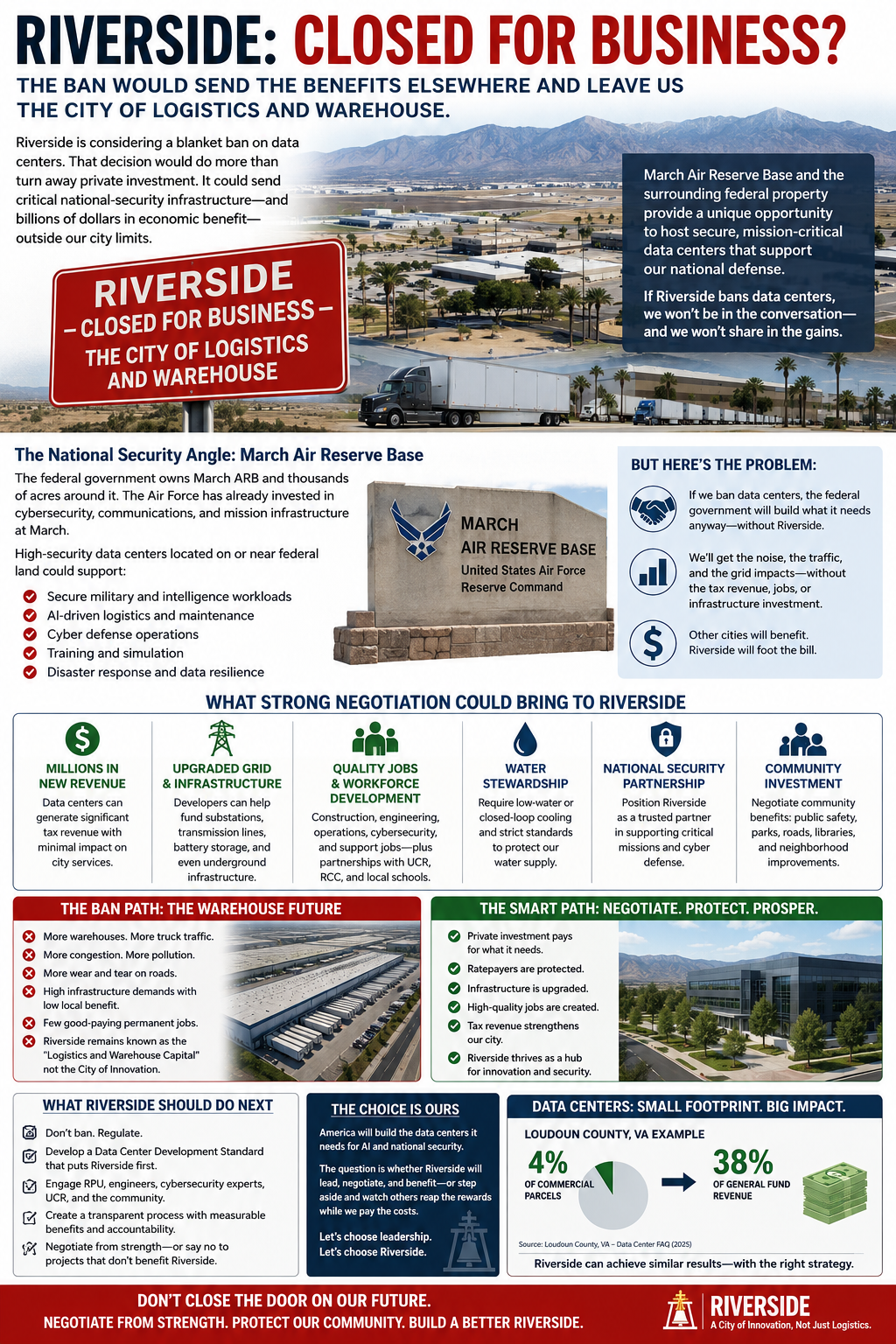
    Ban Data Centers Today. Become the Warehouse Capital Tomorrow.


    In my last article, “Riverside’s Next Big Economic Development Idea: Ban Economic Development,” I challenged the wisdom of a proposed blanket ban on data centers.

    The response has been revealing.

    Some residents raised legitimate concerns about electricity.

    Others raised legitimate concerns about water.

    Others questioned permanent employment.

    And some essentially said: Good. I don’t want a data center anywhere near Riverside.

    Those are reasonable subjects for debate.

    But they continue to miss the fundamental point.

    Data centers are going to be built.

    The question isn’t whether America will build them.

    The question is where they will be built, who will pay for the infrastructure, and which communities will capture the economic benefits.

    And Riverside has a particularly interesting complication sitting almost in our backyard:

    March Air Reserve Base

    The federal government maintains a major military installation at March Air Reserve Base. The surrounding former March AFB property has a more complicated ownership and governance structure following the Base Realignment and Closure process, including substantial property transferred for civilian redevelopment. The March Joint Powers Authority itself includes Riverside, Moreno Valley, Perris and Riverside County. 

    Why does that matter?

    Because Washington is no longer merely talking about AI as an economic-development opportunity.

    It is talking about AI as national-security infrastructure.

    In June, the President issued a National Security Presidential Memorandum directing the national-security enterprise to accelerate AI adoption. Among other things, the memorandum calls for a roadmap ensuring access to advanced computing resources and specifically contemplates commissioning advanced AI computing facilities with high-security requirements for next-generation national-security systems. 

    The federal AI Action Plan similarly calls for high-security data centers supporting military and intelligence workloads. 

    That raises a question Riverside’s City Council should consider before putting up a NO DATA CENTERS ALLOWED sign:

    What happens if Washington needs secure AI compute capacity in this region anyway?

    Riverside doesn’t get to veto America’s national-security requirements.

    The federal government can pursue federal infrastructure, partnerships with private industry and facilities outside Riverside’s jurisdiction.

    And March already has significant federal infrastructure and a national-security mission.

    I am not saying the federal government has announced a March data center. It has not.

    I’m making a strategic point.

    If Riverside prohibits commercial data centers while national-security and commercial demand for compute continues growing, the infrastructure doesn’t magically disappear.

    It gets built somewhere else.

    And so do the economic benefits.

    Riverside Could Get the Impacts Without Getting the Benefits

    This is the part of a municipal ban that deserves far more discussion.

    Suppose significant computing infrastructure eventually develops around March, Moreno Valley, Perris, unincorporated Riverside County or another nearby jurisdiction.

    Riverside could still participate in the regional consequences.

    Regional electrical demand doesn’t stop at the city limits.

    Transmission infrastructure doesn’t stop at the city limits.

    Regional water issues don’t stop at the city limits.

    Traffic doesn’t stop at the city limits.

    Housing demand doesn’t stop at the city limits.

    Neither does economic development.

    But tax jurisdictions do.

    If Riverside says no while neighboring jurisdictions negotiate intelligently, Riverside could watch private investment occur a few miles away while another government collects the revenue.

    That’s not environmental policy.

    That’s potentially outsourcing the benefit while regionalizing the impact.

    What Does Negotiating From Strength Actually Look Like?

    My critics seem to interpret opposition to a ban as support for unrestricted development.

    It is precisely the opposite.

    I want Riverside to establish extraordinarily demanding standards.

    A developer wants 100 megawatts?

    Fine.
    Show us the power plan.

    Need a new substation?

    *Show us what you’re paying.

    Need additional transmission?

    Show us your contribution.

    Want RPU customers to finance infrastructure primarily benefiting your project?

    No.

    Your cooling design consumes unacceptable amounts of potable water?

    Redesign it.

    Your project doesn’t provide enough tax revenue, utility revenue, jobs or infrastructure investment to compensate Riverside for its impacts?

    No permit.

    That is negotiating.

    A ban requires none of that expertise.

    You simply say no.

    And then watch somebody else negotiate the deal.

    Other Communities Have Already Demonstrated What’s Possible

    Loudoun County, Virginia provides an extraordinary example—not because Riverside should replicate everything Loudoun has done, but because it demonstrates the enormous negotiating value these projects can represent.

    According to Loudoun County itself, data centers occupy approximately 4% of the county’s commercial parcels.

    Yet they generate approximately:

    38% of its General Fund revenue.

    The county says that revenue has helped finance schools and government services while allowing it to reduce homeowners’ real-property tax rate to the lowest among Northern Virginia counties. 

    That’s not a promise from a data-center developer.

    That’s a local government’s financial record.

    And Loudoun has also learned about the problems accompanying extraordinary concentration of data centers.

    So it has tightened its policies.

    Again:

    Regulation. Not capitulation.

    Take the benefits.

    Recognize the costs.

    Change the standards.

    Protect residents.

    And retain the ability to reject individual projects.

    Even Washington Now Recognizes the Ratepayer Issue

    One of the biggest criticisms I’ve heard is:

    “Riverside residents will have to pay for all the new electrical infrastructure.”

    My response is:

    Then don’t let them.

    Earlier this year, the White House issued a Ratepayer Protection Pledge specifically addressing this problem. It states that large-scale data-center infrastructure is important to economic and national security while also saying American households must be protected from increasing energy costs associated with AI’s growing electrical demand. 

    That’s remarkably similar to what I proposed for Riverside.

    Build American AI infrastructure.

    But don’t stick residential ratepayers with the bill.

    Why is Riverside’s choice supposedly limited to either subsidizing data centers or banning them?

    It isn’t.

    And Then There’s Riverside’s Real Alternative: Warehouses

    This is the part of this debate I find particularly frustrating.

    What exactly is Riverside’s alternative economic-development vision?

    More warehouses?

    More logistics?

    More trucks?

    More freeway congestion?

    More road deterioration?

    More diesel emissions?

    More industrial land devoted to moving somebody else’s goods from the ports to somewhere else?

    This isn’t speculation either.

    The California Air Resources Board reports that Riverside and San Bernardino Counties experienced high volumes of warehouse-related environmental reviews and approvals from 2020 through 2025.

    CARB associates warehouse growth with increased truck activity, traffic congestion, diesel particulate matter, nitrogen oxides, PM2.5, noise, safety concerns and infrastructure impacts. 

    Even Riverside’s mayor has acknowledged the burden.

    In discussing Inland Empire air quality, Mayor Patricia Lock Dawson noted that 90% of the goods arriving through the Los Angeles/Long Beach port complex must pass through the Inland Empire by rail or freeway, leaving this region with the associated pollution burden. 

    So let’s have an honest economic-development discussion.

    Warehouse development has infrastructure demands too.

    It requires roads.

    It generates truck traffic.

    It consumes industrial land.

    It contributes to freeway congestion.

    It produces environmental externalities that don’t appear on the developer’s balance sheet.

    And unlike electrons moving through fiber, trucks physically move through our neighborhoods, arterials and freeways.

    Yet apparently Riverside is prepared to categorically prohibit digital infrastructure while remaining part of Southern California’s enormous warehouse and logistics economy.

    That deserves an explanation.

    “City of Arts & Innovation” — Or City of Logistics and Warehouses?

    Riverside likes branding itself the City of Arts & Innovation.

    Then let’s decide whether that’s a slogan or an economic-development strategy.

    Artificial intelligence is going to transform medicine, cybersecurity, manufacturing, logistics, finance, scientific research, defense and virtually every knowledge-based industry.

    The infrastructure supporting that transformation will be built.

    The White House’s AI Action Plan explicitly says America’s path to AI leadership requires data centers and substantially greater energy generation and notes that China has rapidly expanded its grid while U.S. energy capacity stagnated. 

    So Riverside faces a choice.

    We can participate intelligently.

    Or we can congratulate ourselves for passing a ban while watching investment move across the city boundary.

    Imagine Two Riversides

    Riverside #1: Closed for Business

    No data centers.

    Private AI infrastructure investment goes elsewhere.

    Neighboring jurisdictions negotiate the projects.

    Other governments receive the tax revenue.

    Other utilities receive the large commercial customers.

    Other communities negotiate infrastructure improvements.

    Riverside continues approving conventional industrial and warehouse development.

    More trucks.

    More congestion.

    More logistics.

    More pressure on roads.

    And Riverside remains what the Inland Empire has increasingly become:

    Southern California’s warehouse floor.

    Now imagine another possibility.

    Riverside #2: Negotiate From Strength

    Riverside adopts one of California’s toughest Data Center Development Standards.

    No residential ratepayer subsidy.

    Strict water requirements.

    Strict noise requirements.

    Strict environmental standards.

    Developer-funded incremental electrical infrastructure.

    Minimum investment requirements.

    Cybersecurity and foreign-supply-chain requirements.

    Local workforce partnerships.

    Community benefits.

    Financial guarantees against stranded infrastructure.

    And a requirement that major electrical users help strengthen—not weaken—Riverside’s grid.

    Then tell the industry:

    Here are Riverside’s rules. Who wants to make us an offer?

    That’s a dramatically different negotiating position.

    We Could Even Leverage This to Fix the Grid

    Riverside already needs additional electrical capacity.

    We already need the second transmission connection.

    We already need greater resiliency.

    And we’re already confronting the enormous cost of modernizing that infrastructure.

    So why wouldn’t Riverside determine whether new private electrical demand can help finance it?

    New substations.

    Battery storage.

    Generation.

    Transmission upgrades.

    Potential additional undergrounding.

    Grid cybersecurity.

    Resiliency.

    The principle should be simple:

    Growth pays for growth.

    Don’t subsidize the data center.

    Leverage it.

    The March Question Should Be a Warning

    Again, there is no announced federal AI data-center project at March Air Reserve Base that I have found.

    But March illustrates why Riverside cannot pretend a municipal prohibition controls regional or national infrastructure policy.

    The federal government retained substantial military property at March, and March continues serving significant military and federal missions. 

    Meanwhile Washington is explicitly ordering the development of secure advanced-computing capacity for national security. 

    If Washington determines Southern California requires additional secure computing capacity, Riverside’s City Council isn’t going to stop the United States government from pursuing its national-security mission.

    What Council can determine is whether Riverside positions itself to participate in the economic opportunity surrounding the AI economy—or deliberately removes itself from consideration.

    That’s why a ban is such an extraordinary surrender of leverage.

    Before You Ban It, Find Out What It’s Worth

    Invite the developers.

    Invite RPU.

    Invite UCR.

    Invite RCC.

    Invite cybersecurity experts.

    Invite electrical engineers.

    Invite water experts.

    Invite environmental experts.

    Invite SCE.

    Invite neighboring jurisdictions.

    And, given March’s importance, invite representatives familiar with federal and military infrastructure requirements.

    Put everybody in the room publicly.

    Then ask:

    What would responsible data-center development look like in Riverside?

    What would developers pay?

    What infrastructure could they finance?

    What tax revenue could Riverside receive?

    Could residents receive rate relief?

    Could new investment help underground additional electrical infrastructure?

    Could we create AI, cybersecurity and engineering programs with UCR and RCC?

    Could Riverside become an actual technology center instead of another logistics waypoint?

    And if, after doing all of that analysis, the economics don’t work?

    Say no.

    But at least Riverside will know what it rejected.

    If Council Passes the Ban, Let’s Call It What It Is

    If Riverside’s City Council ultimately votes for a categorical data-center ban without first conducting that analysis, perhaps it’s time to update the City’s branding.

    Not:

    Riverside — City of Arts & Innovation.

    Perhaps:

    RIVERSIDE — CLOSED FOR BUSINESS

    The City of Logistics and Warehouses.

    Because you cannot continually tell residents that Riverside wants high-value industries, innovation and private investment while simultaneously prohibiting an industry at the center of America’s largest technological infrastructure buildout.

    And you certainly shouldn’t do it while the federal government and neighboring jurisdictions remain perfectly capable of pursuing those investments outside Riverside’s boundaries.

    The data centers will be built.

    The AI infrastructure will be built.

    The electrical infrastructure will be built.

    The question is who negotiates intelligently enough to benefit from it.

    Riverside can protect its residents and participate in the future.

    Those goals are not mutually exclusive.

    Set the standards.

    Protect the water.

    Protect the ratepayer.

    Protect neighborhoods.

    Make developers pay.

    Demand infrastructure.

    Demand jobs.

    Demand community benefits.

    Demand accountability.

    And if the deal isn’t good enough:

    Walk away.

    But don’t close the door before anyone has even made us an offer.

    Because once Riverside puts up the CLOSED FOR BUSINESS sign, we shouldn’t be surprised when the investment goes somewhere else—and the warehouses keep coming.

    Sources worth linking in the published article

    • Loudoun County Data Center FAQ⁠ — especially valuable for the 4% of commercial parcels / 38% of General Fund revenue comparison.
    • Loudoun County FY2026 Budget Story⁠ — independently reinforces the revenue and tax comparison.
    • White House National Security AI Memorandum⁠ — establishes the current federal push for high-security advanced AI computing facilities.
    • America’s AI Action Plan⁠ — documents the federal position on domestic data centers, energy and secure military/intelligence compute.
    • White House Ratepayer Protection Pledge⁠ — extremely useful because it validates your “build it, but don’t make residential ratepayers subsidize it” argument.
    • California Air Resources Board warehouse-impact assessment — supports the warehouse/truck/congestion/pollution comparison.
    • March Air Reserve Base property-transfer history⁠— establishes the retained military acreage versus former base property transferred for civilian reuse.
    • March Joint Powers Commission⁠ — useful because Riverside itself has representation in the governance structure surrounding former March property.
  • Riverside’s Next Big Economic Development Idea: Ban Economic Development

    Riverside’s Next Big Economic Development Idea: Ban Economic Development

    As America races to expand the computing and energy infrastructure required for artificial intelligence, Riverside is considering a blanket ban on data centers. Instead of prohibition, Riverside should protect residents and ratepayers, demand infrastructure and jobs, and make private industry—not taxpayers—carry the risk.

    Sometimes a single statement tells you a great deal about the direction of a city.

    This week, Riverside Councilmember Philip Falcone publicly stated:

    “I am currently authoring a data center ban for Riverside which will be proposed at a future council meeting.”

    Not regulations.

    Not development standards.

    Not a temporary moratorium while Riverside Public Utilities studies electrical capacity.

    Not requirements that developers pay for transmission, generation, water, roads or other infrastructure necessitated by their projects.

    Not minimum standards for jobs, capital investment, cybersecurity, water consumption, noise, setbacks or community benefits.

    A ban.

    Before the City Council travels down that road, Riverside residents deserve a much more serious discussion about what data centers are, what artificial intelligence means to America’s economic and national security, what Riverside could gain—or lose—and why our city’s recent approach to economic development makes a categorical ban particularly difficult to understand.

    There are very legitimate reasons to scrutinize data centers.

    There are considerably fewer reasons to prohibit an entire industry before determining whether Riverside can structure development in a manner beneficial to its residents.

    AI Is Not a Fad. The Infrastructure Behind It Matters.

    The artificial-intelligence revolution isn’t occurring somewhere in an imaginary “cloud.”

    The cloud is physical.

    AI requires semiconductor fabrication, fiber networks, enormous computing resources, data centers, cooling systems and massive amounts of electricity.

    The federal government’s America’s AI Action Plan is unusually direct about this. Its second pillar is literally titled “Build American AI Infrastructure.” It identifies factories to manufacture chips, data centers to operate those chips, and new energy generation as essential infrastructure for American AI leadership. It also specifically calls for high-security data centers capable of supporting military and intelligence workloads. The White House⁠

    That should tell Riverside something.

    Washington isn’t discussing whether America needs this infrastructure.

    It is discussing how quickly America can build it and how securely it can be built.

    The 2026 Economic Report of the President lists announced investments involving AI, data centers, chips and associated energy infrastructure measured not in millions, but in trillions of dollars. The projects listed in one federal table alone total more than $3 trillion in announced investment, although those announcements cover different time horizons and should not be confused with money already spent. The White House⁠

    Meanwhile, China is pursuing the same strategic objective.

    This is an international competition for compute capacity, semiconductors, electrical generation, technical talent and ultimately leadership in artificial intelligence.

    AI already has applications in cybersecurity, intelligence analysis, military systems, logistics, medicine, manufacturing, finance, scientific research and virtually every other important sector of a modern economy.

    So no, I would not characterize every local data-center restriction as “pro-China.”

    But I will say this:

    Policies that unnecessarily prevent America from building the infrastructure necessary to compete in artificial intelligence ultimately make that competition easier for China.

    Riverside doesn’t control American AI policy.

    But Riverside should understand the economic and national environment in which it is making this decision.

    A Data Center Is Not Automatically Good Economic Development

    Let’s be equally clear about the other side.

    I am not suggesting Riverside should approve every data-center proposal that lands at City Hall.

    Far from it.

    Data centers can consume extraordinary amounts of electricity. Some designs can consume significant water. They can require major transmission upgrades. They can occupy substantial industrial property while creating fewer permanent jobs per acre than traditional manufacturing.

    They can create noise.

    They can place new demands on local infrastructure.

    And a poorly negotiated data-center project could result in existing Riverside Public Utilities customers effectively subsidizing infrastructure needed by one enormous industrial customer.

    That would be unacceptable.

    But that is an argument for competent government.

    It isn’t an argument for banning an industry.

    A serious city asks:

    Under what conditions would we permit this development?


    An unserious city simply says:

    Ban it.

    Riverside Has Something Most Cities Don’t: Its Own Electric Utility

    This is where the discussion becomes particularly important for Riverside.

    Riverside owns its municipal electric utility.

    That means electricity isn’t merely a constraint in this discussion. Properly structured, it could also be an economic-development asset.

    For years, I have argued that Riverside needs to confront its long-term electrical infrastructure requirements seriously—including transmission capacity, resiliency and modernization.

    A major industrial power customer therefore should not automatically be viewed as a burden.

    The proper questions are:

    What infrastructure would the customer require?

    Who pays for it?

    Can that investment improve Riverside’s overall electrical system?

    Can Riverside negotiate dedicated generation or storage?

    Can new transmission capacity benefit the broader community?

    Can we contractually ensure residential and small-business ratepayers do not subsidize the development?

    What happens to Riverside if the customer leaves?

    Those are questions for utility engineers, financial analysts, cybersecurity professionals, economists and experienced negotiators.

    They cannot be answered by the word BAN.

    The Second Transmission Line Riverside Needs — But Is Building the Wrong Way

    There is an enormous irony in debating whether Riverside should ban data centers because of their electrical demands while Riverside is already undertaking one of the most consequential electrical infrastructure projects in the City’s history.

    The Riverside Transmission Reliability Project (RTRP) is intended to give Riverside something it unquestionably needs: a second connection to California’s electrical grid.

    Today, Riverside Public Utilities says all of its imported electricity enters through a single Southern California Edison connection at the Vista Substation, with an import limitation of approximately 557 megawatts.

    That is a genuine infrastructure vulnerability.

    A growing city should not depend indefinitely upon a single connection to the statewide electrical grid.

    So the debate shouldn’t be about whether Riverside needs greater transmission capacity.

    We do.

    The question is whether we are building the right infrastructure for the next 50 or 100 years.

    A 21st-Century Grid Deserves a 21st-Century Solution

    The RTRP will establish a new high-voltage connection through portions of Riverside, Jurupa Valley, Norco and unincorporated Riverside County. The project includes both underground and overhead transmission.

    And therein lies the controversy.

    Norco and its residents have fought for years to have the transmission facilities near their community and the Santa Ana River constructed underground. Norco has specifically raised concerns about putting high-voltage overhead infrastructure through an area it describes as wind-prone and fire-prone.

    Those objections were not simply about aesthetics.

    They were about wildfire exposure, evacuation difficulties, property impacts and the wisdom of constructing major new overhead electrical infrastructure in Southern California’s changing fire environment.

    The California Public Utilities Commission rejected Norco’s effort to require the entire project to be undergrounded.

    Then, in 2024, Riverside’s City Council elected to move the project forward.

    And now construction is underway.

    Look at What We Have Learned About Wildfire Risk

    California’s recent fire seasons should have changed the way every elected official thinks about electrical infrastructure.

    Extended dry conditions, extreme heat, Santa Ana winds and accumulated vegetation can turn a small ignition into a major emergency.

    Riverside has another problem that makes this discussion particularly relevant: the Santa Ana River bottom.

    For years, Riverside has struggled with fires, encampments, vegetation and emergency access in and around the river bottom.

    Whatever one’s position on homelessness, the public-safety reality cannot simply be ignored: human activity within heavily vegetated open space creates additional ignition opportunities.

    Combine dry vegetation, extreme weather, Santa Ana winds, difficult emergency access and high-voltage overhead infrastructure and it is reasonable to ask:

    Why are we intentionally adding another potential vulnerability to the system we are supposedly building for resiliency?

    That does not mean an overhead transmission line inevitably causes a wildfire.

    It means infrastructure planning should account for the environment in which that infrastructure will operate for decades.

    Norco Asked the Right Question

    Norco has not argued that Riverside shouldn’t have its second electrical connection.

    Its argument has essentially been:

    Build it—but build it underground.

    That distinction matters.

    In fact, portions of the RTRP are already being constructed underground.

    Recent reporting on the continuing Norco controversy indicates that approximately four of six miles in the relevant area will be underground while the Norco segment remains overhead.

    So underground transmission isn’t some hypothetical technology.

    It is already part of this project.

    The disagreement is over how much should be underground and who should bear the additional cost.

    And that brings us directly back to data centers.

    What If Private Investment Changed the Economics?

    Riverside’s argument against greater undergrounding has always had to confront the substantially greater upfront cost.

    Fair enough.

    Underground high-voltage transmission is expensive.

    But instead of treating that as the end of the conversation, perhaps Riverside should start asking a different question:

    Who else could help pay for it?

    If Riverside attracts a major data center or other large industrial electrical customer requiring substantial new capacity, that company isn’t merely another building permit.

    It represents potentially hundreds of millions—or even billions—of dollars of private capital and an enormous long-term electrical load.

    That creates negotiating leverage.

    Instead of banning that investment, Riverside should determine whether major new electrical customers can help finance the infrastructure required to accommodate their demand.

    Imagine telling a prospective data-center developer:

    You need Riverside’s power capacity. Riverside needs additional transmission capacity. If your project materially increases the infrastructure we must construct, you will participate in paying for it.

    Then take the discussion one step further.

    Could that private investment help finance additional undergrounding?

    Could Riverside combine developer contributions with RPU capital, Southern California Edison investment and available state or federal infrastructure funding?

    Could a large new industrial customer support additional generation and battery storage?

    Could its investment accelerate replacement or undergrounding of other vulnerable electrical infrastructure?

    Could Riverside obtain a substantially more resilient electrical system without placing the entire burden on existing residential and small-business ratepayers?

    Those questions should be answered before Council bans the very industry that might give Riverside additional economic leverage to address them.

    That’s What Economic Development Is Supposed to Do

    This is the fundamental difference between economic development and government-sponsored venture capital.

    When Riverside spends public money buying products from emerging companies in hopes that they eventually create jobs here, Riverside assumes part of the business risk.

    When a private company invests hundreds of millions of its own dollars and helps finance the public infrastructure its project requires, the investor assumes the business risk.

    Which model sounds better for Riverside taxpayers?

    Our second transmission connection is infrastructure Riverside needs regardless.

    The question is whether Riverside simply accepts the project as designed and asks ratepayers to absorb the consequences—or whether we use future economic development strategically to build something better.

    Don’t subsidize the data center. Leverage it.

    Require it to pay the incremental infrastructure costs its electrical demand creates.

    Then determine whether that investment can help Riverside achieve something much larger:

    A safer, more resilient, increasingly underground electrical transmission system designed for the next generation rather than another generation of overhead infrastructure.

    Before Riverside hangs a “NO DATA CENTERS” sign at the city limits, perhaps Council should determine what private investment in the AI economy could buy Riverside in return.

    Because the smartest economic-development deal may not be another taxpayer-funded purchase from the company we’re trying to recruit.

    It may be convincing private industry to help pay for infrastructure Riverside residents already need.

    Make the Developer Pay

    Suppose a company proposes investing $1 billion in a Riverside data center.

    Don’t write it a taxpayer check.

    Don’t subsidize its electricity.

    Don’t gamble General Fund reserves on whether the company succeeds.

    Tell the company what Riverside requires.

    If its project requires a new substation, negotiate the cost.

    If additional transmission is necessary, negotiate the cost.

    If generation or storage capacity is necessary, negotiate the cost.

    If water consumption creates an unacceptable burden, require a different cooling technology or reject the project.

    Require appropriate noise standards and setbacks.

    Require local hiring and apprenticeship programs where legally permissible.

    Require cybersecurity standards and supply-chain protections appropriate to critical infrastructure.

    Require emergency-generation and fire-safety plans.

    Require measurable community benefits.

    And establish financial protections so Riverside isn’t left holding stranded infrastructure if a speculative operator disappears.

    Negotiate from strength.

    If the economics don’t work after those requirements are imposed, the developer can build somewhere else.

    But Riverside should at least have the conversation.

    Especially Because Riverside Has Been Willing to Take the Risk for Other Companies

    Here is where the proposed ban becomes particularly difficult for me to reconcile with Riverside’s recent economic-development philosophy.

    Riverside has repeatedly celebrated its transformation into a center for clean technology and advanced manufacturing.

    The City itself has highlighted companies including Ohmio, Voltu, GreenPower, Hyundai Rotem and Stored Power Technology as evidence of this strategy. Riverside, California⁠

    I support attracting innovative companies to Riverside.

    What I have questioned repeatedly is who should bear the business risk.

    Economic development should primarily mean convincing companies to invest their money in Riverside.

    It shouldn’t mean turning Riverside taxpayers and ratepayers into venture capitalists.

    And some recent Riverside deals deserve another look in that context.

    Ohmio: Up to $2.5 Million, Seven Initial Jobs

    In November 2023, Riverside finalized its agreement with autonomous electric-shuttle company Ohmio.

    The City’s own announcement stated that Riverside would spend as much as $2.5 million on the arrangement, including approximately $1.5 million to lease or purchase three autonomous shuttles for a two-year pilot.

    What was the initial direct employment projection?

    Seven jobs.

    The company expected that figure to increase to at least 25 jobs within three years. Riverside, California⁠

    There was a legitimate economic argument behind the deal: Ohmio would establish its international headquarters and manufacturing operation here, Riverside would become its point of sale, and the City projected future sales-tax revenue.

    Subsequent outside funding also materially improved the City’s position. Riverside Transit Agency contributed $500,000 and South Coast AQMD contributed $1 million, reducing what the City described as its initial $2.5 million cost to approximately $1 million. Riverside, California⁠

    That’s important context.

    But so is the original decision.

    Riverside was willing to commit substantial public resources to an emerging company based largely upon anticipated future production, sales and economic benefits.

    Apparently that type of risk is acceptable.

    Voltu: Another $2.39 Million Purchase

    Then came Voltu.

    Council authorized the preorder and purchase of 20 Voltu electrified trucks for $2,392,500, including a $2,217,500 supplemental appropriation from General Fund Infrastructure Reserves. Councilmember Falcone himself voted for the purchase. Riverside Legistar⁠

    There is encouraging news here.

    Voltu subsequently moved into commercial deployment, and the City announced in June that the company expects its Riverside operation to create hundreds of jobs as production scales. Riverside, California⁠

    I hope it succeeds spectacularly.

    Riverside benefits if it does.

    But future employment projections should still be distinguished from jobs already created, and public officials should be willing to measure actual results against the promises made when public money was committed.

    That is accountability, not opposition to economic development.

    Chaevi: Another $1.96 Million Purchase

    Next came South Korean EV technology company Chaevi.

    In November 2025, Riverside announced an MOU associated with Chaevi’s contemplated $100 million U.S. entry and expansion and potential establishment of its U.S. manufacturing headquarters in Riverside. The original MOU was expressly nonbinding and contemplated, among other things, at least 45 EV chargers. Riverside, California⁠

    Then, in June 2026, the Council agenda called for waiving the formal procurement process and purchasing 45 Chaevi EV chargers for $1,957,500 from General Fund Infrastructure Reserve, with the amount to be reimbursed through Riverside Public Utilities Low Carbon Fuel Standard funds. Riverside Legistar⁠

    Again, perhaps this investment ultimately produces an excellent return for Riverside.

    I hope it does.

    But notice the recurring philosophy:

    Riverside is willing to deploy public resources to help create a market for selected emerging businesses.

    Yet now, when discussing another technology industry capable of bringing enormous amounts of private capital into American infrastructure, the opening policy proposal isn’t:

    How do we structure a deal that overwhelmingly benefits Riverside?

    It’s:

    Ban it.

    Riverside Should Stop Playing Angel Investor

    This is the larger issue.

    There is a fundamental difference between economic development and municipal venture capital.

    Economic development says:

    Come invest in Riverside. Build here. Employ people here. Purchase property here. Pay taxes here. Partner with our universities. Use our local workforce. Help build infrastructure. Become part of our community.

    Municipal venture capital says:

    Come to Riverside and perhaps we’ll help create your market by purchasing your product with public money.

    Those are very different models.

    Riverside should be extremely cautious about the second.

    Government is not particularly well equipped to identify which emerging technology company will become the next Tesla and which will become an expensive lesson.

    Private investors knowingly assume those risks because enormous returns compensate them when they’re right.

    Taxpayers get no equity.

    Ratepayers don’t receive stock options.

    Residents don’t participate in the upside when a startup becomes worth billions.

    They simply carry the downside if public money was poorly deployed.

    Riverside should stop behaving like an angel investor and start behaving like an economically sophisticated city.

    What Riverside Should Do Instead of a Ban

    Rather than drafting a prohibition, Councilmember Falcone and the rest of the Council should consider developing a Riverside Data Center Development Standard.

    Make it one of the most demanding in California if necessary.

    A serious policy could address:

    • No residential-ratepayer subsidy. Data centers should bear the incremental utility and infrastructure costs attributable to their projects.
    • Power-capacity requirements. Projects should demonstrate adequate generation, transmission and distribution capacity before approval.
    • Infrastructure contributions. Where projects trigger substations, transmission upgrades, storage or other major improvements, negotiate developer participation.
    • Water standards. Require disclosure of projected water consumption and favor technologies that minimize potable-water demand.
    • Minimum capital investment. Reserve data-center development for projects producing meaningful economic value.
    • Employment and workforce development. Evaluate permanent jobs as well as construction employment, apprenticeships and partnerships with UCR, RCC and other local institutions.
    • Cybersecurity and supply-chain security. Critical digital infrastructure deserves serious physical, cyber and foreign-supply-chain protections.
    • Noise, aesthetics and setbacks. Protect nearby neighborhoods.
    • Emergency power and fire protection. Require appropriate standards for batteries, generators and other energy systems.
    • Decommissioning protection. Ensure taxpayers aren’t responsible for abandoned facilities or stranded infrastructure.
    • Community-benefit requirements. Negotiate measurable benefits rather than accepting press releases and projections.
    • Periodic public reporting. Compare promised jobs, investment, utility revenue and community benefits against actual performance.

    And perhaps most importantly:

    No taxpayer-funded angel investing should be required to make the project work.

    Imagine the Alternative

    Imagine Riverside receives a proposal for a major AI data center.

    The developer wants to invest hundreds of millions of dollars of private capital.

    Riverside responds:

    You will pay the infrastructure costs attributable to your project.

    You will not increase residential rates.

    You will help finance the electrical capacity necessary to serve your facility.

    You will meet strict water-consumption requirements.

    You will comply with rigorous cybersecurity and supply-chain requirements.

    You will invest in local workforce development.

    You will disclose measurable economic benefits.

    You will protect surrounding neighborhoods.

    And if you cannot satisfy those requirements, you cannot build here.

    What’s wrong with that?

    That isn’t being anti-environment.

    It isn’t being pro-development at any cost.

    It isn’t corporate welfare.

    It is precisely what local government is supposed to do:

    Protect the public interest while creating economic opportunity.

    Riverside Cannot Call Itself the “City of Arts & Innovation” and Ban Innovation’s Infrastructure

    There is also an unavoidable contradiction here.

    Riverside proudly brands itself the City of Arts & Innovation.

    City officials travel internationally seeking foreign investment.

    The City touts advanced manufacturing.

    It celebrates autonomous vehicles.

    It recruits electric-truck manufacturers.

    It courts EV-infrastructure companies.

    It promotes smart-city technologies.

    It even describes its economic strategy as positioning Riverside in industries of the future. Riverside, California⁠

    But artificial intelligence may be the most consequential technological and industrial transformation of this generation.

    And AI requires data centers.

    We cannot put INNOVATION on the City seal while putting NOT WELCOME on the infrastructure required to support the next generation of computing.

    And Yes, This Is a National-Security Issue

    There is another dimension Riverside shouldn’t casually dismiss.

    AI capability is increasingly intertwined with national security.

    The federal AI Action Plan specifically addresses secure AI compute environments for defense and intelligence purposes and calls for technical standards for high-security AI data centers capable of resisting sophisticated nation-state threats. The White House⁠

    Cybersecurity professionals have understood this trajectory for years.

    Future conflicts will not occur exclusively with tanks, ships and aircraft.

    They will involve cyber operations, autonomous systems, intelligence analysis, communications networks, electronic warfare, logistics, satellites and artificial intelligence.

    Compute is becoming strategic infrastructure.

    America therefore needs abundant, resilient and secure domestic computing capacity.

    Does that mean Riverside has some patriotic obligation to approve a 500-megawatt data center?

    Of course not.

    It means that categorically banning an entire class of strategic digital infrastructure deserves considerably more thought than a Facebook announcement.

    The Right Answer Is Neither “Yes” Nor “No”

    The answer should be:

    Show us the proposal.

    Show us how much power you need.

    Show us where that power comes from.

    Show us your water consumption.

    Show us your cooling technology.

    Show us your infrastructure requirements.

    Show us the construction jobs.

    Show us the permanent jobs.

    Show us the tax and utility revenue.

    Show us what you will invest.

    Show us how Riverside residents benefit.

    Show us the cybersecurity plan.

    Show us what happens if the facility closes.


    And most importantly:

    Show us why Riverside should want you here.

    Then negotiate.

    If the proposal isn’t good enough, say no.

    If it threatens grid reliability, say no.

    If it requires residents to subsidize a multinational corporation, say no.

    If the water demands are unreasonable, say no.

    If the economic return doesn’t justify the land and infrastructure, say no.

    Reject a bad project.

    But don’t reject an entire industry before the first serious proposal has even been evaluated.

    Riverside Needs an Economic Strategy, Not Another Knee-Jerk Policy

    This Council has an opportunity to demonstrate something Riverside desperately needs:

    Long-term thinking.

    Instead of another sweeping reaction, commission the analysis.

    Ask Riverside Public Utilities what amount of data-center load can responsibly be accommodated today.

    Determine what new generation and transmission would be required at different levels of development.

    Calculate the ratepayer implications.

    Study the economic impact.

    Establish land-use standards.

    Consult UCR and our other educational institutions about AI, engineering and workforce opportunities.

    Bring cybersecurity and critical-infrastructure experts into the discussion.

    Invite competing data-center developers to explain what they would invest under Riverside’s conditions.

    And conduct all of it publicly.

    Then write the policy.

    That is leadership.

    Riverside’s Next Big Economic Development Idea Shouldn’t Be Banning Economic Development

    America is spending enormous amounts of private capital building the infrastructure for the AI economy.

    China is competing aggressively for leadership in the same technologies.

    Riverside says it wants innovation, advanced manufacturing, international investment and high-quality jobs.

    Yet apparently our next great economic-development idea may be to prohibit one of the fundamental infrastructure components supporting that economy.

    That makes no sense.

    Especially when Riverside has shown itself willing to put public resources behind comparatively small emerging companies in pursuit of projected future benefits.

    Let’s reverse that philosophy.

    Stop asking Riverside taxpayers and ratepayers to behave like angel investors.

    Invite private capital to take the business risk.

    Set demanding standards.

    Protect our neighborhoods.

    Protect our water.

    Protect our electrical system.

    Protect our ratepayers.

    Demand infrastructure.

    Demand jobs.

    Demand measurable economic benefits.

    Demand accountability.

    And negotiate from a position of strength.

    If a company cannot meet Riverside’s standards, send it away.

    But if a company is prepared to invest hundreds of millions—or potentially billions—of private dollars, pay its own infrastructure costs, strengthen our electrical system, create jobs and contribute meaningfully to Riverside’s economy, we should at least be intelligent enough to hear the proposal.

    Regulate intelligently. Negotiate aggressively. Protect the public.

    But don’t put a “Closed for Business” sign at the city limits and pretend that’s economic development.


    Sources and Further Reading

    America’s AI Action Plan — White House⁠

    City of Riverside — Ohmio Agreement⁠

    City of Riverside — Ohmio/RTA Pilot Agreement⁠

    City of Riverside — Chaevi U.S. Expansion Agreement⁠

    City of Riverside — Voltu Commercial Deployment⁠

    City of Riverside — 2050 Economic Development Vision⁠

    Author’s note: Dollar figures and employment projections above are taken from City of Riverside announcements, financial reports and Council records. Projected jobs, investment and tax revenues are identified as projections rather than represented as completed results.

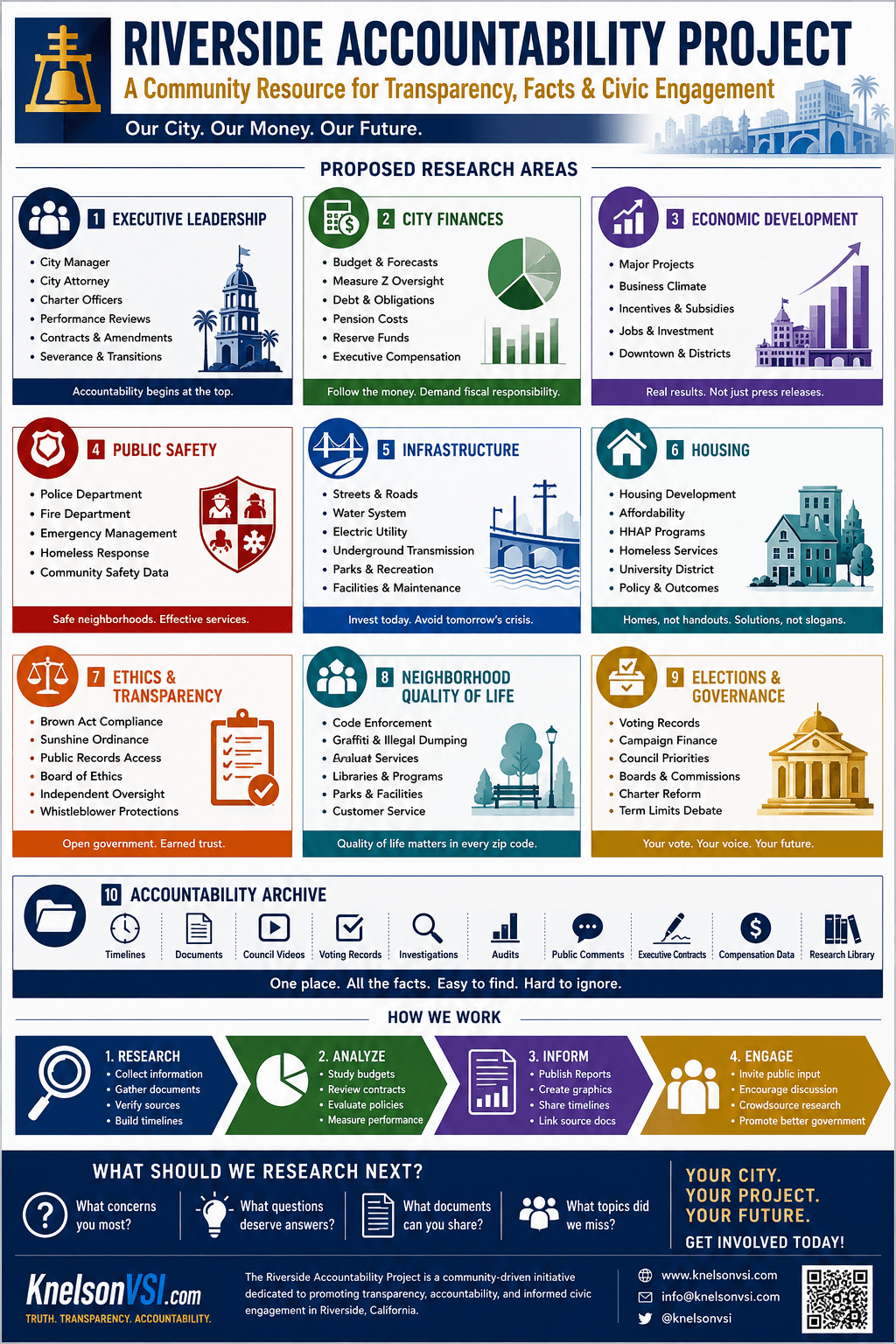
  • Introducing the Riverside Accountability Project

    Introducing the Riverside Accountability Project

    Building a Better Riverside Through Facts, Transparency, and Civic Engagement

    “The strength of a community is measured not by how loudly its leaders speak, but by how informed and engaged its citizens become.”

    For more than a decade, I have written about issues affecting Riverside—from ethics and transparency to public safety, homelessness, economic development, infrastructure, budgeting, and executive accountability.

    Many of those articles have focused on individual City Council meetings, controversial contracts, or specific policy decisions.

    But over time, I realized something important.

    The real story isn’t any single agenda item.

    It is the pattern.

    One meeting rarely tells the whole story.

    One contract rarely explains years of decisions.

    One budget vote rarely reveals how priorities have evolved.

    One public records request seldom uncovers the complete picture.

    Understanding local government requires connecting hundreds of pieces of information over many years.

    That realization is the inspiration for what I hope will become a long-term community resource:

    The Riverside Accountability Project

    This is not intended to be a political campaign.

    It is not about personalities.

    It is not about political parties.

    It is about something much more important:

    Documenting how our City is governed—and giving Riverside residents the information they need to hold every elected official accountable regardless of ideology.


    RIVERSIDE ACCOUNTABILITY PROJECT
    Building a Better Riverside Through Facts, Transparency & Civic Engagement

                         GOVERNMENT & LEADERSHIP
              🏛️ Charter Officers • City Manager • City Attorney
                 Contracts • Performance • Executive Oversight
    
                                     │
        💰 CITY FINANCES              🌆 ECONOMIC DEVELOPMENT
    Budget Business Climate
    Measure Z Downtown
    Debt Major Projects
    Pension Costs Incentives
    Compensation Jobs & Investment

        🚓 PUBLIC SAFETY              🚧 INFRASTRUCTURE
        Police                        Streets
        Fire                          Water
        Emergency Mgmt                Electric Utility
        Homeless Response             Parks
                                     Underground Utilities
        🏠 HOUSING                    ⚖️ ETHICS & TRANSPARENCY
        Development                   Brown Act
        Affordability                 Sunshine Ordinance
        HHAP                          Public Records
        Homelessness                  Independent Oversight
        🏘️ QUALITY OF LIFE            🗳️ ELECTIONS & GOVERNANCE
        Code Enforcement              Voting Records
        Graffiti                      Campaign Finance
        Animal Services               Council Priorities
        Libraries                     Charter Reform
                       📁 ACCOUNTABILITY ARCHIVE
    
        ✓ Timelines
        ✓ Documents
        ✓ Council Videos
        ✓ Voting Records
        ✓ Investigations
        ✓ Audits
        ✓ Public Comments
        ✓ Executive Contracts
        ✓ Compensation
        ✓ Research Library

    WHAT SHOULD WE RESEARCH NEXT? YOUR IDEAS • YOUR DOCUMENTS • YOUR QUESTIONS HELP BUILD THIS RESOURCE


    Why Build This?

    Good government depends upon informed citizens.

    Unfortunately, local government is increasingly difficult to follow.

    Information is scattered across:

    • Council agendas
    • Committee meetings
    • Staff reports
    • Budget documents
    • Public records
    • Independent investigations
    • Audit reports
    • Labor agreements
    • Press releases
    • Social media
    • Public comments

    Few residents have the time to assemble those pieces into one complete picture.

    The Riverside Accountability Project seeks to organize that information in one place.

    Not to tell people what to think—

    —but to provide the facts that allow each resident to draw their own conclusions.

    The Vision

    Rather than publishing isolated blog posts, I envision building a permanent public resource organized by topic.

    Proposed Research Areas

    Riverside Accountability Project
    ├── Executive Leadership
    │ City Manager
    │ City Attorney
    │ Charter Officers
    │ Performance Reviews
    │ Contracts
    │ Severance
    │
    ├── City Finances
    │ Budget
    │ Measure Z
    │ Debt
    │ Pension Costs
    │ Reserve Funds
    │ Compensation
    │
    ├── Economic Development
    │ Major Projects
    │ Incentives
    │ Business Climate
    │ Jobs
    │ Downtown
    │
    ├── Public Safety
    │ Police
    │ Fire
    │ Emergency Management
    │ Homeless Response
    │
    ├── Infrastructure
    │ Roads
    │ Water
    │ Electric Utility
    │ Underground Transmission
    │ Parks
    │
    ├── Housing
    │ Development
    │ Affordability
    │ Homeless Programs
    │ HHAP
    │
    ├── Ethics & Transparency
    │ Brown Act
    │ Sunshine Ordinance
    │ Public Records
    │ Board of Ethics
    │ Independent Oversight
    │
    ├── Neighborhood Quality of Life
    │ Illegal Dumping
    │ Graffiti
    │ Code Enforcement
    │ Animal Services
    │ Libraries
    │
    ├── Elections & Governance
    │ Voting Records
    │ Campaign Finance
    │ Council Priorities
    │ Charter Reform
    │
    └── Accountability Archive
    Timelines
    Documents
    Public Comments
    Investigations
    Reports

    Suggested Focus Areas

    What We Will Document

    Every topic will include documentation. This is a sample list of possible documents:

    ✓ Timelines

    ✓ Interactive maps

    ✓ Budget summaries

    ✓ Contract analysis

    ✓ Compensation comparisons

    ✓ Organizational charts

    ✓ Public records

    ✓ Meeting videos

    ✓ Voting records

    ✓ Independent reports

    ✓ Audit findings

    ✓ Original source documents

    The goal is simple:

    If we make a claim, we’ll show the document.


    This Project Needs the Community

    This project will only succeed if Riverside residents participate.

    I am asking for your help.

    What concerns you most?

    • City spending?
    • Roads?
    • Public safety?
    • Homelessness?
    • Water?
    • Electric rates?
    • Economic development?
    • Executive compensation?
    • Ethics?
    • Development projects?
    • Neighborhood issues?
    • Code enforcement?
    • Public utilities?
    • Parks?
    • Libraries?
    • Animal services?

    Or is there something else entirely?

    Tell me what you believe deserves careful research.

    How You Can Help

    If you have:

    • public documents,
    • historical records,
    • photographs,
    • meeting videos,
    • budget reports,
    • City correspondence,
    • ideas for research,
    • corrections,
    • or expertise,

    I invite you to contribute.

    The Riverside Accountability Project should become a community resource—not simply my own work.

    Guiding Principles

    This project will strive to be:

    • Fact-based – Every significant factual claim should be supported by publicly available documents or clearly identified sources.
    • Transparent – Source documents will be linked whenever possible.
    • Nonpartisan in method – The same standards of accountability should apply regardless of who holds office.
    • Respectful – Critique decisions, policies, and governance; avoid personal attacks.
    • Open to correction – If we make a mistake, we’ll correct it.
    • Community-driven – Reader suggestions will help determine future research priorities.

    Looking Ahead

    Imagine being able to search one place and find:

    • Every City Manager contract.
    • Every Measure Z project.
    • Every executive salary.
    • Every major audit.
    • Every independent investigation.
    • Every Council vote.
    • Every public comment.
    • Every timeline.
    • Every source document.

    That is the vision.

    Not because government should fear scrutiny.

    But because public trust is built through transparency, facts, and informed civic engagement.

    This is only the beginning.

    What would you like to see included in the Riverside Accountability Project? What questions do you think deserve answers? What issues should we investigate together?

    I look forward to hearing your ideas—and, together, building a resource that helps all Riverside residents better understand their city and participate more effectively in its future.

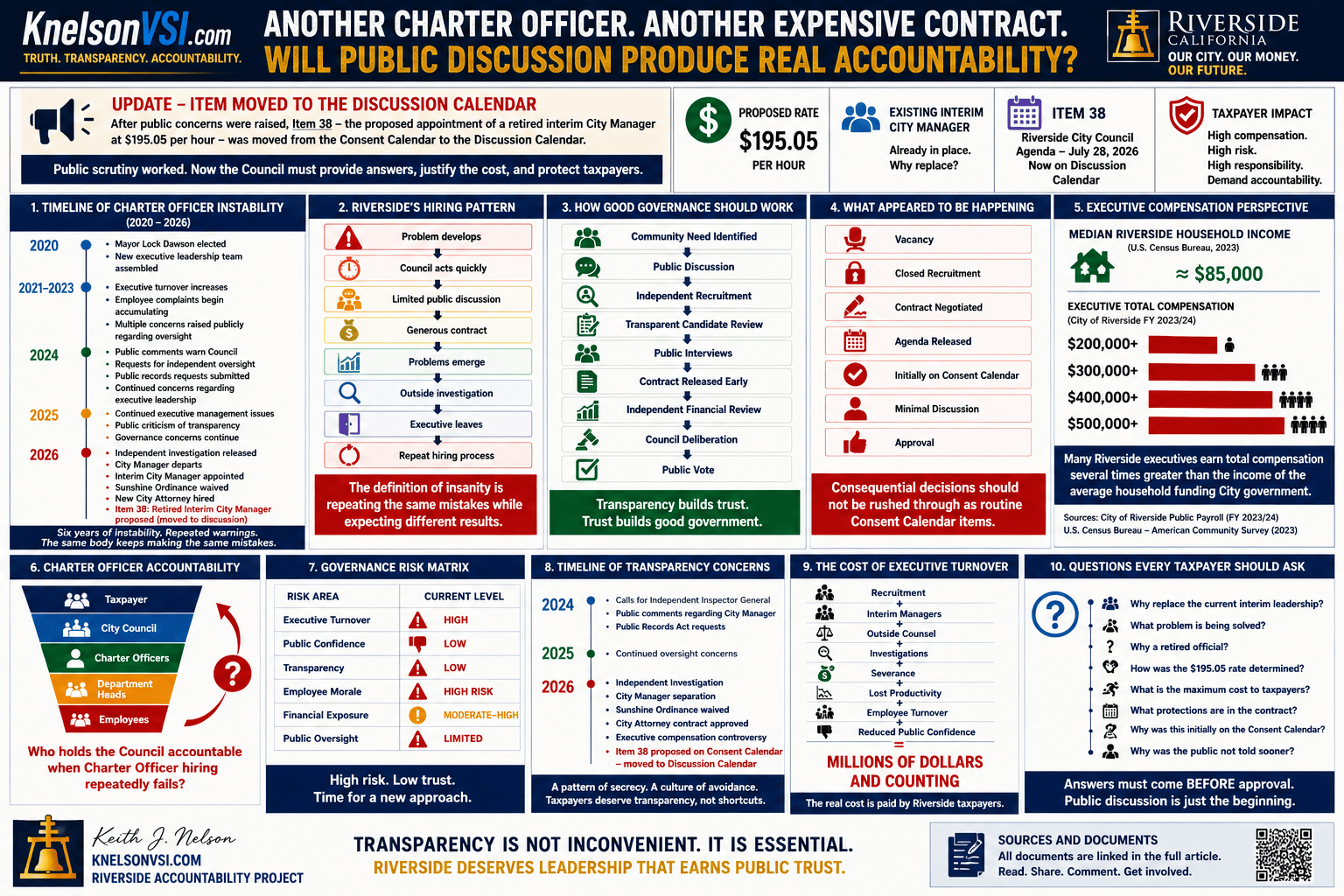
  • Another Charter Officer. Another Secret Process. Another Expensive Contract. When Will Riverside Learn?

    UPDATE: ITEM MOVED TO THE DISCUSSION CALENDAR

    Update — July 28, 2026: After the agenda was published and concerns were raised regarding the placement of this consequential Charter Officer appointment on the Consent Calendar, Item 38 was moved to the Discussion Calendar.

    That is the proper procedural correction. Hiring an Interim City Manager at a proposed rate of $195.05 per hour is not routine City business and should never be approved without separate discussion.

    Moving the item, however, does not answer the underlying questions. Riverside residents still deserve to know why the City is replacing its existing interim leadership, why a retired official is necessary, how the proposed rate and employment terms were established, and what protections the agreement provides taxpayers.

    Public scrutiny appears to have produced more transparent consideration of this item. That is precisely why residents must remain engaged—and why major Charter Officer appointments should be scheduled for public discussion from the beginning, rather than corrected only after concerns are raised.

    “The definition of insanity is repeating the same mistakes while expecting different results.”

    Just weeks after the Riverside City Council approved a highly lucrative employment agreement for its new City Attorney through a process that offered the public little meaningful opportunity to evaluate the agreement, the Council is preparing to make another consequential Charter Officer decision.

    This time, the Council is considering the appointment of a retired official to serve as Interim City Manager beginning July 31, 2026, at an hourly rate of $195.05—despite the fact that Riverside already has interim leadership in place. The appointment appears as Item 38 on the July 28 Council agenda.  

    The item was initially presented on the Consent Calendar, where matters deemed routine can be approved collectively without separate Council deliberation unless pulled for discussion.

    Following public concern, Item 38 was moved to the Discussion Calendar.

    That change is appropriate and should be acknowledged.

    But it also raises an important question:

    Why was the appointment of Riverside’s most powerful administrative officer ever treated as a routine consent matter in the first place?

    Moving the item creates an opportunity for public discussion. It does not resolve the substantive concerns surrounding the appointment, compensation, necessity, recruitment process, or taxpayer protections.

    Why is this being buried on the Consent Calendar?

    Why Was This Initially Treated as Routine?

    The Council’s decision to move the appointment to the Discussion Calendar is a positive and necessary correction.

    The public should recognize the change—but should not ignore how the item was originally presented.

    Consent calendars are intended to streamline routine administrative business. They allow numerous matters to be approved together in one motion, often without separate presentations, questions, or debate.

    The appointment of an Interim City Manager is not routine.

    The City Manager:

    • oversees City departments and employees;
    • implements Council policy;
    • prepares and administers the municipal budget;
    • directs major contracts and projects;
    • influences workplace culture and executive accountability;
    • manages hundreds of millions of dollars in public resources.

    An appointment carrying that much authority and a proposed hourly rate of $195.05 should have been placed on the Discussion Calendar from the beginning.

    The fact that it was ultimately moved demonstrates the value of public scrutiny.

    It also demonstrates why Riverside needs consistent transparency standards rather than corrections made only after residents object.

    Riverside Has Not Earned Blind Trust


    Discussion Is an Improvement—But Trust Still Must Be Earned

    Moving the item to public discussion is better than allowing it to pass as part of a single consent motion.

    That does not mean residents should now simply accept the recommendation.

    Trust is not restored merely by changing an agenda heading.

    It is restored through complete disclosure, direct answers, careful deliberation, and employment agreements that protect the taxpayer.

    This Council recently approved a new City Attorney contract following a process criticized for inadequate public involvement, unusually favorable contractual protections, and a substantial compensation increase.

    Now it must demonstrate that it has learned from that experience.

    The Council should publicly explain:

    • why the current interim arrangement is ending;
    • why a retired official is the preferred replacement;
    • whether other qualified internal or external candidates were considered;
    • how the $195.05 hourly rate was calculated;
    • the maximum number of compensated hours;
    • the projected total cost;
    • the duration of the appointment;
    • termination rights and taxpayer protections;
    • whether the appointment affects the permanent recruitment process.

    Without those answers, a Discussion Calendar designation becomes procedural transparency without substantive accountability.

    Trust is earned through transparency.

    Unfortunately, the City Council has spent years demonstrating exactly the opposite.

    This is the same Council that recently:

    • approved a lucrative employment agreement for a new City Attorney;
    • waived procedural safeguards that were intended to increase public transparency;
    • offered contractual terms that many taxpayers viewed as unusually generous;
    • limited meaningful public discussion before approving the agreement.

    Now the Council appears prepared to repeat that pattern.

    Major decisions involving Charter Officers—the very people responsible for managing hundreds of millions of taxpayer dollars—should never become routine consent calendar items.

    These positions deserve:

    • independent discussion;
    • public questioning;
    • complete disclosure;
    • thoughtful deliberation.

    Instead, Riverside continues moving significant executive employment matters through processes that minimize public scrutiny.

    Didn’t We Already Have an Interim?

    One of the most puzzling aspects of this proposal is that Riverside already has an Interim City Manager.

    If that individual is no longer suitable, taxpayers deserve an explanation.

    If there is an operational emergency, taxpayers deserve an explanation.

    If a retired executive brings unique qualifications, taxpayers deserve an explanation.

    Instead, the agenda simply asks residents to approve another expensive interim appointment.

    Transparency requires more than saying “trust us.”

    Unfortunately, Riverside’s recent history gives taxpayers very little reason to do so.

    Riverside’s Charter Officer Record Speaks for Itself

    The Council’s recent record managing Charter Officers has been deeply troubling.

    Over the past several years, Riverside has experienced:

    • repeated executive turnover;
    • extensive employee complaints;
    • management instability;
    • investigations involving senior leadership;
    • significant legal exposure;
    • declining employee morale;
    • continuing organizational dysfunction.

    The independent investigation concerning the prior City Manager documented extensive concerns regarding workplace management and organizational culture.

    Regardless of where individual blame ultimately lies, one conclusion is difficult to escape:

    The Council’s oversight of executive leadership has failed.

    When the same governing body repeatedly hires executives who later become the subject of controversy, taxpayers have every right to ask whether the hiring process—not just the individual—is fundamentally broken.


    Expensive Contracts Have Become the Norm

    One of the more troubling trends is Riverside’s willingness to negotiate executive compensation packages that bear little resemblance to the financial realities facing the average resident.

    While many Riverside families struggle with:

    • rising utility costs,
    • inflation,
    • increasing housing expenses,
    • higher sales taxes,
    • Measure Z taxes,
    • and escalating city fees,

    Executive compensation continues climbing.

    According to the City’s publicly available compensation records, numerous executive employees receive total compensation well into the hundreds of thousands of dollars annually, with some positions exceeding $300,000, $400,000, and even $500,000 in total compensation when salary and benefits are combined.

    Meanwhile, the median household income in Riverside is roughly in the mid-$80,000 range (based on recent U.S. Census estimates), illustrating a substantial gap between executive compensation and the financial circumstances of the residents who ultimately fund those positions.

    Although public-sector compensation is not directly comparable to private-sector compensation because of differences in pension and benefit structures, critics have argued that Riverside’s executive contracts frequently provide compensation and long-term employment protections that many private-sector executives do not receive.

    The issue isn’t simply salary.

    It is accountability.

    Revised compensation section

    A Rate Requiring Serious Public Examination

    The proposed rate of $195.05 per hour annualizes to approximately $405,704 if multiplied by a conventional 2,080-hour full-time work year.

    That does not mean the retiree will necessarily earn that amount. California retired-annuitant restrictions, the proposed agreement, and the actual number of hours authorized may significantly limit total compensation.

    But that is precisely why the Council must disclose the full calculation publicly.

    Residents deserve to know:

    • the maximum permitted hours;
    • the maximum possible compensation;
    • whether benefits, reimbursements, vehicle allowances, or other payments are included;
    • whether the City compared the rate with similar interim appointments;
    • whether using the current acting executive would cost less;
    • what unique value justifies the additional expense.

    Riverside’s median household income is only a fraction of the compensation routinely provided to its highest-paid executives. Comparing a household’s income with executive compensation is not a perfect labor-market comparison, but it demonstrates the scale of the public obligation and the need for exceptional transparency.

    Taxpayers earning ordinary Riverside incomes are entitled to know why City Hall believes another premium executive arrangement is necessary.

    Taxpayers Deserve Better Contracts

    Every Charter Officer agreement should include strong protections for taxpayers.

    Instead, Riverside repeatedly negotiates contracts that appear heavily weighted toward the employee.

    Questions taxpayers should expect answered include:

    • What measurable performance expectations exist?
    • What happens if objectives are not met?
    • What severance protections exist?
    • What financial risks remain if the relationship fails?
    • How is the public protected from another costly executive turnover?

    These questions should be answered before approval—not years later.

    Consent Calendar Is Not the Place

    Consent calendars serve an important purpose.

    They allow routine administrative items to be approved efficiently.

    Hiring a City Manager—even an interim City Manager—is not routine.

    It affects:

    • every City department;
    • every employee;
    • every taxpayer;
    • every major financial decision made during the coming months.

    This deserves a full public hearing.

    Not a procedural shortcut.

    Leadership Means More Than Photo Opportunities

    Over the past several years, Riverside has devoted enormous energy to announcements, ribbon cuttings, press releases, and social media campaigns.


    Meanwhile, taxpayers continue watching:

    • executive turnover;
    • employee controversies;
    • ethics concerns;
    • repeated governance failures;
    • expensive outside investigations;
    • weakening public confidence.


    Real leadership is not measured by Facebook posts.

    It is measured by sound judgment.

    It is measured by transparency.

    It is measured by fiscal stewardship.


    Most importantly—

    It is measured by whether government earns the public’s trust.

    The Bottom Line


    Moving Item 38 from the Consent Calendar to the Discussion Calendar was the correct decision.

    The Council should receive credit for making—or accepting—that correction.

    But the change is only the beginning of the public process, not the end.

    The Council must now explain:

    1. Why Riverside needs a different interim leader when interim leadership already exists.
    2. Why the proposed appointee’s identity and complete qualifications were not clearly presented when the agenda materials were first released.
    3. How the $195.05 hourly rate was determined.
    4. What the maximum taxpayer cost will be.
    5. What contractual provisions protect Riverside if the appointment does not succeed.
    6. Why the City’s permanent recruitment cannot proceed without another costly interim appointment.
    7. What lessons the Council learned from the investigation, departure, and employment controversies involving the prior City Manager.
    8. What lessons it learned from the recent City Attorney hiring and contract process.

    The public asked for discussion—and discussion is now scheduled.

    The Council must use that opportunity to provide genuine answers, not merely conduct a presentation before approving a predetermined result.

    Transparency is not accomplished by moving an item from one part of the agenda to another.

    Transparency requires the City to explain the need, disclose the cost, defend the contract, consider alternatives, and demonstrate that the agreement protects the people paying for it.


    Suggested Public Comment (3 Minutes)

    Mayor and Council Members:

    I want to begin by acknowledging that Item 38 has been moved from the Consent Calendar to the Discussion Calendar.

    That was the correct decision.

    The appointment of an Interim City Manager at $195.05 per hour is not routine administrative business. It deserves separate discussion, public questions, and a recorded vote.

    But moving the item does not answer the underlying questions.

    Riverside already has interim leadership. The public deserves to know why that arrangement is ending, what operational problem this appointment is intended to solve, and why another retired interim executive is necessary while the City conducts its permanent recruitment.

    The Council should disclose the proposed appointee’s qualifications, the maximum number of compensated hours, the maximum total cost, any additional benefits or reimbursements, and the provisions that protect taxpayers if the appointment does not work.

    This Council’s record on Charter Officer hiring requires caution—not haste.

    We recently watched the Council approve a highly favorable City Attorney employment agreement through a process that provided too little meaningful public review. Before that, residents repeatedly raised concerns about the management and oversight of the prior City Manager. Those concerns were followed by extensive employment controversy, an independent investigation, organizational instability, and the City Manager’s departure.

    The Mayor and Council cannot treat those events as isolated personnel problems. They reflect the Council’s responsibility to select, supervise, evaluate, and hold Charter Officers accountable.

    Riverside residents fund executive compensation packages that far exceed the income of the typical household. With that compensation must come exceptional performance, transparency, and accountability.

    I appreciate that this item will now be discussed publicly. I ask the Council not to treat that discussion as a procedural formality.

    Explain why this appointment is necessary. Explain the complete cost. Explain the alternatives considered. Explain how the contract protects taxpayers. And explain what this Council has learned from its prior Charter Officer hiring and oversight failures.

    Public scrutiny helped move this item to the Discussion Calendar.

    Now the Council must demonstrate that public discussion can actually influence the decision.

    Thank you.

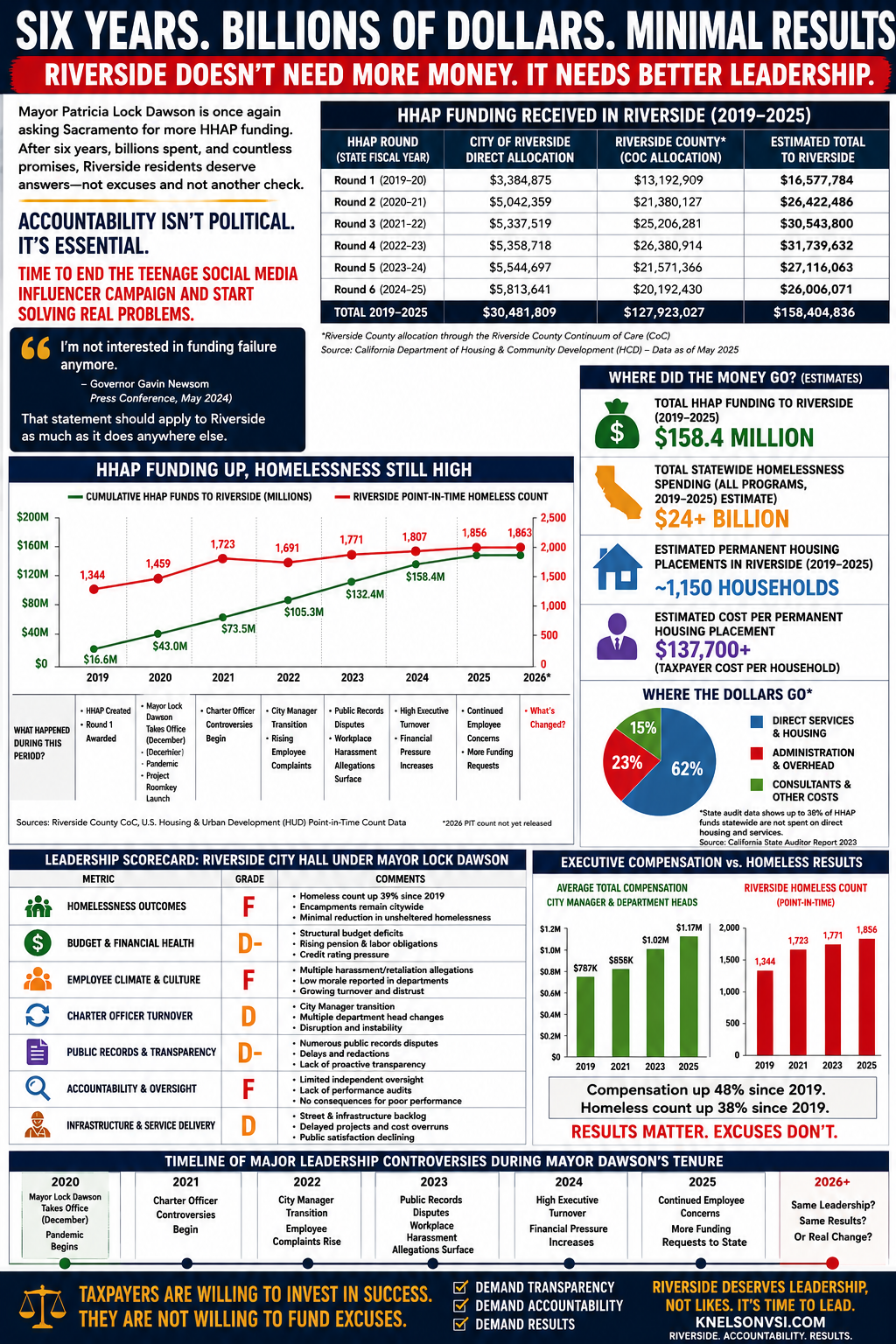
  • Six Years. Billions of Dollars. Where Are the Results?

    Six Years. Billions of Dollars. Where Are the Results?

    Riverside Doesn’t Need Another Press Conference. It Needs Leadership.

    Last week Mayor Patricia Lock Dawson once again stood before cameras urging Sacramento to restore funding for California’s Homeless Housing, Assistance and Prevention (HHAP) Program.

    The message was predictable.

    The State needs to send Riverside more money.

    But after six years of HHAP funding, billions of taxpayer dollars invested statewide, and repeated promises that “this time” progress is around the corner, Riverside residents should be asking a far different question:

    If this program is working, why are we still asking for emergency funding?

    At some point, taxpayers deserve more than press conferences and polished talking points.

    They deserve measurable results.

    HHAP Was Supposed to Solve Problems—Not Become a Permanent Revenue Stream

    Two men in suits handing money to three homeless men sitting on the ground in a dark alley.
    Two well-dressed men give money to homeless individuals in a dimly lit alley at night.

    When California created HHAP in 2019, it was sold as a flexible grant program to reduce homelessness through housing, outreach, prevention, regional coordination, and evidence-based interventions.

    It was never intended to become a permanent dependency where local governments return every budget cycle demanding another billion dollars.

    Even the program itself requires jurisdictions to demonstrate outcomes, regional coordination, and accountability.

    Yet today the conversation has shifted from performance to entitlement.

    The expectation seems to be:

    “We’ve spent the money. Give us more.”

    That is not accountability.

    Billions Have Been Spent Across California

    California has invested billions through:

    • HHAP
    • Project Homekey
    • Project Roomkey
    • Encampment Resolution Grants
    • Behavioral health programs
    • Affordable housing subsidies
    • Local matching funds
    • County mental health funding
    • Federal housing grants

    Despite this unprecedented spending:

    • California continues to have one of the nation’s largest homeless populations.
    • Riverside continues struggling with encampments.
    • Local governments continue requesting emergency funding.
    • Taxpayers continue paying more every year.

    Even Governor Gavin Newsom recently expressed his frustration, stating:

    “I’m not interested in funding failure anymore.”

    That statement should apply just as much to Riverside as it does anywhere else.

    Follow the Money

    Before asking Sacramento—or Riverside taxpayers—for another dollar, City Hall should publish a comprehensive HHAP report that every resident can understand.

    Not a glossy brochure.

    Not another PowerPoint.

    A real financial accounting.

    It should answer questions such as:

    • How much HHAP funding has Riverside received since 2019?
    • How much was received directly by the City versus through the Continuum of Care?
    • How much local money supplemented those grants?
    • How many people were permanently housed?
    • How many remained housed after 12 months?
    • How many returned to homelessness?
    • What was the fully burdened cost per successful permanent housing placement?
    • How much was spent on administration?
    • How much was spent on consultants?
    • How much was spent on overhead rather than direct services?

    These are not unreasonable questions.

    They are exactly the questions any private-sector board of directors would ask before approving another round of funding.

    Riverside Should Measure Success Like a Business

    Imagine if a Riverside business operated this way.

    Sales continue declining.

    Expenses continue increasing.

    Customers remain dissatisfied.

    Employees complain about leadership.

    Financial pressures mount.

    And management’s solution is simply:

    “Give us a larger budget.”

    No board of directors would accept that.

    No shareholders would tolerate it.

    Taxpayers shouldn’t either.

    Leadership Begins Inside City Hall

    Perhaps most troubling is that while the Mayor is focused on statewide lobbying efforts and media appearances, Riverside continues experiencing significant internal challenges.

    During Mayor Patricia Lock Dawson’s tenure, residents have witnessed:

    • Executive leadership controversies.
    • Charter officer turnover.
    • Costly personnel decisions.
    • Serious financial pressures.
    • Public allegations of employee harassment and workplace dysfunction.
    • Ongoing disputes regarding transparency and public records.
    • Declining public confidence in City Hall.

    None of those problems can be blamed on Sacramento.

    Those are management issues.

    Leadership issues.

    Governance issues.

    Before asking taxpayers to invest more money into new programs, Riverside’s leadership should demonstrate it can effectively manage the organization it already oversees.

    Riverside’s Financial Warning Lights Are Flashing

    The timing makes these requests even more concerning.

    The City continues facing:

    • Structural budget challenges.
    • Growing pension obligations.
    • Infrastructure needs.
    • Deferred maintenance.
    • Public safety demands.
    • Utility system investments.
    • Labor costs.
    • Executive compensation increases.

    Every dollar committed to one priority is a dollar unavailable for another.

    That makes accountability even more important.

    Government Has Become Too Focused on Optics

    Increasingly, Riverside government appears to confuse visibility with effectiveness.

    Ribbon cuttings.

    Groundbreakings.

    Photo opportunities.

    Award ceremonies.

    Conference appearances.

    Professional videos.

    Instagram posts.

    Facebook reels.

    LinkedIn announcements.

    None of those solve homelessness.

    None repair employee morale.

    None improve financial stewardship.

    None restore public confidence.

    Government should not operate like an influencer campaign chasing likes, shares, and favorable headlines.

    It should operate like a professionally managed organization focused on measurable performance.

    Leadership isn’t measured by followers.

    Leadership is measured by outcomes.

    Smiling young woman in purple hoodie taking selfie with smartphone outdoors
    A young woman happily takes a selfie outdoors on a city street.

    What Riverside Actually Needs

    The City does not simply need another grant.

    It needs:

    • Independent performance audits.
    • Transparent financial reporting.
    • Objective program evaluations.
    • Independent oversight of Charter Officers.
    • Better employee protections.
    • Greater accountability from executive leadership.
    • Public reporting on measurable outcomes.
    • Leadership willing to acknowledge failure when programs are not producing expected results.

    Until those things occur, asking taxpayers to simply write another check is asking them to finance hope rather than performance.

    The Questions Every Resident Should Ask

    Before another HHAP dollar is spent, every resident deserves answers:

    • Is homelessness meaningfully lower than when HHAP began?
    • Has Riverside demonstrated better outcomes than comparable cities?
    • What is the true cost for every permanent housing success?
    • Which programs should be expanded?
    • Which programs should be eliminated?
    • Who is being held accountable when objectives are missed?

    If City Hall cannot answer those questions clearly and transparently, then the conversation should not begin with requesting more funding.

    It should begin with fixing leadership.

    Riverside Deserves Better

    Riverside is filled with highly paid public employees,and first responders, nonprofits, volunteers, and hardworking taxpayers.

    They deserve leadership focused on governing—not campaigning.

    Managing—not marketing.

    Results—not rhetoric.

    The Mayor has now been in office long enough that Riverside’s successes and failures belong to this administration.

    The City cannot continue blaming Sacramento, Washington, previous councils, or economic conditions every time another program falls short.

    Leadership means accepting responsibility.

    Taxpayers are willing to invest in success.

    They are far less willing to subsidize repeated failure.

    The question is no longer whether HHAP deserves another billion dollars.

    The question is whether Riverside’s leadership has earned the public’s confidence that another billion dollars would produce materially different results.

  • Riverside Cannot Afford Another “Shiny Object”

    Riverside Cannot Afford Another “Shiny Object”

    Economic Development Is Important. Reckless Economic Development Is Not.


    The recent social media comment defended Riverside’s decision to provide nearly $5 million in incentives to South Korean EV charging company Chaevi:

    City council members playing craps with tax funds at a special meeting protest
    City council members dramatize gambling with tax funds during a special meeting.

    “Solid decision by City and Council. Chaevi is investing millions in Riverside. Is another company bringing jobs, tax revenue and economic growth? We should all be supporting businesses in Riverside.”

    I respect the person who made this post and I agree with one sentence.

    We absolutely should support businesses in Riverside.

    The problem is that Riverside leadership has repeatedly demonstrated that it prefers chasing the newest headline over supporting the businesses that have already invested decades in our community.

    That is not economic development.

    That is political theater.

    Riverside Has Earned a Reputation for Poor Due Diligence

    Let’s begin with an uncomfortable reality.

    This is the same City Council that:

    • Recently accepted the resignation of its City Manager after years of controversy while approving a substantial severance package.
    • Has struggled repeatedly with Charter Officer hiring and oversight.
    • Continues to face criticism over transparency and public accountability.
    • Is asking taxpayers for more money while claiming financial hardship.
    • Has repeatedly waived transparency requirements and competitive processes whenever a politically attractive project appears.

    When an organization has this kind of governance history, it should become more conservative with taxpayer resources—not less.

    Instead, Riverside appears determined to gamble.

    Nearly $5 Million Before the Company Has Proven Itself Here

    The City approved:

    • Approximately $1.96 million to purchase 45 public DC fast chargers.
    • Approximately $3 million in Riverside Public Utilities rebates funded from Low Carbon Fuel Standard reserves.

    That is nearly $5 million in public support.

    Supporters point out that these are not General Fund dollars.

    That misses the point entirely.

    Every public dollar has an opportunity cost.

    Nearly $5 million devoted to one speculative venture is $5 million unavailable for:

    • infrastructure,
    • electric reliability,
    • underground transmission,
    • existing business incentives,
    • public safety priorities,
    • or assistance for companies that have been paying Riverside taxes for decades.

    What Is Riverside Actually Receiving?

    Supporters frequently mention Chaevi’s announced $100 million U.S. expansion.

    Notice the wording.

    The original Memorandum of Understanding was non-binding and specifically stated that it created no legal financial obligation and that future agreements would require separate City Council approval.

    That means taxpayers are spending real money today.

    The promised investment remains dependent upon future business success.

    Those are not equivalent risks.

    Chaevi Is Not Yet a Proven U.S. Success Story

    This isn’t criticism of Chaevi.

    It is simply recognizing business reality.

    Chaevi appears to have built a respectable charging network in South Korea and is attempting to enter the American market.

    But the U.S. EV charging market is already dominated by established competitors with nationwide networks.

    Compared to those companies, Chaevi’s American presence remains extremely small.

    Reports indicate:

    • roughly $59 million in annual revenue,
    • an operating loss,
    • approximately 115 chargers sold in the U.S. during 2024,
    • essentially no meaningful U.S. market share.

    Every successful company starts somewhere.

    But taxpayers should recognize the difference between investing private capital and risking public resources.

    Private investors assume that risk voluntarily.

    Government should be much more cautious.

    Riverside Bears Significant Downside Risk

    Supporters keep discussing potential upside.

    Let’s discuss downside.

    What happens if:

    • U.S. expansion stalls?
    • EV charging demand changes?
    • Federal incentives change?
    • New technology overtakes today’s charging platforms?
    • Another manufacturer captures market share?
    • Chaevi ultimately relocates or downsizes?

    Taxpayers still purchased nearly $2 million in equipment.

    The City still spent another $3 million in incentives.

    The risk belongs to Riverside taxpayers.

    Where Is the Competitive Process?

    Perhaps the most troubling aspect is the waiver of competitive bidding.

    Competitive procurement exists for one simple reason:

    To protect taxpayers.

    Competition answers questions such as:

    • Was this the best price?
    • Was this the best technology?
    • Was there a better maintenance package?
    • Were there stronger financial guarantees?
    • Could another company have delivered better value?

    Instead, Riverside largely bypassed that process because negotiations were already underway under the earlier MOU.

    Good government welcomes competition.

    It does not avoid it.

    What About Riverside Companies?

    This is the question that bothers me most.

    Where are the incentives for businesses that have spent decades here?

    Where are the special agreements for:

    • manufacturers already employing Riverside residents,
    • local technology firms,
    • family-owned businesses,
    • industrial employers,
    • companies that stayed during recessions,
    • businesses that continued paying taxes even when Riverside government became increasingly difficult to work with?

    Many local businesses have remained loyal to Riverside for twenty, thirty, even fifty years.

    They don’t receive international press conferences.

    They don’t receive overseas photo opportunities.

    They simply continue paying taxes and employing our neighbors.

    If Riverside has millions available for economic development, perhaps those businesses should be first in line.

    Economic Development Should Be Earned

    I support attracting new employers.

    I support foreign investment.

    I support manufacturing.

    I support creating jobs.

    But I also support accountability.

    If Riverside wishes to provide substantial incentives, they should include measurable protections such as:

    • minimum employment guarantees,
    • claw-back provisions if commitments are not met,
    • local hiring requirements,
    • revenue-sharing when public assets generate profit,
    • independent performance audits,
    • transparent reporting to taxpayers.

    Taxpayer investment should produce taxpayer returns.

    Riverside Has a Pattern

    This decision does not stand alone.

    It reflects an increasingly familiar pattern.

    City Hall becomes excited about the newest project:

    • another announcement,
    • another press conference,
    • another ribbon cutting,
    • another international trip,
    • another social media victory.

    Meanwhile, long-term structural problems remain:

    • deteriorating infrastructure,
    • rising pension obligations,
    • financial instability,
    • governance failures,
    • and declining public trust.

    Those issues are far less glamorous.

    But they are the City’s actual responsibilities.

    We Should Support Businesses…

    The original comment ended with:

    “We should all be supporting businesses in Riverside.”

    I couldn’t agree more.

    Let’s start with the businesses that have already supported Riverside.

    The companies that stayed.

    The companies that hired local workers.

    The companies that paid taxes year after year without asking taxpayers to subsidize their business plans.

    Economic development isn’t about chasing the newest shiny object.

    It is about building lasting prosperity.

    Riverside deserves an economic development strategy built on due diligence, transparency, measurable return on investment, and loyalty to the businesses that have already demonstrated loyalty to Riverside.

    Until City Hall learns that lesson, taxpayers will continue assuming the risks while politicians collect the photo opportunities.

  • Father’s Day – another be nice to XXXXXX day

    This is a post from years past

    Three generations of a family celebrating Father's Day with cake and balloons.
    Family gathered around the table celebrating Father’s Day with cake and love.

    Now I get it – we love our holidays and months. It is fun and spend the day honoring your Father Figures today. My concern over “days and months” is to me I see so many of these “events” becoming a substitute for real change, simply checking the obligation box of some social checklist on being inclusive or woke.

    However as with many of my thoughts, I agree I am odd man out so I go with the flow. I had this debate over “Special” Olympics – how can we say our goal is inclusion when we demand to be “Special”. The same came forward with a recent political advertisement I saw on social media – the ad was simply “Vote for XXXXXXX because she is a Latina Woman and we need to make sure there is one on the School Board”. Interesting concept in my mind, avoid the issues, avoid the qualifications, avoid how one will address the core focus of a school board member, improving education, opportunity and empowerment for students. No simply a statement based on division and privilege.

    However this is supposed to be about Father’s Day. I often say I was blessed to have parents who focused solely on self over community. Who used their children as pawns is a long perverse obsession of each other. One time my mother asked me a question, “did you not gain any knowledge from your father and I?” I responded, “Yes, when confronted with a quandary I simply think what would you two decide, and I have successfully eliminated a mistake”. So I had learned how to do things wrong and move forward.

    I have goals – and in my mind goals are based on a journey that has no end. By this I mean you vision what you wish to accomplish and as you get closer to your goal, you adjust, you find ways to improve what you wish to accomplish, you read, you listen, you learn. Therefore your goal is towards a higher level, an improvement over the mold. I say this to explain why I do not believe I have reached my goals because on my journey I always see new ways, new methods, new ideas and must adjust the finish line.

    My goal as a “Father” moves much in this methodology. I am very proud of my children. Each one has accomplished so much and are huge successes as individuals. They are also close and communicate with each other. This was an area where my parents failed, in my opinion deliberately. The weak believe that division and pointing fingers is the only way to boast one self. I differ, allowing people, especially your children to establish their own relationships out of parental control is empowering for them. My goals with my children will never end. I hope they see, by example that you can accomplish anything when you focus like a monomaniac on a mission and work ethic to put in the effort.

    I have also sought to help fill a gap left by the males (I did not use men on purpose) who have not, will not or cannot be the influence demanded by their actions creating a child. This was so prevalent as I coached youth sports and Special Olympics. This as well is an unobtainable goal, however my vision was always hoping at the end of life, one might say their life was simply a little better because Keith was in it.

    So keep on keeping on. Take the time to appreciate and remember those who provide the influence and guidance of a father figure everyday. More importantly to the MEN out their who fill those gaps, be dedicated to perfecting your mission and focus on improving the value you bring to others.

  • Riverside Deserves Accountability, Not Excuses from the Mayor and City Council

    Note: I will be including the City Council video clips with this blog so residents can review the public comments, Mayor Patricia Lock Dawson’s remarks, Councilmember Sean Mill’s response, and the Council debate on the new City Attorney contract for themselves.

    Riverside’s Mayor and City Council appear to have discovered a new governing strategy: blame the past, blame staff, blame prior administrations, blame prior councils, blame anyone except the elected officials currently sitting at the dais with the legal authority, budget authority, appointment authority, and political responsibility to run the City.

    That was the most troubling theme from the Council discussion surrounding Items 7a and 7b: the rushed waiver of the Sunshine Ordinance and the proposed employment agreement for a new City Attorney.

    Mayor Patricia Lock Dawson attempted to shift responsibility to prior administrations for actions and failures that occurred under her watch. Councilmember Sean Mill then compounded the problem by responding to public comment with a claim that sitting members are not responsible for the failed hires and failures of charter officers.

    That is not accountability.

    That is revisionist governance.

    Riverside is a Charter City. The City Council is not a collection of detached spectators who can point at City Hall from across the street and pretend someone else is in charge. The Council is the governing body. The Council hires the charter officers. The Council evaluates the charter officers. The Council approves their contracts. The Council extends its contracts. The Council controls the budget. The Council sets policy.

    And when things go wrong, the Council cannot escape responsibility by pretending only some prior version of the Council made the mess.

    Mayor Lock Dawson cannot Pretend This Happened Somewhere Else, Under Someone Else’s Watch

    Mayor Patricia Lock Dawson’s attempt to shift responsibility to prior administrations is not credible.


    She has not been a bystander. She has been the Mayor of Riverside since December 2020. That means she has held office through years of warnings, years of public comment, years of charter officer controversy, years of transparency concerns, and years of residents asking this Council to take governance seriously.

    This did not suddenly appear on the Council’s doorstep.

    I, along with others, repeatedly alerted the Mayor and the City Council to shortcomings in the City Manager’s office. We warned about the lack of transparency. We warned about the culture of defensiveness. We warned about resistance to public review. We warned about the need for independent oversight. We warned that the City could not continue operating as if public scrutiny was a nuisance rather than a constitutional and civic obligation.

    Those warnings were not made once.

    They were made repeatedly, over the years.

    So when the Mayor now suggests this is the fault of prior administrations, she is asking the public to forget the record. She is asking residents to ignore the fact that these problems continued under her watch. She is asking us to pretend the Council had no authority, no notice, and no ability to act.

    That is false.

    The Mayor had notice. The Council had notice. The public record contains years of residents raising these issues.

    The problem was not a lack of warnings.

    The problem was a lack of will.

    Governance Requires Presence, Discipline, and Oversight

    Riverside needed serious executive oversight from its elected leadership. Instead, too often, the Mayor appeared more focused on image-building, media moments, regional networking, and a social-media-influencer-style of public office than on the hard, unglamorous work of supervising the government she was elected to help lead.

    Photo opportunities are not governance.

    Social media branding is not governance.

    Regional titles and political networking are not governance.

    Governance is reading the contracts. Governance is asking hard questions. Governance is recognizing when a charter officer is creating risk. Governance is protecting the taxpayers before damage is done. Governance is listening when residents, commissioners, former officials, and community members warn that City Hall’s internal culture is drifting away from accountability.

    If employees within the City do not respect leadership, as the Mayor’s comments seemed to imply, then the responsible question is not what is wrong with the employees.

    The responsible question is what leadership has done to lose that respect.

    Respect is not created by a title. It is earned by competence, seriousness, consistency, fairness, and accountability.

    If the Mayor believes City employees lack confidence in City leadership, that is not an excuse for the Mayor and Council.

    It is an indictment of their leadership.

    I Warned This City Years Ago About Its Opposition to Oversight

    This moment is especially frustrating because many of us have been warning Riverside for years about the City’s hostility toward meaningful oversight, integrity systems, ethics reform, and true public review.

    I spent eight years addressing many people on or connected to this dais about the need for independent oversight. During my time working in and around the City’s ethics framework, I repeatedly pointed out that Riverside’s oversight structure was too dependent on the very political system it was supposed to review.

    The issue was never whether Riverside could create another committee, title, office, or ceremonial reform. The issue was whether Riverside was willing to create oversight with actual independence.

    Again and again, City leadership resisted that.

    Now, even in light of the current embarrassing situation involving charter officer leadership, transparency failures, and public distrust, this Council still appears committed to the same old model: an Inspector General concept controlled, shaped, or hand-picked by City Hall insiders rather than a truly independent oversight mechanism with the authority, structure, and insulation necessary to serve the public.

    Riverside does not need an Inspector General selected to dance to City Hall’s music.

    Riverside needs independent oversight that can investigate, report, question, and challenge without fear of political retaliation or internal pressure.

    Anything less is theater.

    A City Council Is a Continuing Governing Body

    Councilmember Sean Mill’s response to public comment was not merely wrong. It was materially misleading to the public.

    The argument seems to be that because not every current member participated in every original hiring decision, the sitting Council is not responsible for the failed hiring, supervision, retention, or contract management of charter officers.

    That is nonsense.

    A City Council is a continuing legislative and governing body. Individual members come and go, but the institution remains. Contracts remain. Policies remain. Budgets remain. Obligations remain. Consequences remain.

    When a new councilmember is sworn in, that member does not inherit the luxury of selective amnesia. He inherits the responsibility to govern. That includes reviewing prior decisions, correcting bad contracts, demanding performance, refusing to rubber-stamp failed leadership, and protecting taxpayers from continued exposure.

    In Riverside, the sitting Council had every opportunity to act.

    The Council had the authority to evaluate the City Manager. The Council had the authority to hold closed-session performance reviews. The Council had the authority to refuse extensions. The Council had the authority to demand corrective action. The Council had the authority to protect the City.

    Instead, this Council reviewed and extended Mike Futrell’s contract after having constructive notice of serious concerns, public complaints, governance failures, and warnings about the City Manager’s office.

    That matters.

    Once the Council reviewed and extended Mike Futrell’s contract after being placed on notice of his failings, the Council owned the decision. It cannot now pretend the issue belongs only to a prior administration or some earlier version of City Hall.

    Constructive notice is not a technicality. It means the warnings were there. The complaints were there. The public record was there. The Council had enough information for a reasonable governing body to investigate, question, correct, or refuse to reward continued failure.

    Instead, they extended the contract.

    Sean Mill’s Statement Shows Why Riverside Needs Independent Oversight

    Councilmember Sean Mill’s response from the dais was one of the clearest examples of why Riverside needs real independent oversight of this governing body.

    Mill tried to tell the public that the sitting Council is not responsible for the failed charter officer decisions now damaging public confidence. That claim is materially misleading.

    This Council did not merely inherit the Mike Futrell problem.

    This Council reviewed him.

    This Council evaluated him.

    This Council had constructive notice of serious concerns.

    This Council still chose to extend his contract.

    For Sean Mill to stand on the dais and suggest that sitting members are not responsible for these failures is functionally dishonest. Whether intentional or reckless, the effect was the same: the public was given a distorted version of how municipal accountability works.

    And perhaps the most revealing part was not only Mill’s statement.

    It was the silence that followed.

    Not one member of the Council corrected him. Not one member clarified that the City Council is a continuing governing body. Not a single member reminded the public that charter officers serve at the Council’s pleasure. Not one member explained that reviewing, retaining, and extending a City Manager after notice of problems creates responsibility.

    That silence speaks loudly.

    It shows why Riverside cannot rely on the same political body to police itself. It shows why controlled, hand-picked, City Hall-approved oversight will never be enough. It shows why Riverside needs real independent oversight with the authority to review charter officers’ decisions, contract extensions, closed-session practices, ethics concerns, public transparency failures, and Council conduct, without depending on the approval of the very officials being reviewed.

    Riverside does not need an Inspector General selected to dance for City Hall.

    Riverside needs an independent watchdog with enough insulation, authority, and public reporting power to tell residents the truth when elected officials will not.

    Sean Mill’s statement, and the Council’s failure to correct it, should be Exhibit A.

    Councilmembers Cannot Vote for the Benefits and Deny the Consequences

    A councilmember cannot vote to extend a contract and then claim he is not responsible for the consequences of that contract.


    A councilmember cannot participate in closed-session evaluations, budget approvals, compensation decisions, and charter officer supervision, and then pretend failed leadership belongs only to some prior group of elected officials.

    A councilmember cannot approve expensive executive agreements while telling residents there is no accountability for the elected officials who approve them.

    That is the core misrepresentation being made to Riverside residents.

    When the Council wants to hire a City Attorney, it claims authority.

    When the Council wants to waive the Sunshine Ordinance, it claims authority.

    When the Council wants to approve salary, benefits, severance, car allowances, retirement contributions, administrative leave, vacation credits, and executive perks, it claims authority.

    But when the public asks who is responsible for the failed judgment that led Riverside into repeated charter-officer controversies, the answer suddenly becomes: not us.

    That is not governance.

    That is a shell game.

    Charter Officers Are Not Independent Kingdoms

    Riverside’s charter officers are not independent kingdoms floating outside democratic accountability.

    The City Manager, City Attorney, and City Clerk serve at the pleasure of the City Council. That means the Council is responsible for selecting them, evaluating them, correcting them, and, when necessary, removing them.

    The City Manager runs the administrative branch, but he does so as the Council’s appointed chief administrative officer. The City Attorney advises the Council and represents the City, but the Council appoints the City Attorney and controls the City’s legal business. The City Clerk performs essential public records and governance functions, and the Council also appoints the Clerk.

    This structure exists for a reason.

    It creates accountability.

    It prevents elected officials from claiming they are powerless when a charter officer fails. It prevents staff from operating without oversight. It prevents the public from being trapped in a shell game where everyone has authority when things go well and nobody has responsibility when things go wrong.

    That is exactly the game Riverside residents are now being asked to accept.

    We are told the Council cannot be blamed for failed charter officers because some original hiring decisions were made earlier. We are told current leaders should not be held responsible for problems that started before them. We are told the City needs urgency when leadership wants to rush a contract, but patience when the public wants accountability.

    That is not governance.

    That is evasion.

    The New City Attorney Contract Shows the Same Failed Pattern

    The debate over the new City Attorney contract showed that this Council has not learned the right lesson from the City Manager controversy.

    Instead of using this moment to reset the standard for charter officer accountability, the Council appears ready to repeat the same mistakes with a new title and a new compensation package.

    The City Attorney is one of the most powerful positions in Riverside government. The City Attorney advises the Council on closed sessions, public records, litigation, employment matters, conflicts, ethics, contracts, charter interpretation, Brown Act compliance, and taxpayer exposure.

    This is not a ceremonial role.

    This is a position that directly shapes whether the public can trust City Hall.

    That is why the contract should have been negotiated from the taxpayer’s perspective first.

    Instead, the agreement presented to the public appears to protect the executive far better than it protects the residents paying the bill. The Council is again offering a lucrative charter officer package while asking the public to ignore the same red flags that have created problems before: high compensation, generous benefits, severance protection, weak taxpayer-side leverage, and a rushed process that limited meaningful public review.

    This is not fiscal discipline.

    This is not reform.

    This is not accountability.

    It is the same City Hall culture with a new contract.

    Waiving the Sunshine Ordinance Was the Wrong Message

    The decision to waive the Sunshine Ordinance for this contract sent exactly the wrong message.

    The City claimed urgency. But the timeline itself raises the obvious question: if Riverside has known for many months that it needed permanent legal leadership, why did the public process still arrive at the last minute?

    A failure to plan should not be used as a justification to waive public notice.

    When the City is hiring one of its most powerful charter officers, and when that officer will advise the Council on legal risk, public records, closed sessions, contracts, lawsuits, ethics, conflicts, employment matters, and taxpayer exposure, the public deserves maximum transparency, not minimum notice.

    This should have been handled during the evening session, with full public visibility, ample time for the public to review the agreement, and a clear explanation of why this contract better protects Riverside taxpayers than the contracts that came before it.

    Instead, the Council did what it too often does: rush, excuse, rationalize, and demand trust it has not earned.

    The Windfall Salary and Employment History Deserve Their Own Review

    This blog is focused on the Mayor’s and Council’s refusal to accept responsibility for governance.

    In a separate follow-up blog, I will document the windfall salary being offered to the new City Attorney, the full compensation package, the severance exposure, and the public record regarding his history of moving through government positions.

    That review matters because Riverside residents deserve to know exactly what they are being asked to fund.

    When a city facing serious budget pressure offers a charter officer a compensation package far above what most taxpayers could ever imagine earning, the burden is on the Council to explain why the package is necessary, why the terms protect the public, and why the candidate’s employment history supports the risk.

    The Council should not expect residents to simply trust them — especially after the City Manager debacle.

    Trust must be earned.

    And this Council has repeatedly shown that when it comes to hiring, supervising, negotiating with, and holding charter officers accountable, it has not earned that trust.

    This Is Bigger Than One Contract

    The larger issue is not only one City Manager, one City Attorney, one Mayor, or one councilmember’s defensive comments from the dais.

    The larger issue is Riverside’s governing culture.

    This Council has shown a pattern of resisting oversight, minimizing public concern, rushing major decisions, waiving transparency protections, and then acting surprised when residents no longer trust the process.

    For years, I warned this City about its opposition to meaningful independent oversight, ethics reform, integrity systems, and true public review. I spent eight years addressing many people connected to this dais about the need for oversight that is independent of the political structure it may one day need to investigate.

    Now, after another embarrassing charter-officer controversy, the Council still appears more interested in controlled oversight than in real oversight. It wants an Inspector General model that can be shaped by City Hall rather than an independent watchdog with the authority and insulation necessary to serve the public.

    Riverside does not need an Inspector General selected to dance for the same people who need to be watched.

    Riverside needs independent oversight capable of investigating, reporting, and challenging City Hall without fear of political retaliation.

    Until that happens, the public should expect the same cycle to continue: warning signs, denial, rushed decisions, expensive contracts, public backlash, and then elected officials blaming someone else.

    Riverside Needs Adults at the Table

    Riverside is not suffering from a lack of press conferences, slogans, photo opportunities, or expensive executive contracts.

    Riverside is suffering from a lack of disciplined governance.

    We need elected officials who will negotiate as if they were spending public money — because they are.

    We need elected officials who will stop hiding major decisions in rushed agenda items.

    We need elected officials who understand that charter officers serve the City, not the other way around.

    We need elected officials who will stop blaming prior administrations while continuing the same behavior.

    We need elected officials who will tell the truth, even when it is uncomfortable.

    The residents of Riverside are not unreasonable. We understand that government is complex. We understand that mistakes happen. We understand that transitions can be difficult.

    But we should never accept a governing body that refuses to own its authority.

    The City Council cannot have it both ways. It cannot claim authority when hiring, extending, compensating, and defending charter officers, then deny responsibility when those decisions fail.

    Riverside deserves better than excuses.

    Riverside deserves transparency.

    Riverside deserves charter officer contracts that protect the taxpayer.

    And Riverside deserves elected officials who understand that leadership means taking responsibility — not rewriting history from the dais.

  • END THE CLOWN SHOW IN RIVERSIDE

    END THE CLOWN SHOW IN RIVERSIDE

    Mayor, Councilmembers, and City staff:

    My name is Keith Nelson.

    I submitted a long written public comment documenting the record of misconduct, boundary failures, conflicts, and violations involving City Manager Mike Futrell and the City Manager’s Office.

    This Council has had this problem in front of it for far too long. The issue is not one Facebook post. It is not one anonymous letter. It is not one misunderstanding. It is a long pattern of this City Manager failing to maintain the most basic boundary between his public office, City employees, City information, City communications, City resources, and his household.

    The records show City staff being pulled into matters involving Susan Freeman. They show City communications, City HR materials, City Hall access, economic-development messaging, employee-facing communications, private events, donation-related activity, and outside organizations flowing through or around the City Manager’s household.

    The records also show that this City Manager had notice. Council had notice. The Mayor had notice. Yet for years, the City allowed this to continue.

    That failure has harmed Riverside.

    It has harmed employee trust. It has harmed public confidence. It has created legal exposure. It has destabilized the City. It has contributed to Riverside becoming a public embarrassment instead of a serious, professionally managed city.

    And now the City Manager’s spouse has filed a claim against the City for one million dollars.

    That changes everything.

    The City Manager cannot protect the City’s interests while his own household is legally adverse to the City. He cannot supervise employees who may be witnesses. He cannot be trusted with confidential discussions, litigation strategy, risk-management decisions, employee complaints, City Attorney communications, or internal records involving this matter.

    This is not personal. This is governance.

    Your own agenda memorandum identifies this item as public employee discipline under Government Code section 54957. That confirms this is not rumor, not political noise, and not merely a family controversy. It is now formally before Council as a disciplinary matter involving the City Manager.

    Council must treat it accordingly.

    And because the memo states that any required disclosures shall include the vote or abstention of each member, the public deserves to know who protected the City and who protected the City Manager.

    A City Manager has a duty of loyalty to the City. A City Manager has a duty to protect employees. A City Manager has a duty to preserve public trust. A City Manager has a duty to protect City resources and maintain professional boundaries.

    Mike Futrell failed in those duties.

    The Council also failed by allowing this problem to grow. You failed to act when the warning signs were obvious. You failed to protect employees. You failed to protect the City. You failed to manage the charter officer you hired.

    Today is your opportunity to finally correct that failure.

    Do not hide behind process. Do not hide behind contract language. Do not issue a weak reprimand and pretend the problem is solved.

    The record is extensive. The conflict is obvious. The damage is ongoing.

    Mike Futrell should be relieved of duty immediately, removed from access to City systems and confidential records, screened from all matters involving Susan Freeman’s claim, and terminated for cause if the evidence supports what the records already show.

    Council, do your job.

    Protect the employees.

    Protect the taxpayers.

    Protect the City of Riverside.

  • Public Comment — Oppose City Attorney Contract as Written

    Public Comment — Oppose City Attorney Contract as Written

    Mayor and Council,

    I oppose approving this City Attorney contract as written. This is not about the individual candidate. This is about whether this Council is protecting the taxpayers of Riverside.

    The agreement calls this an at-will employment agreement, but when you read the actual terms, it is not true at-will employment in any practical sense. It gives the employee a three-year term, a salary of $372,624 per year, Executive Group benefits, vacation, administrative leave, deferred compensation, professional expenses, and then adds a taxpayer-funded severance package if the Council terminates the agreement while the employee is ready and able to work.

    That is not a clean at-will agreement. That is a one-sided executive contract.

    The most troubling provision is the severance clause. If the Council decides to terminate without cause, the City must pay a lump-sum cash payment equal to twelve months of the employee’s salary plus the applicable 401(a) contribution. That means Riverside taxpayers could be required to pay a full year of compensation simply because this Council made another poor Charter Officer hiring decision.

    Given this Council’s recent history with Charter Officer hiring, management, resignations, removals, and costly employment decisions, the public should not be asked to absorb that kind of risk again.

    The contract also makes termination for cause harder than it should be. It requires a supermajority vote — five affirmative votes — to terminate for cause, while termination without cause appears to trigger the severance obligation. That creates a practical incentive to pay someone to leave rather than hold them accountable. That is bad contract drafting, and it is bad governance.

    If this is truly an at-will position, then make it at will. Remove the twelve-month severance. Remove any golden parachute. Remove provisions that shift the cost of Council mistakes onto the taxpayers. The City should pay final wages, accrued lawful leave, and benefits actually earned — nothing more.

    I also object to approving this level of compensation without a clear public presentation of the total cost. The public should see the full package: salary, CalPERS or retirement impacts, deferred compensation, leave accruals, professional expenses, benefits, insurance, car or auto allowances, and the full severance exposure.

    This Council has repeatedly asked Riverside residents for more taxes, higher fees, and more trust. But trust is earned. It is not earned by rushing another high-dollar executive agreement that protects the employee better than it protects the City.

    I urge you to continue this item, amend the contract, remove the severance pay, make the agreement truly at will, and bring it back only after the full taxpayer cost and risk are disclosed to the public.

    Do not approve this contract as written. Protect Riverside first.