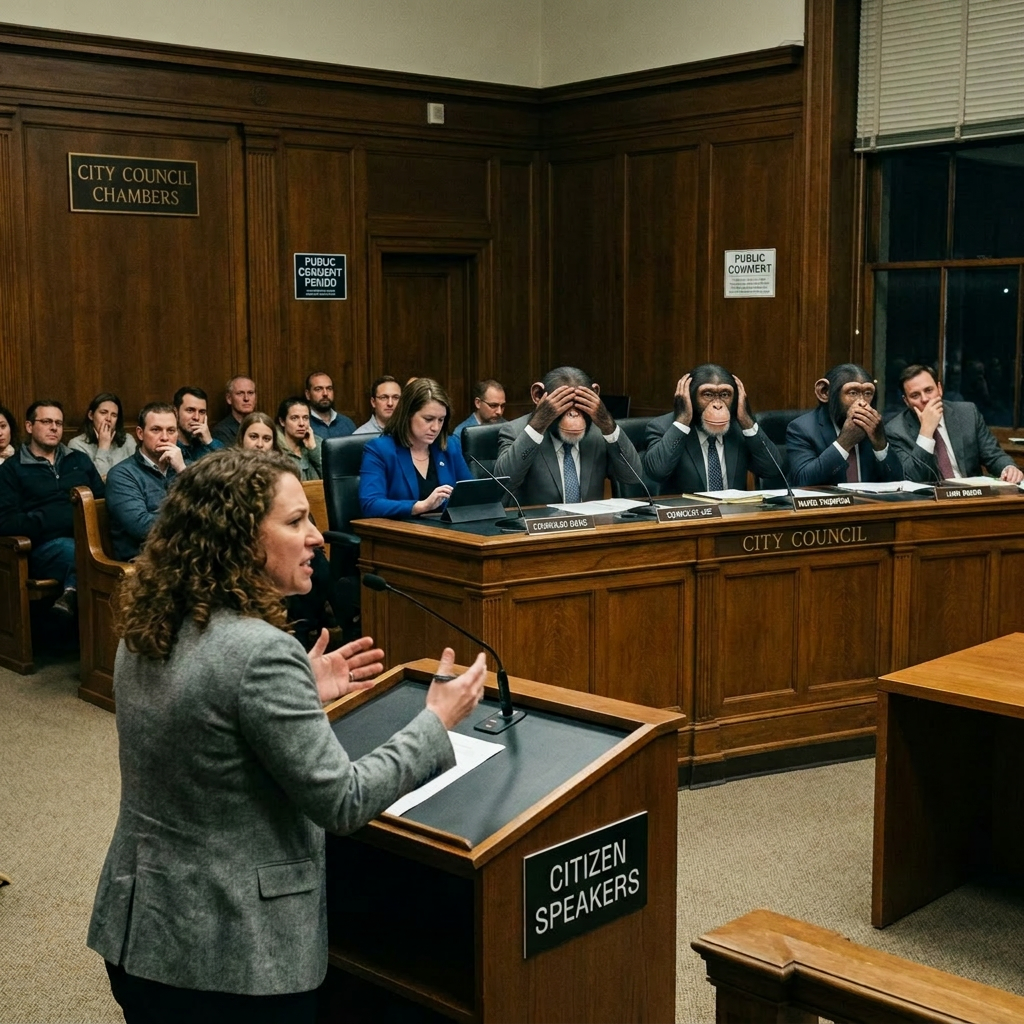
A City Council meeting is not a private corporate board meeting. It is a public meeting where public business is conducted.
The Brown Act could not be clearer: “All meetings of the legislative body of a local agency shall be open and public, and all persons shall be permitted to attend.” California law also says the people do not surrender their sovereignty to the agencies that serve them, and public servants do not get to decide what the people are allowed to know.
The California Constitution says the people have the right of access to information concerning “the conduct of the people’s business,” and that meetings of public bodies shall be open to public scrutiny.
Riverside’s own Charter confirms that all powers of the City are vested in the City Council, and Riverside’s own public materials state that citizens may address the Council on matters concerning the City’s business.
So yes, the Council conducts business. But it is the people’s business — funded by taxpayers, governed by public law, and subject to public scrutiny.
Any councilmember who tries to dismiss public participation by saying “this is a business meeting, not a public meeting” is revealing a fundamental misunderstanding of representative government. The dais does not own City Hall. The people do.
Falcone is correct that the Brown Act does not require councilmembers to sit in total silence during public comment. Councilmembers may ask a clarifying question, refer a matter to staff, briefly respond in limited circumstances, or request that an item be placed on a future agenda. But that limited authority is not a license to ambush, argue with, lecture, belittle, or attack residents after they speak. Too often, this Council waits until public comment is finished and then uses the dais to attack the speaker, reframe the issue, or avoid real scrutiny without allowing a fair response. That is not transparency. That is not leadership. It shows a fear of open debate and, too often, a lack of preparation or understanding of the topic being discussed. Just as troubling, I have not seen other councilmembers or the Mayor call a point of order when this happens, even when the conduct appears to violate the spirit of the Brown Act and the public trust. Silence from the rest of the dais only normalizes the abuse of public comment and sends the message that residents may speak, but only at the risk of being publicly targeted by the very officials who are supposed to serve them.
The most troubling aspect of the current Measure Z extension campaign is not the debate over taxes itself — it is the continued use of fear as a political weapon. When elected officials and their allies repeatedly push “vote for this tax or people will die” narratives, they are not engaging in responsible governance. They are using emotional coercion because they lack confidence in their actual record of leadership, budgeting, and long-term planning.
Fear is not a fiscal strategy.
The reality is simple: many municipalities throughout California and across the nation provide better streets, better parks, better infrastructure, stronger public safety outcomes, and a higher quality of life with lower sales taxes and without utility transfer schemes. Riverside does not suffer from a shortage of taxpayer money. Riverside suffers from a shortage of disciplined leadership, long-term planning, operational oversight, and fiduciary responsibility.
For years, Riverside leadership has prioritized vanity projects, branding exercises, consultant culture, public relations campaigns, and political image management over core city services and sustainable economic development. The public has watched elected officials spend more time building social media personas, campaigning for their next office, and consolidating political influence than solving the structural issues facing the city.
At the same time, taxpayers are expected to believe there is “no choice” but another regressive tax increase.
That argument falls apart under scrutiny.
If public safety is truly the priority, then why has the city continued spending millions on non-essential projects while basic infrastructure deteriorates? Why are taxpayers funding expensive lobby remodels, branding initiatives, consultant contracts, studies, outreach campaigns, and administrative expansion while roads, response times, and maintenance lag behind? Why does the city continue to grow bureaucracy faster than service efficiency?
The public also deserves to question the ethics of the current campaign itself.
Residents are watching city resources, staff time, and taxpayer-funded infrastructure being leveraged to support what appears to be a highly coordinated political messaging campaign. Employees are pulled away from their actual responsibilities to present one-sided narratives to the public. Signs are plastered throughout the community in ways many residents view as disrespectful and excessive. Meanwhile morale inside City Hall continues deteriorating amid the ongoing instability and embarrassment surrounding the City Manager’s office — a situation created internally through poor leadership decisions and political dysfunction.
This is entirely self-inflicted.
The answer cannot always be “raise taxes again.”
A healthy city does not continuously return to taxpayers demanding more revenue while refusing to address spending discipline, accountability, transparency, ethics, and operational reform. Riverside should be aggressively pursuing productive economic development that expands the tax base through quality business growth, industry recruitment, logistics modernization, technology investment, and streamlined permitting — not relying on perpetual regressive taxation that disproportionately hurts working families, seniors, and small businesses.
The city should be focused on: • Cutting wasteful spending • Conducting real performance audits • Demanding measurable accountability from charter officers • Ending insider political culture and patronage hiring • Improving transparency and ethics oversight • Supporting business growth instead of bureaucratic expansion • Prioritizing infrastructure and core public safety before vanity spending • Negotiating responsibly with labor and vendors • Building long-term financial sustainability instead of dependency on temporary tax measures
The public safety concerns raised are real. No reasonable person disputes the importance of fire protection and emergency response. But using emergencies and tragedy to emotionally pressure taxpayers into approving permanent spending expansions without demanding structural reform is irresponsible governance.
Citizens should ask difficult but fair questions: Where did previous revenues go? What measurable efficiencies were implemented? What non-essential spending was cut first? What operational reforms were attempted? What accountability exists for failed leadership decisions? Why are taxpayers always expected to pay more before government is expected to perform better?
Government exists to serve the public — not to perpetually grow itself.
Riverside does not need more fear-based campaigning. It needs mature leadership, fiscal discipline, ethical governance, economic competence, and elected officials willing to put taxpayers ahead of politics, insider influence, and self-promotion.
As Riverside moves deeper into another election cycle, voters face an important question:
Do we continue electing political insiders, operatives, and ideologues who helped create our current problems, or do we finally demand qualified leadership with real-world experience, fiscal discipline, and accountability?
The answer will determine whether Riverside continues its decline into the same failed model we see throughout California, or whether we restore responsible local government focused on taxpayers, businesses, public safety, and quality of life.
Riverside’s Problems Did Not Happen by Accident
The current condition of Riverside is not the result of bad luck. It is the direct result of years of political pandering, ideological governance, reckless spending, and elected officials more concerned with political careers than fiduciary responsibility.
Residents see the results every day:
Growing homelessness and vagrancy
Rising crime and deteriorating public safety
High taxes and utility increases
Failing infrastructure
Businesses leaving California
Endless bond debt and pension obligations
Expanding government payrolls while services decline
Political grandstanding instead of competent governance
The same ideological framework that devastated cities like San Francisco, Oakland, and Los Angeles is now deeply embedded in local politics here in Riverside.
And many of the candidates running today are not outsiders bringing reform — they are products of the very machine that created these failures.
Riverside City Council Is Supposed to Be Non-Partisan
The Riverside City Council races are officially non-partisan. At least they are supposed to be.
Yet many candidates campaign as direct operatives for the same single-party political ideology dominating California politics today. Their social media, endorsements, donors, consultants, and activist alliances make this obvious.
Instead of focusing on local governance, balanced budgets, infrastructure, business development, and public safety, many candidates repeat partisan talking points designed to please political organizations, unions, special interests, and ideological activists.
That is not local leadership.
That is political branding.
And Riverside taxpayers are paying the price.
Endorsements Are Often a Warning Sign — Not a Qualification
One of the biggest mistakes voters make is confusing endorsements with qualifications.
Modern local campaigns increasingly resemble NASCAR race cars covered in sponsor logos.
Every endorsement decal tells you who owns influence over that candidate.
When candidates proudly display long lists of endorsements from political insiders, current office holders, party operatives, unions, lobbyists, or activist organizations, voters should ask:
What is expected in return?
Because endorsements are rarely free.
Political endorsements often represent:
Future loyalty
Voting expectations
Contract influence
Union negotiations
Development interests
Political networking
Career advancement pipelines
A candidate bragging about endorsements instead of accomplishments is often signaling exactly who they will serve once elected.
And Riverside voters should pay especially close attention when candidates proudly promote endorsements from former or current officeholders who helped create Riverside’s current financial and operational problems.
Why would voters want more of the same leadership that produced:
Massive pension liabilities
Expanding debt
Endless tax increases
Utility rate hikes
Business flight
Failed housing strategies
Poor infrastructure management
Weak oversight of city management
An endorsement from failed leadership is not necessarily a recommendation.
Sometimes it is a warning label.
Do Deep Research — Not Surface-Level Voting
Voters must stop making decisions based on mailers, slogans, smiling photos, emotional social media posts, or activist endorsements.
Do real research.
Look deeply into every candidate:
Employment history
Business experience
Financial management background
Voting records
Public statements
Social media activity
Political donors
Consultant relationships
Union alliances
Policy positions
Prior campaign affiliations
Government employment history
Board and commission records
Ask simple but critical questions:
Have they ever run a business?
Have they ever signed the FRONT of a paycheck instead of just collecting one?
Have they ever managed a budget responsibly?
Or do they simply support endless taxation and spending?
Have they ever had to meet payroll?
Negotiate contracts? Control costs? Make difficult operational decisions?
Do they support public safety?
Or do they repeat ideological narratives that weaken law enforcement and accountability?
Do they support local control?
Or do they simply act as political extensions of Sacramento?
Do they understand economics?
Or do they believe government spending creates prosperity regardless of consequences?
These questions matter.
Because Riverside cannot afford more career politicians, political staffers, activists, or office-seekers using local government as a stepping stone to higher office.
Political Careerism Is Destroying Local Government
One of the most dangerous trends in local politics is the rise of professional political careerists.
These individuals move from:
political campaigns,
staff positions,
nonprofit activism,
government employment,
party organizations,
appointed commissions,
and insider networks
directly into elected office — often with little real-world experience outside politics itself.
Their expertise is not governance.
It is campaigning.
Their skill is not solving problems.
It is navigating political alliances.
And once elected, many immediately begin planning their next office rather than serving residents.
Riverside voters should be extremely cautious of candidates whose entire professional history revolves around politics, activism, or government bureaucracy.
Government should not become a protected employment ecosystem where insiders continuously rotate positions while taxpayers absorb the consequences.
Attempting to Stack the Council
Voters should also pay attention to coordinated political efforts currently underway to stack the Riverside City Council with hand-picked ideological allies.
One sitting councilmember appears deeply focused on building a council bloc aligned not around independent governance, but around personal influence, political loyalty, and long-term ambition.
This style of politics is dangerous.
The City Council is supposed to represent independent districts and independent voices — not become an extension of one politician’s personal political machine.
When candidates appear heavily connected to the same consultants, donor circles, activist groups, and insider alliances, voters should recognize the strategy.
The goal is often not debate.
It is control.
And Riverside desperately needs independent thinkers willing to challenge staff, challenge failed policies, and challenge special interests — not rubber stamps.
Measure Z Politics and the Tax-and-Spend Addiction
Riverside voters were promised many things through Measure Z and the surrounding political messaging.
Yet taxpayers continue seeing:
increasing costs,
growing financial obligations,
expanding payroll burdens,
additional taxes and fees,
and worsening long-term liabilities.
At the same time, many residents feel bullied into silence whenever they question spending, priorities, or financial accountability.
The political culture surrounding Measure Z often became hostile toward legitimate taxpayer concerns. Critics were frequently attacked, dismissed, or portrayed as opponents of progress simply for demanding accountability.
That is not healthy governance.
Taxpayer oversight is not extremism.
Questioning spending is not obstruction.
Demanding fiduciary responsibility is not anti-government.
It is exactly what responsible citizens SHOULD do.
Riverside cannot continue operating under the dangerous assumption that every problem can be solved through:
more taxes,
more debt,
more government expansion,
or more spending without accountability.
Eventually economic reality catches up.
And throughout California, we are already seeing the consequences.
Riverside Needs Adults in the Room
The future of Riverside depends on electing leaders who understand:
economics,
budgeting,
negotiation,
operations,
accountability,
infrastructure,
business development,
and public safety.
Not slogans.
Not activism.
Not performative politics.
Not social media influencers pretending to be statesmen.
Riverside needs leaders mature enough to:
stand up to special interests,
challenge staff recommendations,
demand financial accountability,
protect taxpayers,
encourage business growth,
and prioritize core city services over ideological experimentation.
The voters of Riverside have a choice.
We can continue electing candidates chosen by political insiders, activist organizations, unions, consultants, and Sacramento-aligned operatives.
Or we can elect independent leaders focused on Riverside residents first.
But that requires voters to do something many no longer do:
Research deeply. Question everything. Ignore the political theater. And vote based on qualifications, integrity, and results.
Because Riverside’s future is too important to hand over to political marketing campaigns and ideological operatives.
Fool Me Once: Why Riverside Voters Should Reject Measure Z
For nearly a decade, the citizens of Riverside have been told the same story.
We are told the City is in crisis.
We are told essential services are at risk.
We are told police, fire, roads, homelessness, and “quality of life” all depend on giving City Hall more money.
And every time, the answer from the political establishment is the same:
Raise taxes.
Now they are back again with another version of Measure Z.
This time, the City wants to increase the existing Measure Z sales tax from 1 cent to 1.25 cents, pushing Riverside’s total sales tax to 9.00%. Even more concerning, this tax would continue indefinitely until voters somehow manage to repeal it in the future.
The problem is not simply the tax increase itself.
The problem is credibility.
Fool Me Once
When Measure Z was originally sold to voters in 2016, Riverside residents were told the tax was necessary to stabilize finances, protect public safety, improve roads, and preserve basic city services.
Voters were told this was the responsible solution.
Since then, Riverside has collected hundreds of millions of dollars in Measure Z revenue.
Yet here we are again.
The City’s own records now show Measure Z revenues far exceeded original projections. Riverside has already spent more than half a billion dollars tied to Measure Z revenues and debt proceeds.
And despite that massive windfall:
Our streets remain in poor condition.
Infrastructure continues to lag behind comparable cities.
Residents continue paying some of the highest combined local taxes and utility burdens in the region.
Homelessness continues to expand.
City Hall still claims it cannot maintain “basic services” without even more taxpayer money.
At some point, taxpayers have to stop asking how much money government needs and start asking:
Where did the money go?
Riverside Already Taxes Residents Aggressively
This is what makes the Measure Z campaign especially insulting.
Riverside residents already pay:
A high local sales tax
A Utility Users Tax on electricity, gas, water, and telecommunications
Utility transfer revenues that support the General Fund
Increasing fees and assessments across multiple services
The City already receives enormous revenue streams from residents and businesses.
Yet City Hall behaves as if taxpayers have somehow failed to “do their part.”
No.
Taxpayers have done their part.
City Hall has failed theirs.
Sales Taxes Are Regressive
One of the most dishonest talking points surrounding Measure Z is the attempt to minimize the impact of “just another quarter cent.”
That phrase intentionally ignores economic reality.
Sales taxes are regressive taxes.
Why?
Because working-class and middle-class families spend a far larger percentage of their income on taxable goods and daily necessities than wealthy households do.
A wealthy individual can absorb higher consumption taxes with minimal impact.
A senior on fixed income cannot.
A young family struggling with groceries, rent, insurance, utilities, and gasoline cannot.
A blue-collar worker living paycheck to paycheck absolutely feels it.
Every additional sales tax increase disproportionately harms the people least able to absorb it.
That is not “equity.”
That is economic irresponsibility.
If Riverside Is Thriving, Why Are Taxes Going Up?
This contradiction may be the most revealing part of the entire Measure Z campaign.
At the same time City Hall claims it desperately needs more tax revenue, the Mayor and City leadership constantly brag about their economic-development “successes.”
We hear about:
billions in new development,
rising property values,
new jobs,
downtown investments,
economic growth,
and Riverside “leveling up.”
Fine.
If all of that is true, then where is the benefit to taxpayers?
Where is the relief?
Where are the dramatically improved roads?
Where are the measurable improvements in basic city services?
Where is the operational efficiency?
Where is the reduction in long-term liabilities?
If Riverside’s economic-development claims are real, then taxpayers should be seeing stronger finances and better infrastructure — not another regressive tax increase.
Instead, residents are being told:
“Things are better than ever… but we still need more of your money.”
That is not fiscal leadership.
That is dependency.
The Streets Tell the Truth
Politicians can produce polished presentations and social media videos all day long.
But residents drive the streets every day.
And the streets tell the real story.
Riverside’s own pavement reports show the City still trails comparable California cities in road conditions. Years of Measure Z funding have not produced the kind of infrastructure transformation voters were promised.
The City itself admits significant portions of the street network remain in poor or very poor condition.
This matters because roads are one of the clearest indicators of local government competence.
Residents can physically see whether their taxes are producing results.
And many residents are asking a completely fair question:
After nearly a decade of Measure Z money, why are we still so far behind?
Measure Z Became a Habit
At this point, Measure Z no longer looks like a temporary emergency solution.
It looks like an addiction.
In my view, Measure Z has become crack to a City Hall addicted to easy revenue instead of disciplined governance.
Every time the City overspends, mismanages priorities, expands bureaucracy, or avoids structural reform, the answer becomes another plea for taxpayer money.
And every time, the emotional pressure campaign is rolled out:
police,
fire,
homelessness,
potholes,
emergencies,
fear,
urgency,
crisis.
Those are real issues.
But they are also being used as political shields to avoid accountability.
The Ethics and Oversight Problem
This is where the issue becomes bigger than taxes.
Riverside has spent years resisting meaningful independent oversight and transparency.
The City weakened ethics credibility.
The public demanded stronger oversight.
Residents pushed for a truly independent Inspector General.
Instead, Riverside created a structure that remains politically connected and dependent on the very leadership it may need to investigate.
At the same time, residents continue watching:
ethics controversies,
closed-session drama,
instability surrounding the City Manager situation,
and a political culture increasingly focused on optics, branding, and self-promotion rather than measurable governance reform.
Trust matters.
A general tax depends entirely on public trust.
And this City Hall has done very little to earn more of it.
Fear Campaigns Using Public Resources
Perhaps the most troubling part of this entire Measure Z push is the City-funded outreach campaign surrounding it.
When government uses taxpayer-funded communications, employees in uniform, emotional messaging, and fear-based presentations to push for higher taxes, serious ethical questions arise.
The taxpayer should never become the funding source for their own political persuasion campaign.
Government’s fiduciary duty is to taxpayers — not to protecting bureaucratic expansion, political legacies, or institutional addiction to growing revenue.
When City Hall uses fear to drive support for taxes instead of demonstrating operational excellence and accountability, it exposes the deeper problem:
They no longer trust their own performance to justify the ask.
Vote NO on Measure Z
This is not a vote against police officers.
This is not a vote against firefighters.
This is not a vote against city workers.
This is a vote against failed governance.
Vote NO because Riverside should already have better services after years of Measure Z money.
Vote NO because residents already carry enormous tax and utility burdens.
Vote NO because the roads still reflect years of underperformance.
Vote NO because Riverside taxpayers deserve accountability before another blank check.
Vote NO because a city that claims economic success should not simultaneously plead financial desperation.
And vote NO because if the Mayor, Council, and City leadership cannot govern responsibly without constantly demanding more taxpayer money, then Riverside does not need another tax increase.
Mayor Patricia Lock Dawson’s recent opinion piece asks Riverside residents to celebrate outside partnerships, national conferences, climate grants, visiting mayors, advisory networks, and symbolic recognition.
But Riverside residents are entitled to ask a much simpler question:
If City Hall is producing so much progress, why are residents being asked to pay higher taxes again?
The Mayor’s article is polished, but it is not a complete accounting of Riverside’s condition. It highlights the parts of the story that make City Hall look ambitious, connected, and visionary, while leaving out the problems residents and local businesses deal with every day: public safety, homelessness, deteriorating roads, infrastructure backlogs, rising costs, City Hall instability, and another flawed Measure Z tax proposal.
Riverside does not need more self-promotion. Riverside needs disciplined leadership focused on the people who actually live here and the businesses that have invested here for decades.
Partnerships Are Not the Same as Results
The Mayor lists partnerships with Accelerator for America, Bloomberg Philanthropies, ICLEI, Harvard fellows, and climate-action programs. Some of those relationships may produce useful planning assistance, technical support, or grant funding. But her opinion piece blurs an important distinction:
Activity is not achievement.
A conference is not economic development.
A visiting mayor getting a Raincross tattoo is not a jobs strategy.
A climate grant is not road repair.
A planning document is not public safety.
A fellowship is not fiscal discipline.
A national nonprofit relationship is not proof that Riverside families are better off.
The Mayor points to Accelerator for America’s support for the Zero Emission Vehicle Transition Plan and Inclusive Development Action Plan. But AFA itself describes its economic and community-development work broadly as helping local leaders with housing affordability, small businesses, neighborhoods, capital access, and career pathways. Those are goals — not proof that Riverside has solved the local affordability, homelessness, infrastructure, or revenue problems now being used to justify another tax increase. 
If these partnerships are truly transforming Riverside’s economic future, then residents should see measurable outcomes: net new employers, higher-paying jobs, private-sector investment, faster permitting, fewer vacant storefronts, safer neighborhoods, reduced homelessness, improved roads, and less dependence on regressive taxes.
Instead, City Hall is back asking for more money.
What the Mayor Leaves Out About Measure Z
The Mayor’s article celebrates outside resources, but it avoids the obvious contradiction: Riverside is simultaneously asking voters to increase and extend Measure Z.
The City’s own press release says voters will decide whether to extend and increase the Measure Z sales tax.  The City Attorney’s impartial analysis states that the measure would eliminate the current expiration date, increase the existing transaction and use tax from 1% to 1.25%, raise Riverside’s total retail sales tax rate from 8.75% to 9%, and generate approximately $21 million more annually. 
That is not merely “renewal.” It is an increase. It is also a general tax, meaning the revenue goes into the general fund and is not legally locked into the specific priorities used in campaign-style messaging.
The ballot language was so problematic that a judge ordered the City to rename the measure after a resident challenged the language as misleading. Raincross Gazette reported the court ordered changes after the City’s proposed wording was challenged over whether it fairly described the tax measure.  Riverside Record similarly reported that a Superior Court judge ordered the City to update the ballot language after ruling in favor of a resident who argued the wording was biased and violated election law. 
That matters. If City Hall’s case for Measure Z is so solid, why did it require judicial correction?
Sales Taxes Are Regressive — and Riverside Families Pay the Price
A sales tax is regressive because it takes a larger share of income from lower-income and middle-income households than from wealthier households.
A wealthy household can absorb another quarter-cent at checkout. A working family living paycheck to paycheck cannot. Seniors on fixed incomes cannot. Renters already squeezed by housing costs cannot. Small businesses whose customers are price-sensitive cannot simply ignore the cumulative impact.
Sales taxes hit ordinary purchases. They fall hardest on people who spend most of their income on basic needs. So when Riverside raises the sales tax, City Hall is not taxing an abstraction. It is taxing residents at the register.
It is taxing families buying school supplies.
It is taxing seniors buying household goods.
It is taxing workers maintaining their cars.
It is taxing small businesses trying to compete.
It is taxing the very people City Hall claims to be helping.
If the Mayor and City Manager were truly effective at bringing high-value businesses and durable private-sector investment to Riverside, the City should be growing its tax base through productivity and economic expansion — not demanding another regressive tax increase from residents.
Riverside Should Be Reducing the Tax Burden, Not Increasing It
The Mayor says Riverside can build “a more resilient and diversified economy that creates jobs so people can live where they work.” That is a worthy goal. But after years of that rhetoric, Riverside is still being asked to raise taxes for the same core issues: public safety, homelessness, roads, and infrastructure.
That is the problem.
If City Hall were bringing in enough value-producing businesses, expanding the employment base, accelerating quality development, and supporting long-standing local employers, Riverside would be discussing how to reduce the regressive sales tax burden — not increase it.
Strong economic development means the City can fund core services without constantly returning to taxpayers for more. It means a broader base of productive businesses. It means better jobs. It means a healthier local economy. It means prioritizing private investment over government vanity projects.
Instead, the Mayor’s article celebrates partnerships and accolades while City Hall asks residents for more money.
That is not proof of success. It is evidence that the current strategy is not producing enough real value.
The Article’s “Studies” and Plans Are Incomplete Without the Missing Context
The Mayor cites plans and initiatives — the Zero Emission Vehicle Transition Plan, Inclusive Development Action Plan, Economic Development Strategy, Bloomberg-supported procurement work, climate-action funding, and infrastructure partnerships.
But the missing context is this:
Planning support is not the same as delivered infrastructure.
Residents do not drive on plans. They drive on roads.
Recognition is not the same as fiscal health.
A “green fleet” award does not prove Riverside has solved public safety, homelessness, staffing, or infrastructure funding.
Climate grants do not answer why basic services require higher taxes.
A Youth Climate Action grant may fund civic engagement or sustainability projects, but it does not explain why residents must pay a higher sales tax for core services.
Inclusive development language does not prove economic inclusion.
The relevant question is whether Riverside residents are seeing better jobs, improved affordability, safer neighborhoods, and a stronger business climate.
Outside partnerships can create dependency and distraction.
Chasing grants and national recognition can become a substitute for disciplined local governance.
The Mayor does not measure opportunity cost.
Every dollar, staff hour, and executive focus spent on conferences, awards, advisory networks, climate branding, and image-building is time and attention not spent fixing roads, cleaning neighborhoods, improving permitting, enforcing standards, protecting businesses, and stabilizing City Hall.
The article lists activity. It does not prove results.
Vanity Projects Are Part of the Fiscal Problem
Riverside’s leaders continue to ask residents for more money while City Hall pursues projects and partnerships that often look better in press releases than they feel in neighborhoods.
Residents are tired of hearing that every new initiative is an “investment” while the basics remain unresolved. City Hall cannot continue to celebrate civic-space visions, national nonprofit partnerships, outside conferences, climate branding, and feel-good accolades while telling residents the City needs another sales tax increase for police, fire, homelessness, roads, and infrastructure.
That is exactly how cities lose public trust.
The City must stop confusing visibility with value. Riverside needs economic engines, not image campaigns. It needs safe streets, functional roads, clean public spaces, disciplined spending, accountable leadership, and support for businesses that have already committed to Riverside.
City Hall Must Focus on Existing Residents and Businesses
Riverside’s future will not be built by chasing applause from outside organizations. It will be built by taking care of the people and businesses already here.
That means:
supporting long-standing Riverside businesses;
reducing barriers to business expansion;
fixing permitting delays;
cleaning up commercial corridors;
prioritizing police, fire, roads, and infrastructure;
addressing homelessness with treatment, enforcement, and accountability;
reducing wasteful spending;
rebuilding trust with employees;
and restoring discipline inside City Hall.
The Mayor says she acts as Riverside’s ambassador in every room. That sounds good. But Riverside does not need a mayor chasing personal accolades in every room. Riverside needs leaders who fix the rooms residents actually live and work in.
The City Must Manage Rogue Charter Officers and Clean Up City Hall
Before asking residents to pay higher taxes, Riverside’s leaders should clean up their own house.
Public records already show serious governance concerns involving the City Manager’s office and the City Manager’s spouse. The City Council sent Susan Freeman a certified letter stating that she contacted City employees through “unwanted and harassing calls, text messages, emails, comments, social media posts, and other communications.” The letter also said comments involving confidential personnel or disciplinary issues were intrusive and violated employee privacy. 
The City’s letter further stated that Freeman’s relationship with the City Manager created pressure for staff when she solicited employees to participate in paid services or asked for donations, and that staff could fear negative career consequences if they opted out. 
That is a City Hall governance problem.
The Mayor’s article talks about bringing the best of the country and the world home to Riverside. But residents are asking for something more basic: manage City Hall, protect employees, control spending, and stop letting rogue Charter officers destabilize the City.
A city cannot credibly ask for higher taxes while failing to manage its own executive leadership.
The Real Test Is Not Whether Riverside Gets Invited — It Is Whether Riverside Gets Better
The Mayor wants residents to celebrate the fact that Riverside is in the room with national organizations and visiting mayors.
But the test is not whether Riverside is invited to the table.
The test is whether Riverside residents are safer, whether roads are better, whether businesses are growing, whether homelessness is reduced, whether taxes are lower, whether City Hall is stable, and whether residents trust their government.
By that standard, City Hall has a lot more work to do.
Riverside deserves leaders focused less on personal recognition and more on measurable results.
Less branding.
Less boasting.
Less dependency on outside validation.
Less tax pressure on working families.
Less tolerance for dysfunction inside City Hall.
More public safety.
More road repair.
More support for local businesses.
More fiscal discipline.
More accountability.
More focus on Riverside residents.
The Mayor’s opinion piece tells a story about ambition. Riverside residents deserve a government that delivers results.
And if City Hall cannot deliver those results without increasing a regressive sales tax again, then residents should ask whether the problem is really lack of revenue — or lack of leadership.
Riverside Residents Must Speak Today: City Council Must Protect Employees, the Public Trust, and the City’s Best Interest
Riverside residents should call in today and speak during public comment regarding the City Manager’s closed-session performance evaluation.
This is not a normal personnel review. This is not a political disagreement. This is not about personalities.
This is a governance crisis.
Public records now show a troubling pattern involving the City Manager’s office, the City Manager’s spouse, City employees, workplace pressure, business-related communications, and the City’s own formal warning letter. The Council is now being asked to address this issue in closed session. Residents must make clear that the Council cannot delay, minimize, or hide behind contract excuses.
The Council must act today.
The City Manager should be relieved of duty and access immediately, and the Council should move toward termination for cause based on the documented evidence and the best interests of the City.
How to Call In Today
To comment on closed-session items and matters within the jurisdiction of the City Council, the City’s agenda instructions state that residents may participate in person or call (951) 826-8686, follow the prompts, press 9 to enter the speaker queue, and press 6 when prompted to unmute. Public comments are generally limited to 3 minutes.
Call-in number: (951) 826-8686
Press: *9 to be placed in the speaker queue
Press: *6 to unmute when called
Tell them: “I want to comment on the closed-session City Manager performance evaluation.”
Residents should call early and be ready when public comment opens.
The City’s Own Records Show This Is Bigger Than Pasadena
Much of the public attention has focused on Mike Futrell accepting the Pasadena City Manager position and then reversing course. That alone raises serious unanswered questions:
Did he submit a written resignation?
Was the resignation accepted?
Did the City act in reliance on it?
Was there a formal rescission or withdrawal?
Was any closed-session action taken?
Was any action properly reported to the public?
Why should Riverside retain a City Manager who publicly accepted another city’s top job and then reversed course without full public explanation?
But the public records now show the Pasadena issue is not the whole story. It appears to be the final straw in a much larger governance problem.
The City Council Already Warned the City Manager’s Wife
On December 11, 2025, the City of Riverside sent Susan Freeman, the City Manager’s wife, a certified letter signed by Mayor Pro Tem Chuck Conder on behalf of the City Council. The letter was copied to Mike Futrell, the Mayor, and the City Council.
That letter states that Freeman had contacted City employees through:
“unwanted and harassing calls, text messages, emails, comments, social media posts, and other communications.”
The letter further states that communications about confidential personnel or disciplinary issues were intrusive and violated employee privacy. It also states that comments suggesting Freeman was part of the City’s decision-making team were inappropriate because she was not a City employee and not a consultant hired by the City.
That should alarm every Riverside resident.
The City Manager’s spouse is not elected. She is not appointed. She is not a City employee. She is not a City consultant. Yet the City’s own letter states that her communications had crossed boundaries serious enough for the Council to formally intervene.⸻
City Employees Felt Pressure Because of Her Relationship With the City Manager
The same certified letter states that Freeman’s relationship with the City Manager created a feeling of pressure for City staff when she solicited employees to participate in paid services or asked City staff for donations. The City further stated that staff could fear negative career consequences if they opted out.
That is not a minor issue.
City employees should never feel pressured to participate in services, respond to solicitations, tolerate intrusive communications, or worry about career consequences because the person contacting them is married to the City Manager.
The City’s own letter also states:
“Your pattern of communication has been disruptive at the workplace, caused significant distress to City staff, and serves no legitimate purpose.”
This is not gossip. This is not rumor. This is a City Council letter.
The Records Also Show Business-Related Access to City Staff
Other public records show Freeman communicating with City staff using business email accounts and sending training or curriculum-related materials.
On November 6, 2024, Freeman emailed City staff from susan@consciousinclusioncompany.com with an attached presentation titled “RENEE_Language of Inclusive Leadership_FINAL.pptx.” Her signature identified her as CEO and Founder of Conscious Inclusion Company, LLC and described the company as providing DEI customized solutions.
On November 13, 2024, Freeman sent additional training/curriculum material. City staff then forwarded it internally, writing:
“From Mike’s wife, I thought you would like to review.”
In the same chain, a City employee told Freeman:
“I am happy to accept any material you have that will help team riverside. I have an excellent training and organizational development team and we are always looking for new curriculum and to refresh existing curriculum.”
Freeman had stated that she had a collaborative communication class she had done for another city and asked whether the City employee wanted her to send it.
These records raise fair and necessary questions:
Were these materials reviewed on City time?
Were they considered for City training or curriculum?
Was any procurement review performed?
Was any conflict-of-interest review performed?
Did staff feel free to reject or ignore the City Manager’s spouse?
Did the City Manager know his spouse was sending business-related training materials into City channels?
Did any employee feel pressured because of the City Manager relationship?
These questions go directly to public trust and the City Manager’s performance.
The Contract Excuse Is Not Enough
Some will say the City must be careful because of contract clauses, severance provisions, or legal risk.
Of course the City must follow the law. But contract clauses cannot become an excuse for ignoring misconduct, workplace disruption, conflicts of interest, employee pressure, or a loss of public trust.
Based on the records released so far, the Council has more than enough reason to determine that the City Manager has violated the spirit — and potentially the terms — of his employment responsibilities. A City Manager is expected to protect the organization, safeguard employees, preserve public trust, avoid conflicts of interest, and maintain professional boundaries around City operations.
When the City’s own letter says the City Manager’s spouse caused workplace disruption, significant distress, employee pressure, privacy concerns, and fear of career consequences, the Council cannot pretend this is isolated from the City Manager’s performance.
If the City Manager knew or should have known this was happening and failed to stop it, that is a management failure. If City employees were placed in a position where they felt pressure because of the City Manager’s household relationship, that is a leadership failure. If business-related materials were introduced through informal access connected to the City Manager’s spouse, that is a governance failure.
The Council should not use contract language as a shield against accountability.
The City Manager should be relieved of duty and access today while the City completes the necessary legal steps for termination for cause.
The Council cannot credibly claim surprise. The December 11, 2025 certified letter was sent on behalf of the City Council and copied to Mike Futrell, the Mayor, and the Council.
The Council Is Late to the Game
That means the Council already had notice.
City employees deserved protection earlier. Riverside residents deserved transparency earlier. The City deserved decisive leadership earlier.
Now that these records are public, delay is no longer acceptable.
Closed session cannot become a place where accountability goes to die. It must be the place where the Council finally does its job.
What Residents Should Demand Today
Residents should call in and respectfully but firmly demand that the Council:
Relieve the City Manager of duty and access immediately.
Preserve all records involving the City Manager, Susan Freeman, City staff complaints, Pasadena, resignation issues, and contract matters.
Determine that the documented pattern constitutes grounds for termination for cause.
Begin a transparent recruitment process for new City Manager leadership.
Publicly report any legally reportable action taken in closed session.
Protect City employees from retaliation.
Release all non-exempt records so residents can understand what happened.
This is about protecting employees. It is about protecting taxpayers. It is about protecting the integrity of City Hall.
Riverside deserves a City Manager who is fully committed to Riverside, free from conflicts, free from insider pressure, and capable of restoring public trust.
Suggested Public Comment
Mayor and Councilmembers,
I am commenting on the closed-session performance evaluation of the City Manager.
I urge the Council to relieve Mike Futrell of duty and access today and move toward termination for cause.
This is not personal. This is about City employees, public trust, and the City’s best interest.
Public records show that on December 11, 2025, the City Council sent a certified letter to Susan Freeman, the City Manager’s wife, warning her to stop harassing communications toward City employees. The letter stated that she had contacted employees through unwanted and harassing calls, texts, emails, comments, social media posts, and other communications.
The letter also stated that communications involving confidential personnel and disciplinary issues were intrusive and violated employee privacy. It stated that comments implying she was part of the City’s decision-making team were inappropriate because she was not a City employee and not a City consultant.
Most troubling, the City stated that her relationship with the City Manager created pressure on staff when she solicited employees to participate in paid services or asked for donations, and that employees could fear negative career consequences if they opted out.
The City’s own letter said her pattern of communication disrupted the workplace, caused significant distress to City staff, and served no legitimate purpose.
The Council had notice. The City Manager was copied. The Mayor and Council were copied.
Now we are also dealing with the Pasadena resignation reversal. Residents still do not know whether Mr. Futrell resigned, whether the resignation was accepted, whether it was rescinded, or whether the City acted in reliance on it.
Please do not hide behind contract clauses or severance excuses. Based on the evidence released so far, the City Manager has violated the trust and responsibilities required by his position. At minimum, he should be relieved of duty and access immediately while the City proceeds with termination for cause.
City employees deserved protection earlier. The Council is late to the game, but it can still act today.
Many have asked for a copy of the Public Records Request I have made. Here it is:
Subject: California Public Records Act Request — City Manager Michael “Mike” Futrell, Susan Freeman, Hiring, Employment, Resignation, Contract Matters, Complaints, Communications, Vendors, and Related Records
To the City Clerk / Public Records Officer:
This is a request under the California Public Records Act, Government Code § 7920.000 et seq., and Article I, Section 3(b) of the California Constitution, for inspection and production of public records in the possession, custody, or control of the City of Riverside.
For purposes of this request, the term “records” includes all public records and writings as broadly defined under the California Public Records Act, including but not limited to emails, text messages, instant messages, Microsoft Teams messages, voicemails, phone logs, call-detail records, memoranda, letters, notes, handwritten notes, meeting minutes, calendars, appointment records, visitor logs, sign-in sheets, video recordings, audio recordings, photographs, contracts, drafts, reports, evaluations, complaints, investigations, settlement documents, agendas, staff reports, attachments, presentations, invoices, payment records, electronic files, metadata, and any records maintained on City-issued or personal devices/accounts where those records concern City business.
Please search all City systems and repositories reasonably likely to contain responsive records, including but not limited to City email systems, archived email, Microsoft 365, Teams, SharePoint, OneDrive, text-message systems, City-issued phones, call-log systems, voicemail systems, calendar systems, agenda-management systems, City Manager’s Office files, Human Resources files, City Attorney files, City Clerk files, Mayor and City Council records, Finance/Purchasing records, visitor-management records, security logs, video/security camera records, and any records maintained by outside consultants, recruiters, investigators, law firms, or contractors acting for or on behalf of the City.
Time Period
Please produce all responsive records from six months before the hiring, recruitment, appointment, or first formal consideration of Michael “Mike” Futrell as Riverside City Manager through the date this request is fulfilled.
If the City interprets this date differently, please apply the broadest reasonable interpretation and include records from at least June 1, 2022 through the date of production, including any earlier records relating to recruitment, hiring, negotiations, candidate vetting, background review, employment discussions, or City Manager succession planning involving Michael “Mike” Futrell.
Please treat this as a continuing request through the date of final production and include records created after the date of submission if they concern the same subject matter.
Records Requested
Hiring, recruitment, appointment, and selection of Michael “Mike” Futrell
Please produce all records concerning the hiring, recruitment, vetting, interview, selection, appointment, negotiation, or onboarding of Michael “Mike” Futrell as Riverside City Manager, including but not limited to:
all recruitment materials;
job postings;
executive-search documents;
scoring sheets;
rankings;
interview notes;
candidate lists;
applications;
resumes;
background-check records, to the extent disclosable;
reference-check records, to the extent disclosable;
communications with or about any recruiting agency, consultant, headhunter, or executive-search firm;
contracts with recruiting agencies or consultants;
invoices and payments to recruiting agencies or consultants;
City Council communications concerning recruitment, selection, appointment, or hiring;
communications between City staff, Councilmembers, the Mayor, the City Attorney, Human Resources, or outside consultants concerning Futrell’s hiring or appointment;
all closed-session agendas, minutes, notes, report-outs, summaries, and records concerning Futrell’s hiring, appointment, employment contract, compensation, or terms of employment.
Employment agreement, amendments, compensation, benefits, and contract extensions
Please produce all records concerning Michael Futrell’s employment agreement, contract negotiations, compensation, benefits, amendments, extensions, renewals, proposed extensions, proposed renewals, demands, conditions, threats to resign, threatened departure, leverage, concessions, or any discussion of future employment terms, including but not limited to:
all executed employment agreements;
draft employment agreements;
proposed amendments;
contract-extension proposals;
Council agenda items;
closed-session items;
public-session items;
staff reports;
City Attorney legal memoranda or summaries, to the extent disclosable;
communications between Futrell and any Councilmember, Mayor, City Attorney, City staff member, former City Manager, consultant, recruiter, or outside attorney regarding his contract, compensation, benefits, extension, resignation, continued employment, or performance evaluation;
all records concerning any alleged or actual demand for contract extension;
all records concerning any statement, communication, or conduct suggesting Futrell might resign, leave, seek other employment, or condition continued employment on contract terms;
records concerning any comparison of Futrell’s compensation or contract terms to other city managers;
records concerning severance, payout, deferred compensation, leave accruals, vacation, sick leave, retirement, car allowance, housing allowance, travel, reimbursement, or other benefits.
Resignation, Pasadena employment, withdrawal, rescission, or retention
Please produce all records concerning Michael Futrell’s acceptance of, recruitment for, negotiation with, or withdrawal from the City Manager position with the City of Pasadena, and all records concerning any resignation, proposed resignation, notice of resignation, rescission, withdrawal, retraction, continued employment, or retention by the City of Riverside, including but not limited to:
any resignation letter, notice, email, memorandum, text message, or other record submitted by or on behalf of Michael Futrell;
any record stating or reflecting an effective resignation date;
any record accepting, rejecting, discussing, or acknowledging a resignation;
any record concerning whether the City Council accepted or declined to accept a resignation;
any record concerning whether Futrell attempted to rescind, withdraw, or retract a resignation;
any record concerning whether Council approval was required for withdrawal or retention;
any communications with the City of Pasadena, Pasadena elected officials, Pasadena staff, Pasadena recruiters, Pasadena consultants, or Pasadena representatives regarding Futrell;
all communications concerning Pasadena’s hiring process involving Futrell;
all communications concerning Riverside’s April 2026 public statements regarding Futrell’s departure or continued employment;
drafts of press releases, public statements, talking points, media responses, social-media posts, Q&A documents, or communications plans regarding Futrell’s move to Pasadena or decision to remain in Riverside;
all communications involving the Mayor, Councilmembers, City Manager, City Attorney, City Clerk, Human Resources, Public Information Officer, or outside counsel regarding Futrell’s Pasadena appointment, resignation, rescission, or retention;
all records concerning whether Riverside acted in reliance on Futrell’s resignation or expected departure;
all records concerning any interim City Manager, acting City Manager, succession plan, transition plan, or recruitment plan resulting from Futrell’s expected departure;
all records concerning any closed-session discussion, report-out, or action regarding Futrell’s resignation, rescission, withdrawal, retention, employment status, performance evaluation, or contract status.
Performance evaluations, counseling, warnings, discipline, complaints, investigations, and corrective action
Please produce all records concerning performance evaluations, performance reviews, counseling sessions, warnings, complaints, investigations, discipline, corrective actions, workplace concerns, management concerns, employee complaints, Council complaints, resident complaints, staff complaints, or third-party complaints involving Michael Futrell, including but not limited to:
annual or periodic performance evaluations;
closed-session evaluation materials;
Council evaluation forms;
Councilmember comments, notes, rankings, or scoring materials;
performance goals and performance metrics;
records of counseling, coaching, warnings, admonishments, reprimands, corrective-action plans, or performance-improvement plans;
all complaints by employees, former employees, department heads, union representatives, Councilmembers, commissioners, residents, vendors, or members of the public concerning Futrell;
all complaints alleging bullying, retaliation, intimidation, hostile conduct, abuse of authority, pressure on staff, pressure on Council, improper influence, misuse of City resources, conflicts of interest, procurement irregularities, contract irregularities, favoritism, or inappropriate conduct;
records of any investigation, inquiry, review, or fact-finding related to such complaints;
all records concerning any complaints involving the conduct of Futrell and Susan Freeman together or in connection with one another;
all records concerning any complaints or concerns that Susan Freeman contacted, pressured, influenced, criticized, confronted, or interfered with City staff, elected officials, contractors, vendors, commissioners, or residents regarding City business or Futrell’s employment.
Susan Freeman communications, involvement, visitor logs, events, public comments, and City access
Please produce all records concerning Susan Freeman’s communications, involvement, presence, attendance, participation, or access relating to City of Riverside business, City facilities, City events, City officials, City staff, City vendors, or City contractors, including but not limited to:
emails to or from Susan Freeman and any City email account;
text messages, Teams messages, instant messages, letters, notes, voicemails, or other communications to or from Susan Freeman and any City official, Councilmember, Mayor, City staff member, commissioner, consultant, vendor, contractor, recruiter, attorney, or representative;
visitor logs, sign-in sheets, access records, badge records, security logs, and front-desk logs showing Susan Freeman’s presence at City Hall or other City facilities;
records showing Susan Freeman’s attendance at City functions, ceremonies, events, meetings, receptions, briefings, public events, community events, press events, or City-sponsored events;
invitations to Susan Freeman for City events;
communications inviting Susan Freeman to City events or arranging her attendance;
records identifying whether Susan Freeman attended City events in any official, unofficial, guest, spouse, consultant, vendor, volunteer, speaker, advisor, or other capacity;
photographs, videos, programs, seating charts, event lists, name badges, attendee lists, or protocols identifying Susan Freeman at City events;
public comments made by Susan Freeman at City Council meetings, committee meetings, commission meetings, public hearings, or other City meetings;
meeting videos, transcripts, minutes, speaker cards, eComments, written comments, and audio recordings reflecting any public comment by Susan Freeman;
correspondence between Susan Freeman and the Mayor, Councilmembers, City Manager’s Office, City Attorney’s Office, City Clerk, department heads, or staff;
records of complaints by employees, residents, officials, or vendors concerning Susan Freeman’s actions, conduct, communications, presence, influence, or involvement in City business;
records concerning any City staff concerns regarding Susan Freeman’s access to City officials, staff, events, information, or facilities.
Vendor recommendations, referrals, introductions, contracts, conflicts, and business relationships involving Susan Freeman
Please produce all records concerning any business, vendor, contractor, consultant, company, nonprofit, entity, client, employer, or business relationship involving Susan Freeman that had, sought, proposed, requested, was recommended for, or received any contract, vendor relationship, meeting, introduction, referral, recommendation, payment, grant, sponsorship, partnership, or business opportunity with the City of Riverside, including but not limited to:
contracts with any company owned by, controlled by, employing, retaining, represented by, affiliated with, or financially benefiting Susan Freeman;
proposals, bids, quotes, invoices, purchase orders, checks, payments, reimbursements, grant records, sponsorships, or vendor records involving any such company or entity;
records concerning any request by Susan Freeman to introduce, recommend, promote, refer, advocate for, or support any vendor, consultant, nonprofit, contractor, business, developer, donor, or service provider;
records concerning any vendor introduction, recommendation, referral, endorsement, or meeting arranged by Susan Freeman;
communications between Susan Freeman and City officials or staff concerning vendors, contracts, procurement, events, sponsorships, grants, donations, city services, development, permitting, consulting, communications, public relations, community relations, nonprofit partnerships, or business opportunities;
conflict-of-interest analyses, ethics opinions, City Attorney reviews, FPPC-related communications, Form 700-related records, recusals, disclosures, or advice concerning Susan Freeman, Michael Futrell, or any related vendor/business relationship;
records concerning any concern, complaint, warning, or inquiry about whether Susan Freeman’s relationships or communications created an actual, potential, or perceived conflict of interest.
Communications with former City Manager, prior City leadership, and contract-extension issues
Please produce all records involving Michael Futrell, Susan Freeman, any former City Manager, City Attorney, Mayor, Councilmember, Human Resources official, or senior staff member concerning:
contract-extension discussions;
proposed contract terms;
executive employment demands;
threats or statements concerning resignation or departure;
pressure on Councilmembers;
public or private advocacy to influence Council action;
communications with Councilmembers regarding employment terms;
any prior incident in which Council was asked, urged, pressured, or advised to approve or extend an employment contract for a City Manager or executive employee;
any complaint, concern, or allegation that City staff, a City Manager, a spouse, or a third party improperly influenced or attempted to influence Council action regarding executive employment.
Council meetings, closed sessions, agendas, minutes, videos, and public comments
Please produce all records, including agendas, amended agendas, revised agendas, minutes, closed-session descriptions, report-outs, staff reports, attachments, meeting videos, audio recordings, transcripts, speaker cards, written comments, eComments, emails, and public comments, for all City Council meetings, special meetings, committee meetings, or closed sessions where any of the following were discussed:
Michael Futrell’s hiring;
Michael Futrell’s appointment;
Michael Futrell’s employment agreement;
Michael Futrell’s compensation;
Michael Futrell’s contract extension or amendment;
Michael Futrell’s performance evaluation;
Michael Futrell’s discipline, counseling, warning, or complaints;
Michael Futrell’s resignation, proposed resignation, Pasadena employment, rescission, withdrawal, retention, or continued employment;
Susan Freeman’s communications, public comments, attendance, involvement, or complaints concerning City business;
any vendor, contract, referral, recommendation, or business relationship involving Susan Freeman.
Please include any public comments made by Susan Freeman and any public comments made by residents, employees, former employees, vendors, or officials concerning Michael Futrell, Susan Freeman, the City Manager’s employment, contract, resignation, retention, or conduct.
Search terms requested
Please search all responsive repositories using, at minimum, the following search terms and combinations:
“Futrell”
“Mike Futrell”
“Michael Futrell”
“Charles Futrell”
“Charles M. Futrell”
“City Manager”
“resignation”
“resign”
“resigned”
“rescission”
“rescind”
“withdraw”
“withdrawal”
“retract”
“Pasadena”
“City of Pasadena”
“employment agreement”
“contract extension”
“extension”
“renewal”
“compensation”
“performance evaluation”
“evaluation”
“closed session”
“Government Code 54957”
“interim City Manager”
“acting City Manager”
“transition”
“succession”
“recruitment”
“recruiter”
“search firm”
“headhunter”
“Susan Freeman”
“Freeman”
“wife”
“spouse”
“visitor”
“vendor”
“recommend”
“recommendation”
“introduction”
“introduce”
“referral”
“complaint”
“warning”
“counseling”
“discipline”
“retaliation”
“intimidation”
“pressure”
“harassment”
“hostile”
“conflict of interest”
“Form 700”
“FPPC”
Please also search for communications where “Futrell” and “Freeman” appear within the same record or thread, and where “Susan,” “Freeman,” “wife,” or “spouse” appears in records concerning City Manager employment, contract, resignation, public communications, City events, vendors, or complaints.
Personal devices, private accounts, and third-party platforms
To the extent City officials, employees, consultants, contractors, or elected officials used personal phones, personal email accounts, private messaging applications, social-media direct messages, or other non-City accounts to conduct City business concerning the subjects in this request, please produce those records as public records.
This request includes, without limitation, public-business communications on:
personal email accounts;
personal cell phones;
text messages;
iMessage;
WhatsApp;
Signal;
Facebook Messenger;
Instagram direct messages;
LinkedIn messages;
Teams or other collaboration platforms;
any other communication method used for City business.
Native electronic format and metadata
Please produce electronic records in their native electronic format, including attachments, embedded files, metadata, header information, sender/recipient fields, timestamps, file paths where available, and parent-child relationships between emails and attachments.
For emails, please produce complete email threads, including attachments, recipients, CC, BCC, timestamps, and all replies/forwards.
For text messages and chat messages, please produce the complete conversation context necessary to understand the communication.
For videos and audio recordings, please produce the original digital file or a reasonably accessible electronic copy.
Withholding, redactions, and exemption log
If the City contends any record or portion of a record is exempt from disclosure, please:
identify the specific statutory exemption claimed;
explain how the exemption applies;
produce all reasonably segregable non-exempt portions;
provide a redaction/withholding log identifying the date, author, recipient, general subject matter, type of record, and exemption asserted.
Please do not withhold entire records where redaction of exempt portions would permit disclosure of the remainder.
Preservation demand
Please preserve all potentially responsive records, including emails, text messages, phone logs, voicemails, Teams messages, calendar entries, security logs, visitor logs, videos, drafts, metadata, and records on personal devices or accounts used for City business. This preservation request includes records held by elected officials, City employees, former employees, consultants, contractors, attorneys, recruiters, and agents of the City.
Please immediately suspend any routine deletion, retention purge, overwriting, auto-delete, or destruction policy applicable to potentially responsive records.
Rolling production and narrowing
Because this request covers time-sensitive matters of public interest involving the City Manager, City Council oversight, executive employment, public trust, and possible conflicts of interest, please produce records on a rolling basis as they become available.
If the City believes any portion of this request is overly broad, unduly burdensome, or requires clarification, please contact me promptly and identify the specific category or search term at issue. Please do not delay production of clearly responsive records while discussing any narrower subset.
Fee waiver / electronic production
I request that records be produced electronically wherever possible. Please notify me in advance if the City contends that any fees will exceed $25.00.
Because these records concern the conduct of public business, executive employment, City Manager accountability, public meetings, public comments, possible conflicts of interest, and public trust in municipal governance, disclosure is in the public interest.
Response deadline
Please provide the City’s determination within the time required by the California Public Records Act and identify the estimated date of production for responsive records.
Op-Ed: Riverside Cannot Tax Its Way Out of California’s Homelessness Crisis
Summary: Riverside taxpayers should meet the City Manager’s latest homelessness propaganda post with a heaping dose of skepticism. California has the highest homelessness rate in America. We cannot tax our way to better results and Riverside residents deserve honesty about failed government policies before they’re asked to pay more.
First, some facts.
Riverside taxpayers should meet the City Manager’s latest homelessness propaganda post with a heaping dose of skepticism. The post heralds the newest homeless numbers like a victory lap, cites anecdotes about two homeless women who are thriving thanks to government services, and finishes with a call for more tax dollars so bureaucracy can “coordinate” more services.
Minus the hopeful last paragraph, what’s fact-checking Santa Claus left out?
California has by far the highest homelessness rate in America. As of last January, California had about 187,000 people experiencing homelessness on a single night in 2024.That’s about 28% of the nation’s homeless population despite having only about 12% of the nation’s total population. Our statewide homelessness rate was 48 people per 10,000 residents compared with 23 people per 10,000 residents nationally.
The City Manager quotes “facts and data.” My question for Riverside taxpayers is this: when has government told you the truth about homelessness?
HUD’s once-yearly Point-in-Time count of homeless individuals is what it sounds like, an imperfect accounting of homelessness on a single night in January. Riverside County’s own press release on homeless counts admits the count is “just a snapshot in time.” HUD itself notes CoC-submitted counts can vary “considerably in how they are conducted and produce unreliable and inconsistent information.”
When has government presented any information about homelessness — or homelessness solutions — in all its complicated, ugly glory?
The State of California has spent billions upon billions of dollars fighting homelessness with zero proof it works. After dedicating nearly $24 billion of taxpayer dollars to homelessness and housing-related programs over five fiscal years, California State Auditor issued a report last year exposing how California STILL lacks “a standardized method to track homelessness spending and performance across programs.”
For crying out loud!
“I can’t believe we still don’t have this information,” reads the auditor’s own report. “Without this information, the Department cannot determine which approaches are cost-effective.”
Subtract that carefully constructed faith in government from your worldview. If the government can’t know where homeless dollars go after throwing billions at the problem for decades, what we’re really looking at is evidence of institutionalized drift.
This matters, folks. Riverside is not on the sidelines issuing lazy press releases about homelessness. The City Manager’s office began shopping tax proposals with Riverside City Council earlier this year.
The City sent Council a tax memo back in March featuring potential dates and concepts for tax measures including notice that the City intends to put a notice on the November ballot asking voters to extend and increase Measure Z, the city’s sales tax.
The City’s memo from March plainly states, yes, they want to extend and increase the sales tax.
Mindful of this critical takeaway? City Hall wants you to solve problems. But they also want you to pay more taxes to solve problems.
Tell you what, the costs may add up differently for some residents. But here’s what else City Hall isn’t telling you.
Taxpayer money is not Riverside’s problem. Riverside spent about $1.45 billion per year on its adopted biennial budget last year. City Hall’s own April budget letter demands City Hall make “strategic cost reductions” JUST TO STABILIZE GROWING FUTURE BUDGET DEFICITS caused by more expenses and so-called “soft revenues.”
In plain English, City Hall can’t stop budget deficits from growing without cuts because taxes are already too high.
Tax dollars are allocated, spent, and on their way out the door LONG BEFORE City Hall asks voters to raise taxes again. If City leadership can’t balance the budget while also asking you to pay more, residents should ask one simple question: Where did the money go?
Why on Earth would anyone think throwing more tax dollars at the problem will produce different results?
Ask any renter. Ask any family who can’t afford a downpayment in Riverside. Talk to would-be homeowners dealing with California’s affordability crisis and you’ll hear the same sad stories about government failure. Over and over.
City Hall wants you to pay thousands more per year in taxes.At the same time, City Hall says it wants to “solve problems.” That doesn’t sound honest. It sounds convenient.
California’s marginal state income tax rate is 13.3%. We have the 9th highest tax ether and our statewide tax system ranks 48th in Tax Foundation’s overall state tax competitiveness index. The housing shortage is decades in the making.Housing costs in California have outpaced inflation for decades. California ranked 49th worst among states in housing units per capita and our continuing statewide housing audit found California lost about $140 billion per year because not enough people can afford to live here.
None of this is solved by rising tax burdens either.Californians already pay more to live here. Businesses pay more to hire us. Anyone paying taxes in California already pays through the nose.
There will come a time and place where government requires more resources to address a problem. But when taxpayers are already paying through the nose, government’s answer shouldn’t always be more taxes.
The burden of proof should be on politicians and city officials who want your tax dollars to prove they can spend it wisely, prove programs work with real data measuring success, and CUT FUNDING TO PROGRAMS THAT DON’T WORK OR REFUSE TO CIVILIZE THEMSELVES BEFORE ASKING YOU TO PAY MORE TAXES.
Oh, City Manager post highlights another useful omission from the state’s homelessness narrative..
When government discusses homelessness it focuses too much on prevention subsidies and temporary service expansions while giving little-to-no attention to addiction, untreated mental illness, street disorder, and grossly incompetent governance.
Last year UCSF’s Benioff Homelessness and Housing Initiative released a study based on surveys of homeless Californians showing 48% of surveyed adults experiencing homelessness had at least one complex behavioral health issue, 35% of homeless adults reported using illicit drugs regularly, and scores of homeless Californians who wanted treatment during their “current homelessness episode” were unable to get the help they needed.
Politicians want you to believe homelessness will disappear if they use softer language and shovel more tax dollars at our state’s largest nonprofits. Don’t believe them.
People need housing help. But people experiencing homelessness also need structure, treatment, and accountability. Compassion without accountability is not compassion. It’s the abolition of consequences. And that’s not policy.
Speaking of things being dressed up as policy…ask your local city officials about the so-called “homeless industrial complex.”
I know, polarizing term right? But hear me out. The concept behind that phrase is REAL. Too many organizations, consultants, bureaucrats, and politicians have built careers and six-figure salaries dependent on managing homelessness rather than actually ending it.
If the State of California can’t track homelessness program outcomes after spending billions of dollars.. If our cities continue to raise taxes on working families as affordability declines statewide…If politicians and bureaucrats double-down on studies, grants, and new programs with new press releases every time they fail to meet homelessness reduction goals.. They may truly mean well. But you know what word you’re looking for?
Skepticism. Nice skepticism based on actual facts we can access ourselves. Californians shouldn’t be forced to choose between barbarity and bankrupting ourselves. Here’s how we stop failing:
California should aggressively limit barriers to building new housing, enforce our laws against camping in public and drug trafficking NOW, massively expand treatment capacity for addiction and serious mental illness, mandate governments CONTRACT FOR HOMELESSNESS PROGRAM RESULTS (ends homelessness in 90 days or your money back), publish local homeless dashboards breaking down exits to stability, returns to homelessness, treatment completion rates, and actual cost per successful outcome, and start telling Riverside residents the truth about taxes.
No one wants to spend billions without results. But promising results then giving shelter providers and service professionals free rein to do as they please year-after-year is not accountability. Budgeting like your city depends on it is.
Riverside’s Appointed Inspector General Is Not Real Oversight It is a taxpayer-funded illusion designed to protect City Hall from the public
By Keith J. Nelson, Ph.D.
There is a difference between oversight and the appearance of oversight.
Riverside’s newly created Inspector General, in its present form, is not the independent watchdog the public was promised. It is not a meaningful check on power. It is not structurally accountable to the people. It is, instead, a carefully packaged layer of bureaucracy that gives City Hall a new talking point while preserving the same political control that has frustrated transparency and weakened ethics enforcement for years. The office was created as an appointed position, not an elected one, and that distinction is not minor. It is the entire issue. The City’s own ballot materials state that Measure L created a new Charter officer, the Inspector General, appointed by the City Council, with additional powers and duties to be set by City Council ordinance. 
That means the same political body that may one day be scrutinized by the Inspector General also controls the appointment structure and much of the office’s functional reach. You do not create independent oversight by placing it inside the chain of political influence. You create managed oversight. And managed oversight is how institutions protect themselves while claiming reform.
I know this because I lived Riverside’s ethics process from the inside
I served for more than eight years on the Riverside Board of Ethics, many of those years as Chair. That service was frustrating not because the mission lacked value, but because the City never showed a real commitment to honest, ethical, and transparent governance with meaningful oversight by citizens. The Board’s purpose, as described by the City, is to advise on the Code of Ethics and Conduct, conduct complaint hearings, and annually review the effectiveness of the ethics system for the City Council’s consideration. 
On paper, that sounds serious.
In practice, too often it felt like a controlled process designed to contain ethical accountability rather than expand it.
I did not join the Board of Ethics to help construct a ceremonial process. I believed, and still believe, that Riverside deserves an ethics framework that is independent, credible, transparent, and responsive to the public. Instead, year after year, I saw a structure that struggled to move beyond formality toward actual accountability. Even when dedicated board members worked hard, the system itself remained tethered to the same city infrastructure, legal framework, and political culture it was supposed to review.
That is why the current Inspector General model alarms me. It repeats the same mistake on a larger scale: it advertises independence while preserving dependency.
Riverside knew the difference between independent oversight and political oversight — and chose political oversight anyway
This is what makes the current arrangement so troubling. Riverside cannot honestly say it did not understand the issue.
In 2022, the City publicly acknowledged that the Charter Review Committee had originally suggested that the Inspector General be directly elected by voters. But the City Council chose instead to move forward with an appointed version. The City’s own press release says exactly that. It also noted that the proposed office would add “a new layer of oversight,” while a staff report estimated the annual budget for the office would exceed $500,000. 
So let’s be clear: Riverside considered a model answerable directly to the public and then chose a model answerable structurally to City Hall.
The ballot argument against Measure L made the same point with unusual bluntness. It warned that an appointed Inspector General would not be as independent or directly accountable to the people as an elected one and would risk becoming little more than a legitimizing facade over the same internal power structure. 
That concern was not fringe rhetoric. It was a rational structural critique.
And the impartial analysis confirms the concern. The Inspector General will be appointed by the Mayor and City Council, will serve at their pleasure, and must submit a budget through the City’s existing administrative chain, even while supposedly operating as an independent watchdog. 
That is not the architecture of a truly independent office. That is the architecture of dependency with a better title.
An appointed Inspector General is especially hollow in a city with Riverside’s ethics history
My concern is not theoretical. It is informed by Riverside’s long and disappointing pattern of weakening independent civic oversight when it becomes inconvenient.
The Board of Ethics was supposed to be part of the City’s accountability ecosystem. The City’s own materials describe the purpose of the Code of Ethics and Conduct as achieving fair, ethical, and accountable local government, and they emphasize that annual public review is supposed to improve the system. 
But when ethics oversight moved from vague aspiration to concrete findings and procedural rigor, the process became more constrained, not less.
Even the Board’s own hearing rules show how tightly controlled the process was. The 2017 hearing packet shows the Board wrestling with basic procedural mechanics such as witness oaths, findings, appeals, pre-hearing objections, and subpoenas. The rules expressly limited attorney participation at hearings, gave the Chair final authority over objections, and required written findings to be voted on later by only the hearing-panel members. They also required four affirmative votes for subpoenas. These are not inherently improper rules, but they reflect a highly formalized and tightly channeled process in which access to evidence, structure, and procedure could make or break public accountability. 2017 Board of Ethics agenda packet
That matters because the issue in Riverside has never been whether a process exists. The issue has been whether the process is designed to produce truth and accountability, or to absorb public complaints in a way that protects the institution.
My experience on the Ethics Board taught me that Riverside too often protects process over principle
Over the years, I watched repeated tension between the stated purpose of the ethics system and the way it functioned in practice. The official language always sounded right: fairness, integrity, accountability, public confidence. But too often the operational reality felt different.
The City’s Board of Ethics page says the Board annually reviews the effectiveness of the Code and forwards recommendations to the City Council.  That sounds like a system committed to continual improvement. Yet during my tenure, despite years of effort, concern, and firsthand experience, we never truly moved toward a durable commitment to honest, ethical, and transparent governance with meaningful citizen oversight. We discussed rules. We refined procedures. We sat through hearings. We raised issues. But the institutional appetite for genuine independence always seemed limited.
That frustration is part of why I have written publicly about Riverside’s ethics failures before. In my March 2024 blog, I explained that during my tenure I advocated for an ethics process that upheld integrity rather than serving as a protective veil for elected officials, and I argued that real legitimacy required independence from City Council oversight. 
I stand by that.
Because once you have sat inside these systems long enough, you learn to distinguish between reform that shifts power and reform that merely rebrands it.
The Brown Act problem is part of the same culture
I have also said that Riverside’s leadership often violates the spirit of the Brown Act, even when it stays near the outer edges of technical compliance. The problem is not only what is said in chambers. It is how power is exercised in settings where the public is structurally unable to challenge the official narrative in real time.
When officials respond from the dais, invoke procedure, legal language, or institutional framing, and move on, the public is left with a one-directional record. There is no meaningful cross-examination. No responsive challenge. No equal procedural footing. That is precisely why robust outside oversight matters. A city cannot seriously claim transparency if its accountability structures are routed through the same internal channels that control the meeting, the legal framing, the record, and the response.
That is one reason I reject the idea that an appointed Inspector General solves Riverside’s transparency deficit. It does not. It extends it.
The City’s own structure proves the problem
The best evidence is in the structure itself.
Under Measure L, the Inspector General is:
•	appointed by the Mayor and City Council,
•	subject to Charter language that leaves additional powers and duties to be defined by City Council ordinance,
•	budgeted through City processes,
• and required to report to City Council in public meetings. 
Supporters argue that the office can still function independently. In theory, perhaps. But good-government design is not built on hopeful assumptions about personalities. It is built on incentives, legal protections, independence of appointment, clarity of jurisdiction, and insulation from political retaliation.
If the office can be shaped, starved, limited, or softened by the very institution it may need to investigate, then the public is being asked to trust a structure that lacks the most important safeguard: separation from the power it is supposed to check.
Taxpayers are being asked to fund an office that may create legitimacy without accountability
That is why I have described the current Inspector General model as a waste of taxpayer money in its present form.
The issue is not whether Riverside should have oversight. It absolutely should.
The issue is whether taxpayers are paying for real oversight or for the appearance of reform.
The City’s own 2022 materials estimated the office would cost more than $500,000 annually.  A publicly funded office with that price tag should have unmistakable independence, clear investigative authority, protected access to records, public reporting obligations, and direct accountability to the people. Instead, Riverside created a model that keeps core leverage points inside City Hall.
That is not a strong return on investment for taxpayers. It is a premium price for ambiguity.
And once such an office exists, City Hall can point to it whenever concerns are raised and say, “We have an Inspector General now.” That is exactly how weak oversight structures become politically useful. They do not need to be fully effective. They only need to exist loudly enough to blunt criticism.
What would real oversight look like?
If Riverside actually wants an Inspector General that means something, the office needs to be redesigned around independence, not symbolism.
At a minimum, meaningful reform would require:
Direct public accountability
The Inspector General should be elected by the voters, or at the very least selected through a genuinely independent process insulated from council control. Riverside already considered an elected model and rejected it. That choice should be revisited. 
Charter-level powers that cannot be easily narrowed
The office’s core jurisdiction, investigative authority, reporting obligations, and access rights should be fixed in the Charter itself, not delegated to future ordinance drafting by the City Council. Measure L leaves too much to ordinance. 
Budget insulation
A watchdog whose funding is vulnerable to the political body it oversees is not truly independent. The office needs a protected baseline budget or charter-defined funding formula.
Independent counsel and investigative staff
No meaningful oversight body should depend on the same City legal and administrative channels it may have to investigate. This was one of the enduring lessons of ethics oversight in Riverside.
Public-facing transparency requirements
Final reports, findings, recommendations, declinations, and annual work plans should be public by default, with only narrow legal exceptions.
Real jurisdiction over fraud, waste, abuse, and ethics failures
If the office is going to exist, it should have explicit authority to examine not just bookkeeping issues but misuse of office, abuse of process, contracting concerns, internal administrative shielding, and other forms of institutional misconduct.
Without these protections, Riverside’s Inspector General will remain what I fear it already is: not a guardian of public trust, but a professionally branded buffer between City Hall and the public.
This is why my years on the Board of Ethics still matter
Some will say this criticism is too harsh.
I disagree.
I believe it is informed by service.
I spent years working inside Riverside’s ethics framework because I believed the City could do better. I saw sincere people try to make the system work. I saw the public come forward expecting fairness. I saw how much structure matters. And I saw, again and again, how a city can speak the language of ethics without embracing the discipline of accountability.
That is what made my time on the Ethics Board, especially as Chair, so frustrating. We never fully moved toward a culture of honest, ethical, and transparent governance with meaningful oversight by citizens. We had opportunities. We had warnings. We had experience. But too often the City preferred control over courage.
Now the same instinct is visible in the Inspector General model.
Riverside did not create a watchdog independent of politics. It created a watchdog politically housed, politically defined, and politically convenient.
That is not reform.
That is reputation management.
Riverside still has time to get this right
I am not opposed to oversight. I have spent years fighting for it.
But the public should never confuse a new office with a new standard.
If Riverside truly wants to rebuild trust, it should return to first principles:
•	independence from the officials being scrutinized,
•	accountability to the people,
•	transparency in process,
•	and citizen oversight that cannot be quietly managed from inside City Hall.
Until then, the appointed Inspector General should be seen for what it is: a thinly veiled, taxpayer-funded substitute for the real accountability Riverside still refuses to embrace.
It is illegal for immigrants to enter the country not throw a point of entry, to overstay a visa, to scam welfare, to get paid under the table. They do it anyway. The talking point about illegals voting is a red hearing.
These articles like so many from the ivory tower ignore on the ground realities.
The fundamental problem with studies like this is that they rely on data generated from a system stripped of prudent guardrails. Without strict Voter ID, actual citizenship verification, and real chain-of-custody oversight, claiming there is “no fraud” is scientifically meaningless.It is impossible to audit an election when the ballots themselves cannot be verified against a legitimate voter. If you remove the speed traps and fire the police, you can claim “speeding tickets are down,” but you cannot claim speeding has stopped. Brookings is effectively celebrating a lack of detection as a lack of crime. Without verification, their data lacks basic credibility.
As people who specialize in data, we know the value of real data and chain of custody.
While think tanks try to gaslight the public into believing our elections are secure, the American people know better. There is a massive consensus that Brookings ignores:
Over 80% of Americans support Voter ID.
This includes over 70% of Democrats.
The citizenry understands that you need an ID to drive, buy alcohol, board a plane, or enter a federal building. The refusal to implement this basic standard for the most sacred act of democracy—voting—is not about “access”; it is about maintaining a system that is loose, opaque, and unverifiable.
The most galling aspect of this narrative is the historical amnesia regarding the Democrat Party’s stance on election fairness. Democrats have made entire careers out of claiming elections are stolen or unfair when they lose:
Mail-In Voting: Top Democrats in Congress and former President Jimmy Carter’s own commission famously warned that unchecked mail-in voting was the largest source of potential voter fraud.
Electronic Machines: For years, Democrat Senators warned that voting machines were prone to hacking and fraud—until they started winning on them.
Remember DEM started the “stolen election” narrative:
Al Gore contested the 2000 election for weeks.
Hillary Clinton spent years claiming the 2016 election was “stolen” and implied her opponent was an “illegitimate president.”
Stacey Abrams became a liberal superstar, wrote books, and built a lucrative career specifically by refusing to concede the 2018 Georgia gubernatorial race, claiming the system was rigged.
When Democrats question elections, it’s treated as “protecting democracy.” When conservatives demand the same verification standards, it’s labeled “disinformation.”
The United States is an outlier in its laxity. Throughout the free world, including deeply democratic countries in Europe, Voter ID is the baseline. They understand that to have faith in the outcome, you must have faith in the process.We cannot accept the conclusions of a study that assumes the system is working simply because it was designed not to catch failure. Until we have citizenship verification and Voter ID, studies like this are nothing more than theoretical cover for a broken system.