Blog

  • Riverside’s Arts Grants Demand More Than an Inspector General Review

    Riverside’s Arts Grants Demand More Than an Inspector General Review

    Taxpayers deserve an accounting of who authorized the spending, who changed the awards, and whether the watchdog is sufficiently independent to examine City Hall’s leadership.

    Riverside should have to explain every dollar it awards to private organizations: who approved it, what authorized the payment, why that recipient was selected, and what the public received. The arts-grant controversy raises serious questions about those basic responsibilities.

    My position is straightforward. Riverside should stop using discretionary taxpayer grants to subsidize private arts and nonprofit operating budgets. Those organizations should build support through donors, memberships, sponsorships, foundations, and earned revenue. City Hall should concentrate its resources and management attention on essential services, infrastructure, and financial discipline.

    The immediate problem also demands an accounting of money already allocated. Sending that problem to an Inspector General does not relieve the Mayor and Council of responsibility for the government they lead.

    Riverside arts grants: $410,050 in FY2026–27 awards preserved; $414,150 in FY2027–28 funding paused, subject to existing legal obligations, with findings due within six months before the pause can be lifted. The 2024 and 2026 grant cycles are under review. Open questions concern authorization, changed recommendations, and oversight of appointing officials. Keith Nelson favors ending discretionary operating grants and building private support.
    The Council’s decision, the open oversight questions, and my position on future funding. Select the infographic to view it at full size.

    Start with the authority to spend

    The Raincross Gazette reports that Council preserved $410,050 for 27 organizations in the current fiscal year while pausing $414,150 in second-year funding and new awards pending a review of the 2024 and 2026 grant cycles. Councilmember Sean Mill said approximately $1 million in 2024 awards lacked Council approval. The November 17 motion limited the pause to what existing legal obligations permit and required findings and recommendations to return to Council within six months, before the pause could be lifted. Gazette report; Council meeting, approximately 1:26–1:28.

    The discussion exposed several matters that require answers. Mill said staff changed the outside panel’s recommendations for 25 of 27 organizations in 2026. Parks Deputy Director Margery Haupt said the former City Manager directed increases for certain organizations in the earlier cycle; she could not find a written directive from him. Finance Director Julie Nemes explained that verification of Council approval depended on the requesting department marking that approval was required. She also said a Finance manager challenged a submission marked otherwise, prompting Finance to require a Council report before further program payments. City Attorney James Johnson agreed that the City Manager lacked authority to make the 2024 awards. Investigators still need to reconstruct the underlying transactions. Council record, approximately 0:43, 1:07–1:12, and 1:14–1:15.

    Budgeting money for a program and authorizing particular awards are separate decisions. A payment system should verify both. A department’s assertion that Council approval is unnecessary should never substitute for verifying the authority to commit public funds.

    The records should establish who requested each payment, who approved it, what authority they relied on, and which controls should have stopped an unauthorized payment. They should also show how the City responded once the problem was identified.

    Mill expressly said he was not alleging wrongdoing. That matters. Missing authorization, inconsistent procedures, favoritism, and criminal misuse are different findings requiring different evidence. The public can insist on an explanation of a serious control failure without pretending the investigation has already established a crime. Gazette report.

    Independent scoring must have a traceable result

    In my view, discretionary grants are political decisions about which organizations taxpayers will subsidize. Calling a selection process independent does not settle whether the final decisions were unbiased.

    The October 6 staff report describes an outside panel followed by staff finalizing recommendations. It lists the proposed recipients and amounts, but it does not provide a comparison showing the panel’s original recommendations and each subsequent adjustment. October 6 Council memorandum.

    Residents should be able to see that comparison. For every change, the City should identify the decision-maker, the written reason, the governing rule, and any relevant conflict disclosure. That would allow the public to judge whether the same standards applied to every applicant.

    An organization’s familiarity, popularity, or relationship with City Hall should not substitute for an announced standard. A longstanding recipient should have to justify its claim on taxpayers just as a new applicant would.

    My concern is political preference operating through discretionary adjustments. The way to test that concern is to release the records and examine the decisions. We should expect a review capable of confirming favoritism where evidence supports it and rejecting allegations where it does not.

    I raised the independence problem years ago

    I was raising these independence concerns years before the current arts-grant controversy.

    The City’s May 5, 2022 report confirms that the Board of Ethics voted in September 2021 to obtain outside counsel for a complaint involving Councilmember Chuck Conder. It also confirms the Board’s discretion to obtain outside legal advice on specific matters. City Attorney’s report, file 22-1405.

    In “Regrets – Time Wasted,” published in October 2022, and my March 2024 article on the Ethics Board, I described my concern that Council politics were compromising the ethics process. I wrote about due process, outside counsel, and the need for oversight insulated from the officials being scrutinized. Those articles record the warnings I made and my assessment of that experience.

    I returned to the same issue in “Riverside’s Appointed Inspector General Is Not Real Oversight,” published March 6, 2026.

    The City also had a different model before it. Its August 2022 announcement states that the Charter Review Committee originally proposed direct election of the Inspector General before Council advanced an appointed position. The structural choice was deliberate. City announcement, August 3, 2022.

    The appointment structure still deserves scrutiny

    Measure L’s Charter language gives the Mayor and Council selection and removal authority. The Inspector General serves “at the pleasure of the City Council and Mayor.” Council must provide sufficient funding, and the office submits its budget through the City Manager. The same section prohibits political interference, provides access to City records, and requires public reporting. Those protections are real and belong in any fair account of the office. Measure L, Section 420, printed page RV029-024; City Attorney’s impartial analysis.

    I remain unconvinced that those safeguards adequately insulate an officer whose continued appointment depends on officials the office may need to investigate. In March, I called this model a waste of taxpayer money in its present form. That criticism concerns the design and the dependence it preserves.

    Lori Cox deserves the opportunity to demonstrate what she can accomplish. The City announced her appointment in October, with a starting office budget of $712,000. The public should judge her work on the evidence and expect that investment to produce an effective examination of leadership decisions as well as departmental practices. City appointment announcement, October 6, 2026.

    For this review, the City should publish how conflicts will be handled, how the Inspector General will obtain independent legal advice when needed, and how findings will reach the public. The review should examine the actions of senior management and the adequacy of Council oversight wherever the evidence leads.

    A promise of noninterference needs practical protection. Riverside should revisit an elected office or an appointment process insulated from the officials under review, along with a fixed term, removal standards, and dependable funding. Any redesign should make it harder to retaliate against inconvenient findings and easier for residents to see what the office accomplishes.

    Private organizations should build private support

    Even a perfectly administered grant program would leave the policy question: why should Riverside taxpayers subsidize these organizations’ operating budgets?

    My answer is that discretionary arts and nonprofit grants should give way to private fundraising. Organizations that provide valued programs can ask residents, patrons, businesses, and foundations to support them. Supporters can make that choice directly.

    The City’s guidelines already evaluate diversified financial support and active fundraising. They also expressly allow administrative salaries as a use of grant funds. 2026–2028 grant guidelines, pages 2–3.

    A nonprofit label does not answer whether compensation is reasonable, whether an organization has substantial reserves, or whether its programs deliver enough value to justify a subsidy. Taxpayers asked to support an organization should be able to review its applicable public filings, executive compensation, reserves, fundraising results, and use of the award.

    I want those figures disclosed before anyone claims that a City subsidy is indispensable. Any claim of excessive salaries should be demonstrated with the organization’s actual records.

    The strongest argument for public arts funding is that some benefits are shared widely, including by people who cannot pay. Supporters also argue that stable grants help organizations plan. Those arguments deserve a public hearing. They still require a choice about priorities and a credible explanation of why the benefit should be financed by taxpayers.

    My position remains that discretionary operating grants should end. If the City needs a nonprofit to deliver a defined public service, it should contract for that service through a transparent agreement specifying the need, cost, selection process, deliverables, and performance requirements. Residents should be able to assess what the agreement purchases and whether the organization delivered it. Those contracts should not become a way to continue discretionary operating subsidies under another name.

    Financial discipline starts with leadership

    At Riverside’s June 23 budget hearing, staff presented approximately $17.9 million in first-year cost reductions and $22.3 million in second-year reductions across the General Fund and Measure Z. Staff described higher costs and slower revenue growth, alongside a balanced General Fund outlook and strong reserves. Those conditions call for priorities and restraint. June 23 Council record, approximately 2:40–2:45 and 2:50.

    Discretionary grants belong in that examination, alongside executive recruitment, compensation, separation agreements, and the results achieved by senior management.

    The Gazette’s June reporting described Mike Futrell’s separation terms as nine months of salary and retirement contributions plus one month of health benefits. That is a reported contractual cost that deserves a complete public accounting. Gazette report, June 23, updated June 25, 2026.

    Residents should be told the full cost of an executive’s recruitment, employment, departure, and replacement, along with the performance expected and delivered. An expensive hiring process does not excuse an inadequate appointment. A separation payment does not close the question of who supervised that executive and how problems were addressed.

    The Council appoints the City Manager and other key officers within Riverside’s council-manager government. That responsibility requires sustained evaluation of performance and controls. The Mayor’s public leadership should reinforce that accountability. City Council’s description of Riverside’s government.

    My criticism is that elected leadership must answer for the quality of its appointments and supervision. If managers can direct spending without adequate authority, the review must examine the people who made those decisions and the oversight that failed to catch them. Responsibility should follow the evidence through the management chain.

    The comments point toward a public debate

    Under the Gazette’s Facebook post, I said I had no confidence in a watchdog handpicked by the officials it should oversee. Other visible comments raised competing needs such as roads, public health, and public safety. Some welcomed the review. Those reactions expose questions City Hall should answer openly.

    Allegations of misappropriation or influence peddling require evidence. The grant controversy already provides enough documented questions to demand serious scrutiny without treating every comment as a finding.

    Residents can engage now by asking for three concrete things:

    1. An award and payment accounting: original recommendations, later changes, decision-makers, approvals, agreements, and disbursements for both cycles.
    2. An accountable review: a published scope, conflict procedures, a public timetable, findings that explain responsibility, and corrective actions with named owners and completion dates.
    3. A public funding debate: whether discretionary nonprofit grants should continue at all, what private funding alternatives exist, and how essential services and infrastructure rank against those subsidies.

    Preserving records and examining existing obligations should proceed immediately. A review period should also be time for residents to examine policy, rather than a reason to postpone the conversation.

    This is the debate I want Riverside to have: how public money is authorized, how leaders are held responsible, and how oversight earns public confidence. I intend this series to make those questions concrete and invite residents to challenge the answers, including mine.

    The Mayor, Council, nonprofit boards, donors, and residents should participate now. We already have decisions and records to examine.

    Related RAP coverage

  • Riverside City Hall: Spending Is Easy. Where Is the Accountability?

    Riverside City Hall: Spending Is Easy. Where Is the Accountability?

    A follow-up to my October 2026 article, “Riverside’s $400,000 Revolving Door.”

    Political graphic criticizing Riverside City Hall spending and lack of accountability, featuring city hall, expense documents, and a magnifying glass stamped “No Oversight, No Accountability.”

    For more than 35 years, Riverside has been home to my family. We raised four children here. I have served on city boards and commissions, including chairing the Board of Ethics. Professionally, I have operated a business in Southern California for decades.

    That experience has taught me a principle that should not be controversial: spending is not a result. Activity is not achievement. And public money should come with a public accounting.

    Finland: what will residents receive? The November 10 Council agenda listed a request for $7,608 in travel expenses for Mayor Patricia Lock Dawson and Councilmember Steven Robillard for a November 15–20 visit to Helsinki and Lahti, Finland. That line item does not establish the complete cost of the delegation. Nor does the fact of travel establish either success or waste.

    Economic-development travel can be legitimate. But every trip should be paired with a public business case, total-cost disclosure, named objectives, and follow-up at six, twelve, and twenty-four months. How many firms established operations? How much private capital actually arrived? What payroll, jobs, and recurring tax revenues were realized?

    A memorandum of understanding is not a factory. A photograph is not an investment.

    The Inspector General should follow the money Voters approved Measure L in 2024. On October 6, 2026, Council appointed Lori K. M. Cox as Inspector General at a $219,000 annual salary; the office opened with a $712,000 starting budget and Cox began October 19.

    It would be unfair to judge a newly appointed Inspector General for not having completed investigations in her first month. It is entirely fair to ask the office to publish an independent risk-based audit plan addressing contracting, incentive performance, travel expenditures, executive compensation, and spending controls.

    The measure of independent oversight is not another organization chart. It is accessible findings and corrective action.

    The executive revolving door The City’s 2026 City Manager recruitment offered $405,696 in annual base salary. The June 16 Council agenda provided for a $372,624 salary for incoming City Attorney James Johnson and included a Sunshine Ordinance waiver to consider that agreement.

    High compensation can be warranted by the complexity of a position. It should also bring transparent selection practices, objective performance standards, and careful scrutiny of severance and total compensation. Municipal legal experience matters; the public still deserves to know why waiving notice was necessary and how the Council will evaluate results.

    I have previously criticized Riverside’s executive-recruitment revolving door. The answer is not simply to replace career government managers with business executives. It is to hire people who can demonstrate financial discipline, operational judgment, integrity, and the ability to say no to elected officials when proposals do not withstand scrutiny.

    Economic development requires a ledger The City’s 2023 agreement with Ohmio authorized up to $2.5 million, including autonomous-shuttle pilot costs. The City subsequently reported that Ohmio relocated its headquarters near Riverside Airport, and external partners helped offset costs. Those are meaningful developments, not evidence that nothing happened.

    But the full scorecard remains the point: what funds were actually spent, how many jobs exist today, how many shuttles were delivered and deployed, what private investment occurred, and how actual recurring revenue compares with projections? Similar milestone reviews should accompany every business-attraction arrangement, including preliminary memoranda of understanding that may never become binding projects.

    The standard should apply to both supporters and critics of these agreements: show the documents, actual disbursements, outcomes, and dates.

    Start with the employers already here Established Riverside employers have already committed capital, hired residents, and contributed to the local tax base. How often does City Hall ask them what prevents expansion? How many have moved projects elsewhere because of utility rates, infrastructure, permitting, or uncertainty?

    An accountable development strategy would measure retention and expansion alongside new recruitment, and make public the obstacles it solves.

    The budget makes scrutiny urgent In April 2026, Riverside projected General Fund revenue decreases of $8.1 million in 2026–27 and $9.1 million in 2027–28, while expenses were projected to rise by $19 million and $25 million, respectively. The City recommended $17.95 million and $22.27 million in reductions across the General Fund and Measure Z. City leaders also described reserves as strong. Both facts matter.

    A healthy reserve position is not a permanent substitute for bringing recurring spending and recurring income into alignment.

    Publish the outcomes Riverside should establish an accessible ledger of travel, consultants, executive recruitment and separation costs, economic-development incentives, planned milestones, actual payments, and verified results. The Inspector General should have a published independent audit plan and track whether recommendations are implemented. Charter-officer agreements should be reviewed for total taxpayer cost, transparent hiring practices, and performance accountability.

    Riverside can invest in growth without asking residents to take every risk on faith. It can hire capable leaders without accepting executive turnover as a cost beyond examination. And it can promote innovation while refusing to confuse announcements with accomplishments.

    The Riverside Accountability Project will continue following the public records, examining costs and outcomes, and inviting residents and City officials to supply documentation that confirms, corrects, or challenges its findings.

    Spending is easy. Accountability requires receipts and results.

    _Keith J. Nelson, Ph.D. — Riverside Accountability Project_

    Primary records – City Council, Nov. 10, 2026, Item 26-3497: https://riversideca.legistar.com/MeetingDetail.aspx?G=370C32CE-6D46-4A7C-9F25-71EEE8475909&GID=233&LEGID=8741 – Inspector General appointment, Oct. 6, 2026: https://www.riversideca.gov/press/riverside-city-council-appoints-inspector-general – City Manager job bulletin: https://www.governmentjobs.com/careers/cityofriversideca/jobs/newprint/5428298 – City Attorney agenda, June 16, 2026: https://riversideca.legistar.com/MeetingDetail.aspx?GUID=5CCEF817-75C8-4FFD-BA38-C6D29464ADBB&ID=1416169&Options=info%7C&Search= – Budget release, Apr. 2026: https://riversideca.gov/press/proposed-budget-wrestles-increased-costs-decreased-revenues-and-need-maintain-crucial-services – Ohmio agreement, Nov. 2023: https://riversideca.legistar.com/LegislationDetail.aspx?G=370C32CE-6D46-4A7C-9F25-71EEE8475909&GUID=74FE8A98-2258-43F7-9664-5F6F15F42B1E&ID=6420534&Options=&Search=

  • Before You Take a Seat at the Next Industry Conference, Ask Yourself: Is the Speaker Worth Listening To?

    Before You Take a Seat at the Next Industry Conference, Ask Yourself: Is the Speaker Worth Listening To?

    Not every speaker is an expert. Not every successful salesperson is a successful business owner. And not every cybersecurity expert has ever managed a real cybersecurity crisis.

    By Keith J. Nelson, Ph.D.
    CEO & CISO | Vistem Solutions, Inc.

    MSP Conferences: Evaluating Speaker Expertise

    As we head into another season of major technology, managed services, and cybersecurity conferences, thousands of business owners, executives, and technology professionals will spend considerable money and time traveling to learn from industry leaders.

    We will attend keynote presentations, breakout sessions, workshops, and vendor-sponsored discussions. We will hear about the latest technologies, artificial intelligence, cybersecurity threats, mergers and acquisitions, recurring revenue, and the next great business model that supposedly promises to transform our companies.

    But before selecting your conference sessions, I encourage you to ask a question that might make some people uncomfortable:

    Who is giving the advice, and what qualifies them to give it?

    A speaking invitation does not automatically establish expertise. A polished presentation does not demonstrate business success. A large social media following does not establish credibility.

    And perhaps most importantly, someone else’s definition of success may have absolutely nothing to do with your own.

    The Industry Has Plenty of Speakers. But How Many Have Actually Done What They Teach?

    I have attended technology conferences for decades. Some speakers have provided extraordinary insight, shared hard-earned lessons, and challenged me to reconsider my approach to business.

    Others have left me questioning why they were on the stage in the first place.

    We have created an industry where visibility is too often confused with expertise.

    Someone builds a personal brand, becomes active on social media, develops relationships with conference organizers or vendors, and suddenly becomes a recognized industry thought leader.

    But thought leadership should require more than having thoughts and a microphone.

    Before attending a business strategy session, I want to know something about the person delivering it.

    • Have they built and operated a successful business?
    • Is their company consistently profitable?
    • Is their business more successful than mine in the areas they propose to teach?
    • Have they managed employees, customers, vendors, and business crises?
    • Have they experienced economic downturns and successfully navigated them?
    • Can they demonstrate measurable outcomes from the strategies they advocate?
    • Are their values and business objectives consistent with mine?
    • Are they sharing proven experience, personal opinion, or a sales presentation?

    These are legitimate questions.

    Profitability alone does not make someone a good teacher, and a smaller company can certainly develop ideas that benefit a much larger organization. But when someone proposes to teach business owners how to improve profitability, scale operations, or create enterprise value, asking whether they have achieved those outcomes themselves is hardly unreasonable.

    If someone is going to teach me how to operate a successful company, I want to understand the success of the company they operate.

    Over the years, I have encountered conference speakers and recognized industry personalities who subsequently approached me about investing in their businesses because they needed additional funding.

    There is nothing inherently wrong with raising capital. Successful companies raise money for many legitimate reasons.

    However, these experiences reinforced an important lesson: a person’s conference reputation and their actual business performance are not necessarily the same thing.

    Before treating someone as an authority on profitability, growth, or financial management, understand the business behind the presentation.

    I Was Talking About Business Outcomes Before They Became Fashionable

    Since approximately 2000, I have consistently advocated that technology companies should focus on delivering measurable business value rather than simply selling technology.

    For years, that position often ran counter to prevailing industry advice.

    We were repeatedly told that the path to success was standardization, packaging, and recurring revenue.

    Build your stack.

    Bundle your products.

    Sell by the device.

    Sell by the user.

    Standardize your agreements.

    Increase the number of licenses under management.

    Create predictable monthly recurring revenue.

    The industry embraced what I have often described as Kmart Blue Light Special pricing—reducing sophisticated technology and professional services to a commodity sold at a promotional price per user or per device.

    Don’t misunderstand me. Standardization, automation, and recurring revenue can be essential elements of a well-managed technology services business. We use many of these principles at Vistem Solutions.

    But somewhere along the way, too many providers confused the method of delivering a service with the value of that service.

    Technology stacks became the product.

    Licenses became the measure of success.

    The number of endpoints became more important than the business outcomes delivered to the customer.

    And the industry gradually trained customers to compare providers based on price per user, price per device, and which products were included in the bundle.

    When every provider sells essentially the same stack, what makes one provider worth more than another?

    That is the uncomfortable question our industry needs to confront.

    If the only difference between two providers is the price of a nearly identical bundle, we have allowed ourselves to become interchangeable.

    We have commoditized our own expertise.

    And then we wonder why customers challenge our pricing.

    Vendors Sell Products. Service Providers Must Deliver Business Outcomes.

    This brings me to another distinction I believe conference attendees should recognize: the difference between vendor success and service-provider success.

    Technology vendors develop and sell products.

    Their business objectives generally involve increasing license adoption, expanding market share, improving retention, and generating recurring revenue.

    There is nothing inherently wrong with those objectives. Vendors are businesses, and profitability is essential to their continued innovation.

    But a managed services or cybersecurity provider has a fundamentally different responsibility.

    Our obligation is to understand what the customer is trying to accomplish and determine how technology, cybersecurity, process improvement, and professional expertise can help achieve those objectives.

    Our customers do not wake up in the morning wanting more licenses.

    They want to:

    • Increase productivity and operational efficiency.
    • Reduce downtime and business interruptions.
    • Protect revenue and critical business processes.
    • Reduce cybersecurity exposure and financial risk.
    • Improve regulatory compliance.
    • Control operational costs.
    • Improve the customer experience.
    • Support growth without introducing unnecessary complexity.

    A vendor may measure success by the number of licenses sold.

    A service provider should measure success by what those licenses, combined with its expertise and service delivery, actually accomplish for the customer.

    That distinction matters when choosing conference sessions.

    A presentation about increasing average revenue per user may be useful. But does the speaker explain how the additional revenue corresponds to measurable improvements for customers?

    A presentation about selling more cybersecurity products may help a vendor or reseller increase sales.

    But does it teach us how to measurably reduce customer risk?

    A session about improving margins through automation sounds attractive.

    But what happens to customer satisfaction, service quality, response times, and actual business outcomes?

    We should be asking those questions.

    Because our industry’s future should not depend on finding increasingly creative ways to sell the same products at different prices.

    It should depend on delivering expertise and outcomes that customers recognize as valuable.

    Cybersecurity Expertise Deserves Even Greater Scrutiny

    Nowhere is the distinction between presentation skills and actual experience more important than cybersecurity.

    Cybersecurity conferences are filled with speakers discussing threat intelligence, incident response, ransomware, business continuity, zero trust, security operations, and executive leadership during a crisis.

    Many are highly qualified professionals with extensive experience.

    Others have impressive titles and polished presentations but limited practical experience with the situations they are discussing.

    Before accepting cybersecurity advice, particularly about incident response and crisis management, I believe we should examine the speaker’s background carefully.

    Have they actually provided cybersecurity services in complex, high-profile, or critical environments?

    Have they worked in industries where system failures can interrupt essential operations?

    Have they managed security programs where availability, confidentiality, and integrity are all critical business requirements?

    Have they successfully led security operations, or have they primarily advised others about what they should do?

    Professional certifications, formal education, and technical knowledge matter. I strongly support them.

    But they are not substitutes for experience.

    And experience is not automatically interchangeable.

    Someone who has conducted security assessments may be highly qualified to discuss vulnerability management. That does not automatically qualify them to teach executive crisis leadership.

    Someone who has analyzed malware may be an exceptional technical specialist. That does not necessarily mean they have managed the business consequences of a major breach.

    We need to distinguish between technical expertise, operational experience, and executive leadership.

    Knowing how an attack works is not the same as knowing how to lead an organization through one.

    Incident Response: Have You Ever Actually Been in the Chair?

    This is perhaps the area where I am most critical of industry presentations.

    Everyone seems to have an incident response methodology.

    We hear about playbooks, tabletop exercises, communication plans, escalation procedures, and recovery strategies.

    All are important.

    But when someone presents themselves as an incident response expert, I want to know:

    What major incident have you personally managed?

    Not merely observed.

    Not simply studied.

    Not attended a presentation about.

    Managed.

    Have you been responsible for coordinating a significant cybersecurity incident involving hundreds or thousands of employees or customers?

    Have you dealt with an incident that attracted national or international media attention?

    Have you personally been responsible for coordinating executive leadership, legal counsel, insurers, forensic investigators, law enforcement, vendors, customers, and employees?

    Have you made decisions with incomplete information while operations were disrupted and the financial and reputational consequences continued to grow?

    Have you managed recovery while maintaining employee confidence, customer relationships, regulatory obligations, and public communications?

    And perhaps the most important question:

    Can you demonstrate what happened after the headlines disappeared?

    Was the organization restored to normal operations?

    Were customers retained?

    Were employees supported?

    Were business relationships preserved?

    Were meaningful improvements implemented to reduce future risk?

    The technical containment of an incident is only one dimension of effective crisis management.

    A serious incident can become a financial, operational, legal, reputational, and leadership crisis simultaneously.

    The best technical incident responders bring essential expertise to that effort. But executive crisis leadership requires a different set of responsibilities and experiences.

    That is why I want to know whether the person teaching incident response has actually been accountable for the decisions and consequences they are describing.

    I am not suggesting that someone must have managed an internationally publicized breach to be a credible cybersecurity professional.

    That would be absurd.

    I am suggesting that the experience and credentials of the speaker should match the scope of the advice being offered.

    A forensic investigator should teach forensic investigation.

    A security architect should teach security architecture.

    An experienced incident commander should teach incident command.

    And someone teaching executive crisis leadership should have relevant experience managing the operational, financial, legal, and human consequences of a crisis.

    The distinction is not an insult to anyone’s profession.

    It is an acknowledgment that cybersecurity is a broad discipline requiring different forms of expertise.

    Cybersecurity Should Be Measured by Business Resilience, Not the Number of Tools Deployed

    The same philosophy applies to the cybersecurity products and services we deliver.

    Too often, cybersecurity is presented as a shopping list:

    Endpoint protection.

    SIEM.

    MDR.

    SOC.

    Vulnerability management.

    Identity protection.

    Email security.

    Backup and disaster recovery.

    These capabilities can be essential. At Vistem Solutions, we employ many of them.

    But deploying products does not, by itself, establish that a customer is meaningfully more secure.

    The real questions are:

    • Have we reduced meaningful business risk?
    • Have we improved our ability to detect and respond to threats?
    • Have we reduced the potential duration and impact of interruptions?
    • Have we improved recovery capabilities?
    • Can executives understand the risks being managed and the results being achieved?
    • Can we demonstrate that security investments support the organization’s actual business objectives?

    This is consistent with the direction of the NIST Cybersecurity Framework 2.0, which emphasizes organizational mission, governance, risk management, and cybersecurity outcomes.

    Security should be evaluated in the context of the business it protects.

    A cybersecurity stack is a collection of tools.

    Cyber resilience is a business capability.

    The two should never be confused.

    We Should Never Stop Learning—even From People We Disagree With

    Let me be clear about something.

    I am not suggesting that conference attendees should limit themselves to speakers who are wealthier, more educated, more experienced, or more successful than they are.

    That would be intellectual arrogance.

    One of the principles I have tried to follow throughout my career is that the person who refuses to learn from someone they consider less knowledgeable may be the least intelligent person in the room.

    Some of the best ideas I have encountered came from people with less experience, smaller businesses, or entirely different perspectives.

    A technician can teach a CEO something valuable.

    A young entrepreneur can identify an opportunity that an experienced executive has overlooked.

    A struggling business owner may share a mistake that saves someone else millions of dollars.

    And someone whose philosophy differs significantly from mine may challenge an assumption that deserves reconsideration.

    The willingness to learn is essential.

    But so is the ability to exercise judgment.

    Being open-minded does not mean being indiscriminate.

    Listen to opposing ideas.

    Question your assumptions.

    Consider unfamiliar approaches.

    But examine the evidence, the experience behind the advice, and the motivation for delivering it.

    There is a substantial difference between learning from an unfamiliar perspective and blindly accepting advice because someone has been given a microphone.

    My Conference Preparation Begins Before I Arrive

    I do not simply arrive at a conference and select sessions based on their titles.

    Before attending, I spend time reviewing the agenda and evaluating speakers.

    I research their professional backgrounds, education, experience, business accomplishments, and areas of expertise.

    I consider whether they have achieved results relevant to what they propose to teach.

    I also ask whether their objectives align with mine.

    A speaker whose primary motivation is selling consulting services, promoting a product, attracting investors, or developing a personal brand may still offer valuable information.

    But understanding those motivations helps put the presentation into context.

    My personal evaluation generally comes down to seven questions:

    1. What has this person actually accomplished?

    Can I verify their professional achievements, business experience, or technical expertise?

    2. Is their experience relevant to the subject?

    Success in sales does not automatically establish expertise in cybersecurity, operations, or financial management.

    3. Can they demonstrate measurable outcomes?

    I am more interested in documented results, including lessons from failures, than a collection of impressive claims.

    4. Are they teaching principles or promoting products?

    Both types of presentations can be useful, but they serve different purposes.

    5. What is their motivation?

    Are they educating the audience, developing professional relationships, selling services, or pursuing another objective?

    6. Do their values and objectives align with mine?

    A strategy designed to maximize short-term resale value may not align with a business owner focused on long-term customer relationships, employee development, and sustainable profitability.

    7. What will I be able to implement when I return?

    If I cannot identify a meaningful opportunity to improve my organization or deliver additional value to customers, I question the value of attending that session.

    These questions do not guarantee a great presentation.

    But they help make conference attendance a deliberate professional investment.

    Stop Confusing Popularity With Authority

    Our industry has developed an interesting ecosystem of conference speakers, influencers, consultants, vendors, analysts, and recognized personalities.

    Many contribute tremendous value.

    But we should be careful about allowing visibility to become a substitute for independent evaluation.

    The number of times someone appears on stage does not necessarily establish how successful they are at the business they teach.

    The number of social media followers they have does not establish technical competence.

    An impressive title does not establish operational experience.

    And an expensive presentation does not transform an opinion into a fact.

    Conference organizers also have a responsibility to audiences.

    Speaker selection should emphasize demonstrated expertise, relevant experience, and educational value.

    Commercial sponsorship and genuine educational merit can coexist, but audiences deserve to understand the difference between sponsored content and independent professional instruction.

    We should welcome new voices and emerging professionals while applying reasonable scrutiny to the claims speakers make.

    The objective should be better education, not an exclusive club of established personalities.

    The Real Conference ROI Begins When You Return Home

    Conferences are expensive investments.

    Registration fees, travel, hotels, meals, and several days away from your business all contribute to the cost.

    The largest expense, however, may be the time spent away from customers, employees, and strategic priorities.

    So I believe conference return on investment should be measured by more than the number of sessions attended, contacts collected, or vendor demonstrations completed.

    What did you learn that changed your thinking?

    What did you discover that will improve your organization?

    What processes can you improve?

    What risks can you reduce?

    What measurable business outcomes can you deliver to customers?

    What assumptions did you challenge?

    And what advice did you consciously decide not to follow?

    Sometimes the most valuable outcome from a conference is confirmation that your organization is already pursuing the right strategy.

    Other times, it is discovering that an accepted industry practice is not appropriate for your customers or your business.

    Either outcome can be valuable when supported by careful evaluation.

    My Challenge to the MSP and Cybersecurity Industry

    After more than 27 years operating Vistem Solutions, I remain convinced that our industry’s greatest opportunity is not selling additional licenses, expanding technology stacks, or finding new ways to package commodity services.

    It is delivering measurable business outcomes through technology, cybersecurity, professional expertise, and meaningful customer relationships.

    Technology vendors are important partners in that mission.

    But they should not define our value proposition.

    Our expertise should.

    Our execution should.

    Our results should.

    And as we attend the next round of industry conferences, I encourage every MSP, MSSP, technology service provider, cybersecurity professional, and business owner to become a more discerning consumer of industry advice.

    Evaluate the speakers.

    Verify their experience.

    Question their assumptions.

    Understand their motivations.

    Listen to perspectives that challenge your own.

    And never confuse confidence with competence or popularity with proven success.

    The best conference speakers should leave you better equipped to run your business—not simply better prepared to sell someone else’s products.

    Most importantly, remember that your customers are not paying you to attend conferences, collect certifications, or build impressive technology stacks.

    They are paying you to help their businesses succeed.

    That is the outcome that matters.

    Keith J. Nelson, Ph.D., is CEO and Chief Information Security Officer of Vistem Solutions, Inc., a technology and cybersecurity services company founded in 1999. Vistem provides managed IT, cybersecurity, strategic technology consulting, and operational support, including long-standing services supporting critical West Coast port operations. Nelson advocates for outcome-driven technology services, cybersecurity resilience, and measurable business value.

  • Big City Mayors, Bigger Political Ambitions: Is Riverside Getting Results or Just More Photo Ops?

    Big City Mayors, Bigger Political Ambitions: Is Riverside Getting Results or Just More Photo Ops?

    By Keith J. Nelson, Ph.D.

    Riverside Mayor Patricia Lock Dawson has added another impressive-sounding title to her political résumé: Chair of California’s Big City Mayors coalition for 2025 and 2026.

    Selected in October 2024, Lock Dawson leads an organization representing the mayors of California’s 13 largest cities. The coalition advocates in Sacramento on homelessness, housing, public safety, mental health programs, and other statewide policies.

    The mayor’s leadership role has been promoted as an accomplishment for Riverside. But before taxpayers applaud another political appointment, we should ask a fundamental question:

    What measurable value does this organization—and Mayor Lock Dawson’s leadership of it—actually deliver to Riverside residents?

    Political titles, conferences, legislative advocacy, and meetings with influential politicians may enhance an elected official’s visibility. They do not necessarily improve the financial health, infrastructure, public safety, or economic opportunities of the city that elected that official.

    And Riverside has far more pressing concerns than the expansion of anyone’s political résumé.

    A Coalition of California’s Largest Cities—and Its Political Establishment

    Big City Mayors represents California’s largest municipalities, including Los Angeles, San Diego, San Jose, San Francisco, Fresno, Sacramento, Long Beach, Oakland, Bakersfield, Anaheim, Stockton, Irvine, and Riverside.

    These cities face many legitimate challenges. Yet the coalition’s public policy agenda deserves scrutiny, particularly when its advocacy aligns with the priorities of California’s dominant political establishment.

    The organization promotes legislative initiatives and additional state funding for issues including homelessness, housing, and behavioral health.

    But a political coalition representing large municipalities is not inherently a nonpartisan source of effective public policy.

    Its proposals should be evaluated based on their cost, effectiveness, and measurable outcomes—not the political influence of the mayors supporting them.

    California has spent enormous sums addressing homelessness, housing affordability, public safety, and mental health. Nevertheless, residents continue confronting serious problems in these areas.

    That does not mean every government initiative has failed. It does mean taxpayers are justified in demanding evidence that particular programs work.

    Does Big City Mayors challenge unsuccessful policies supported by Sacramento’s political leadership?

    Does it advocate regulatory reform, private-sector investment, lower operating costs, and financial accountability?

    Or does it primarily seek additional government appropriations to continue existing approaches?

    These are important questions because advocating for more taxpayer spending is not the same as advocating for effective government.

    Millions in Government Funding—But Where Are the Results?

    Big City Mayors points to its success securing millions of dollars in funding for member cities.

    That sounds impressive in a press release.

    However, transferring taxpayer money from Sacramento to municipal governments does not automatically create economic value.

    The money was already collected from taxpayers or obtained through government financing.

    The important questions concern what happened after the money was distributed.

    How much funding did Riverside receive that can be directly attributed to Big City Mayors’ advocacy?

    What specific programs were funded?

    What measurable results did those programs produce?

    Were homelessness, crime, infrastructure deficiencies, or municipal operating costs actually reduced?

    And how much did each successful outcome cost?

    Government organizations frequently celebrate the amount of money they obtain rather than the results delivered with that money.

    This is precisely backward.

    A successful business measures results against investment. Government should be held to an equally rigorous standard.

    Taxpayers deserve to know the return on their investment—not simply how much of their money government managed to spend.

    A Political Networking Machine With Questionable Local Returns?

    There are obvious political advantages to chairing an influential statewide organization.

    The position provides access to elected officials, state legislators, administration officials, advocacy organizations, media opportunities, and political networks.

    It also creates opportunities for conferences, photographs, public appearances, press releases, and social media promotion.

    These activities can be valuable to an ambitious politician.

    But are they equally valuable to Riverside taxpayers?

    Mayor Lock Dawson also maintains leadership responsibilities in other prominent municipal organizations.

    According to the reported organizational announcements, these include:

    • Chairing the Legislative, Communications & Membership Committee for the Southern California Association of Governments (SCAG).
    • Serving as Vice Chair of the Community and Economic Development Federal Advocacy Committee for the National League of Cities.
    • Participating in organizations and regional bodies including the U.S. Conference of Mayors and air quality and conservation agencies.

    There may be legitimate reasons for participating in these organizations, and collaboration among cities can produce worthwhile results.

    Nevertheless, the accumulation of political appointments raises reasonable questions about time, priorities, expenses, and accountability.

    How many hours are devoted to these outside organizations?

    How much taxpayer-supported travel and staff time do they require?

    What tangible benefits have resulted specifically for Riverside?

    Most importantly, who is measuring the return on these commitments?

    Political networking is not an achievement in itself. It is a tool that must ultimately serve the public.

    Riverside Has Problems That Cannot Be Solved With Photo Opportunities

    While Mayor Lock Dawson participates in statewide organizations and promotes her political relationships, Riverside faces significant challenges at home.

    Our city must confront difficult financial decisions, infrastructure requirements, public utility costs, economic development performance, and the consequences of past municipal management decisions.

    Residents and businesses face substantial financial pressures.

    Meanwhile, city leadership continues emphasizing awards, appointments, organizational affiliations, and announcements that create an image of accomplishment.

    But an impressive political résumé does not balance a municipal budget.

    A conference photograph does not improve Riverside’s reserves.

    An organizational leadership title does not repair aging infrastructure or attract productive private investment.

    And another press release does not reduce the cost of government.

    Riverside needs measurable business outcomes, not an endless marketing campaign promoting its elected officials.

    We should be evaluating elected leadership using objective measures:

    • Has Riverside improved its long-term financial position?
    • Are operating expenses being controlled?
    • Are infrastructure projects completed efficiently and within budget?
    • Is economic development producing sustainable private-sector jobs and tax revenue?
    • Are residents receiving improved services relative to what they pay?
    • Are government programs evaluated against documented performance objectives?

    These are the standards that matter to residents and taxpayers.

    They should matter more than political recognition.

    Is This Really Nonpartisan Advocacy?

    Big City Mayors represents municipalities, but its organizational structure does not automatically make its policy recommendations politically neutral.

    California’s largest municipalities operate within a political environment heavily influenced by Democratic leadership, organized labor, government advocacy organizations, and interest groups seeking public funding.

    That political environment warrants examination.

    Does the coalition welcome meaningful disagreement about government spending, regulation, housing policy, and homelessness?

    Does it critically evaluate the effectiveness of its preferred legislation?

    Does it support policies that reduce dependence on government funding and encourage private investment?

    Or does it reinforce the same political consensus responsible for many of the state’s unresolved problems?

    These questions are not attacks on cooperation among cities.

    They are questions about whether the organization produces thoughtful, balanced policy or simply amplifies the priorities of an established political network.

    The distinction matters.

    Riverside residents have diverse political views. Their interests should not be subordinated to any statewide coalition’s ideological preferences.

    Our mayor represents Riverside—not a political party, statewide advocacy organization, or collection of political allies.

    It’s Time to Follow the Money

    Rather than simply accepting the coalition’s publicity, Riverside residents should demand an accounting of the city’s participation.

    Through the Riverside Accountability Project, I believe this subject warrants a public records investigation examining:

    1. Direct expenditures: Membership dues, conference registrations, travel, lodging, meals, and related costs associated with Big City Mayors and other municipal organizations.
    2. Staff resources: The amount of city employee time devoted to supporting the mayor’s external leadership responsibilities.
    3. Public communications: City-funded promotional materials, travel-related communications, and staff involvement in publicizing organizational activities.
    4. Direct financial benefits: Grants, appropriations, and other financial commitments Riverside received specifically because of the coalition’s advocacy.
    5. Program performance: Whether those funds produced documented improvements in homelessness, public safety, housing, infrastructure, or economic development.
    6. Policy advocacy: The legislation and regulatory positions supported by the coalition, including their financial implications for Riverside residents and businesses.
    7. Opportunity costs: Whether public resources devoted to these activities could have produced greater value through direct attention to Riverside’s local challenges.

    The purpose should be straightforward: establish what the city spends, what the mayor and her office accomplish, and what residents receive in return.

    If these affiliations produce substantial benefits, taxpayers should welcome that evidence.

    If they do not, their continued prioritization deserves serious reconsideration.

    Leadership Is About Results, Not Recognition

    There is nothing inherently wrong with a mayor representing Riverside in statewide or national organizations.

    In fact, well-managed relationships can create meaningful opportunities.

    But participation must have a purpose beyond political visibility.

    The public deserves more than a collection of titles, awards, publicity photographs, and announcements about obtaining additional government funding.

    We need elected officials who understand that government resources are finite, taxpayer money is not free, and meaningful progress must be demonstrated through measurable outcomes.

    Riverside’s financial health, infrastructure, public safety, economic development, and quality of life should remain the mayor’s priorities.

    Not another conference.

    Not another organizational title.

    Not another carefully staged photograph.

    And certainly not another political accomplishment that cannot be connected to meaningful improvements for the people paying the bills.

    The Bottom Line

    Mayor Patricia Lock Dawson’s chairmanship of Big City Mayors may be a meaningful professional accomplishment.

    But professional recognition for an elected official is not automatically an accomplishment for the taxpayers who elected that official.

    Riverside doesn’t need a mayor who measures success by the number of politicians she knows, organizations she chairs, conferences she attends, or photographs she posts.

    Riverside needs a mayor who measures success by the financial health of our city, the quality of services delivered, the economic opportunities created, and the long-term well-being of residents.

    Political recognition is not economic development.

    Government appropriations are not automatically a return on investment.

    And statewide influence means little unless it produces measurable local benefits.

    The question isn’t what Patricia Lock Dawson has accomplished for Big City Mayors.

    The question is what her leadership of Big City Mayors has accomplished for Riverside.

    Until that question is answered with evidence instead of publicity, taxpayers have every reason to remain skeptical.

    Keith J. Nelson, Ph.D., is a Riverside resident, business executive, and advocate for fiscal accountability, responsible economic development, and transparent local government.

  • RUSD’s Graduation Illusion: Are We Handing Students Diplomas Instead of Preparing Them for the Future?

    RUSD’s Graduation Illusion: Are We Handing Students Diplomas Instead of Preparing Them for the Future?

    By Keith J. Nelson, Ph.D.

    A 96.5% graduation rate sounds impressive. But when barely one in four 11th graders meets mathematics standards, Riverside parents need to ask a much more important question: What is that diploma actually worth?


    Riverside Unified School District (RUSD) has much to celebrate—or so its graduation statistics would suggest.

    The district reports an impressive 96.5% graduation rate. Parents hear that number and reasonably assume their children are receiving the education necessary to succeed in college, build careers, and compete in an increasingly demanding economy.

    But the district’s academic performance tells a very different story.

    According to RUSD’s own 2025–26 student performance dashboard:

    • Only 50.3% of 11th-grade students met or exceeded English language arts standards.
    • An alarming 27.1% of 11th-grade students met or exceeded mathematics standards.

    Districtwide assessments across grades 3–8 and 11 paint a similarly troubling picture. Approximately 47% of students met English standards, while only 34% met mathematics standards.

    Let that sink in.

    We have a school district reporting graduation rates approaching 100%, while a substantial majority of its 11th-grade students cannot demonstrate grade-level mathematics proficiency on California’s standardized assessments.

    The graduation and assessment measures do not track precisely the same students, and proficiency on one examination is not the sole measure of readiness. Nevertheless, the enormous disconnect deserves far more attention than another congratulatory announcement about graduation rates.

    Are we celebrating educational achievement—or merely the distribution of diplomas?

    The Hidden Cost of Graduating Students Who Are Not Prepared

    For students and their families, this is far more than an embarrassing statistic.

    It is a financial and educational crisis.

    Consider the student who completes 12 years of public education, receives a high school diploma, and enrolls in college believing that diploma represents an adequate academic foundation.

    Then reality arrives.

    College-level mathematics requires skills the student has never fully mastered.

    English composition demands reading comprehension, analysis, and writing proficiency beyond what the student can comfortably demonstrate.

    Instead of advancing confidently toward an engineering, business, computer science, healthcare, or other marketable degree, the student must devote additional time and effort to mastering academic foundations that should have been established before graduation.

    Historically, colleges placed enormous numbers of underprepared students into remedial mathematics and English classes, often without credit toward their degrees.

    California has since changed that system. State universities and community colleges now generally emphasize direct enrollment in college-level courses, sometimes with additional academic support.

    Those reforms have reduced many of the old remedial-course barriers. But they have not eliminated the underlying problem of students arriving academically underprepared.

    And changing the placement system does not magically create the knowledge students were supposed to acquire in high school.

    Academic deficiencies do not disappear simply because the education system changes how it classifies them.

    A student who struggles with foundational mathematics may face difficulty in accounting, statistics, engineering, economics, computer science, or other degree requirements.

    A student lacking strong reading and writing skills may struggle across virtually every academic discipline.

    Additional academic support, repeated courses, reduced course loads, or changes in academic direction can extend the time required to graduate.

    For students already confronting substantial college costs, that can mean more tuition, additional living expenses, delayed entry into the workforce, and potentially greater student loan debt.

    The damage may also be less visible but equally significant: a student may abandon a promising degree or career because the necessary foundational preparation was never provided.

    Imagine discovering that your dream of becoming an engineer is slipping away—not because you lack intelligence, motivation, or ambition, but because your public education failed to give you the mathematical foundation needed to succeed.

    The student bears the consequences of an education system’s failure long after the district has celebrated another graduating class.

    Parents Deserve More Than Graduation Statistics

    RUSD should be proud of students who graduate.

    But graduation should represent meaningful academic achievement, not simply the successful completion of administrative requirements.

    The district’s responsibility is not fulfilled when a diploma is handed across a stage.

    It is fulfilled when students leave prepared to pursue higher education, meaningful employment, technical training, entrepreneurship, or another productive path.

    Not every student needs a four-year university degree. Our community desperately needs skilled tradespeople, technicians, healthcare professionals, entrepreneurs, and workers trained for modern industries.

    But every student deserves strong foundational skills in reading, writing, mathematics, reasoning, and problem-solving.

    California’s own College/Career Indicator attempts to measure preparation beyond the graduation rate, using multiple pathways that recognize academic and career accomplishments.

    That is an important distinction. A student can satisfy graduation requirements without necessarily demonstrating proficiency on standardized academic assessments, just as a student can demonstrate career readiness through pathways that do not require traditional college preparation.

    RUSD’s trustees should be examining all these outcomes, not selectively promoting whichever number generates the most favorable publicity.

    Parents deserve transparent answers:

    1. How many RUSD graduates demonstrate college-level readiness in mathematics and English?
    2. How many enroll in college but struggle to complete introductory courses?
    3. How many require additional academic support after high school?
    4. How many complete a college degree, certificate, apprenticeship, or recognized career pathway?
    5. What measurable improvements has district leadership achieved in actual academic proficiency?

    These are not unreasonable demands.

    They are the fundamental performance measures of an education system entrusted with our children’s futures and supported by taxpayers.

    School Board Trustees Must Represent Students—Not Special Interests

    This brings us to the responsibility of the RUSD Board of Education.

    School board trustees are not elected to be cheerleaders for district administrators, protect institutional relationships, or advance personal political careers.

    They are elected to represent the public and ensure that students receive the education taxpayers are funding.

    That responsibility requires independence, transparency, financial oversight, and the willingness to challenge established practices when results fall short.

    It also requires the courage to question powerful special interests—including employee unions.

    Teachers perform an essential public service. Dedicated educators deserve respect, the resources necessary to teach effectively, and fair employment conditions.

    But the interests of a labor organization and the educational interests of students are not automatically identical.

    Unions exist to represent their members in employment matters.

    School board trustees exist to represent the public and oversee the education of children.

    Those are fundamentally different responsibilities.

    When employee organizations provide substantial financial or political support to school board candidates, voters should scrutinize whether those relationships create conflicts between political loyalty and independent oversight.

    Campaign support does not, by itself, prove improper influence. But the public has every right to demand transparency and to judge trustees by their willingness to hold every part of the education system accountable.

    The question is simple: When difficult decisions must be made, whose interests come first—the students or the organizations that helped elect the trustee?

    One Question Every Trustee Should Ask the Teachers’ Union

    Imagine a school board meeting where the teachers’ union representative approaches the microphone.

    Instead of another predictable exchange of political rhetoric, imagine an independent trustee asking:

    “Since our last board meeting, what measurable actions have your organization and its members taken to improve student achievement in Riverside Unified? What specific progress have we made in mathematics, reading, and college readiness?”

    That is a question worth asking.

    Not because teachers alone are responsible for every educational outcome. Administrators, district leadership, families, policymakers, and the board itself all share responsibility.

    But because every organization participating in public education should be prepared to explain how its work contributes to better results for students.

    The same accountability should apply to the superintendent, district administrators, curriculum leaders, and the trustees themselves.

    Every board meeting should bring us closer to answering one fundamental question:

    Are our students learning more, becoming better prepared, and developing the skills necessary to succeed?

    If student proficiency remains inadequate, then continuing the same practices, celebrating the same statistics, and maintaining the same political alliances should not be acceptable.

    Students Need Advocates, Not Political Career Development

    Riverside families should demand trustees whose primary ambition is improving public education.

    School board service should never become merely another steppingstone toward higher political office or an opportunity to cultivate relationships with organizations capable of financing future campaigns.

    That concern is particularly important when trustees must negotiate budgets, approve labor agreements, evaluate administrators, and establish educational priorities.

    An independent board must be willing to demand measurable progress even when doing so creates political discomfort.

    It must challenge ineffective programs, scrutinize spending, examine instructional outcomes, and insist that academic proficiency—not public relations—remain central to district priorities.

    Students deserve trustees willing to ask difficult questions.

    Parents deserve honest answers.

    Taxpayers deserve measurable results.

    And teachers who are genuinely improving educational outcomes deserve recognition and support.

    The Real Graduation Test Comes After High School

    The ultimate measure of educational success is not how many students walk across a graduation stage.

    It is what happens afterward.

    Can they succeed in college-level coursework?

    Can they enter a technical training program with the foundational skills required?

    Can they pursue careers in fields that offer financial independence and upward mobility?

    Can they read critically, reason mathematically, solve complex problems, and compete in a rapidly changing economy?

    When nearly three out of four tested 11th graders fail to meet mathematics standards, we should not be satisfied with congratulatory graduation statistics.

    We should be demanding answers, corrective action, and measurable academic improvement.

    RUSD does not need another generation of trustees who confuse institutional stability with educational success. It needs independent leadership willing to put students ahead of politics, public relations, and special interests.

    Parents, your children’s futures are at stake.

    A high school diploma should be a foundation for opportunity—not a costly surprise when the real academic demands begin.

    It is time to stop measuring success by the number of diplomas awarded and start measuring success by the futures those diplomas make possible.

  • RUSD’s November Election: Students Deserve Results, Taxpayers Deserve Accountability

    RUSD’s November Election: Students Deserve Results, Taxpayers Deserve Accountability

    Academic Performance, Financial Oversight, Political Influence, and the Future of Riverside’s Schools

    Infographic promoting Duffy Atkinson's campaign for the RUSD School Board, highlighting academic performance statistics, graduation readiness, budget information, and key priorities for improvement.

    By Keith J. Nelson, Ph.D.

    On November 3, Riverside Unified School District voters will decide who represents Trustee Area 1 on the Board of Education.

    This election comes at a consequential time for our schools.

    RUSD faces declining enrollment, a substantial operating deficit, continuing questions about school construction oversight, and academic performance results that deserve far more public attention than they receive.

    Yet school board campaigns frequently become contests of political endorsements, campaign financing, professional relationships, and promises about putting students first.

    The question voters should be asking is much simpler:

    What have our elected trustees actually accomplished for students, and what evidence demonstrates that their decisions are improving educational outcomes?

    A school board is not a ceremonial organization. It is the governing body responsible for overseeing educational policy, district finances, executive leadership, and the responsible expenditure of taxpayer resources.

    Trustees should be expected to understand the consequences of their decisions, challenge administrative recommendations when necessary, and demand measurable results.

    Those responsibilities cannot be delegated to administrators, employee unions, political supporters, or campaign consultants.

    A Diploma Is Not the Same as an Education

    Riverside Unified has reason to recognize students who successfully graduate from high school.

    But graduation statistics alone do not establish whether students have acquired the knowledge and skills necessary to succeed afterward.

    Consider RUSD’s 2026 California Assessment of Student Performance and Progress results.

    Only 47.24% of tested students met or exceeded California’s English language arts standards.

    In mathematics, that figure was just 34.47%.

    Put another way, approximately two-thirds of students tested did not meet the state’s mathematics standard.

    These are not abstract statistics. They represent real students whose future opportunities depend on the quality of their education.

    Meanwhile, the district’s reported College/Career Indicator identifies 62.3% of the Class of 2026 as prepared for college or career.

    These measures evaluate different populations and outcomes, but they raise a common governance question.

    How does the Board of Education determine whether the district’s academic programs are working, and what changes does it require when they are not?

    Students need more than reassuring presentations and graduation ceremonies.

    They need proficiency in fundamental academic subjects, access to meaningful career pathways, and preparation for the opportunities and challenges that follow high school.

    Career Technical Education can play an important role. But offering a pathway is not the same as demonstrating its effectiveness.

    Families should have access to understandable information about enrollment, pathway completion, industry credentials, and postsecondary outcomes.

    A board that approves educational programs should also establish how their success will be measured.

    An $846 Million Budget Demands Serious Financial Oversight

    RUSD’s adopted 2026–27 budget includes approximately $846 million in expenditures against $816 million in revenue.

    That is a $30 million difference.

    Declining enrollment adds further pressure because school funding is closely connected to student attendance and enrollment.

    These conditions require difficult decisions about priorities, staffing, facilities, and the preservation of educational programs.

    The public deserves to understand where district resources are going and what those expenditures accomplish.

    Financial oversight requires more than approving a budget presented by district staff.

    It requires trustees who can evaluate financial assumptions, identify long-term liabilities, question expenditures, and understand how today’s decisions affect tomorrow’s classrooms.

    Before reducing programs that directly serve students, trustees should be prepared to demonstrate that administrative costs, discretionary spending, facilities commitments, and other expenditures have received meaningful scrutiny.

    The district’s financial condition makes these questions increasingly urgent.

    Measure O: What Were Taxpayers Promised?

    I served multiple terms on Riverside Unified’s Citizens’ Bond Oversight Committee, including as chairman.

    That experience gave me firsthand exposure to the challenges of overseeing major school construction programs.

    During my service, I repeatedly raised concerns about project priorities, construction costs, financial controls, and the consequences that changes in spending could have for schools awaiting improvements.

    I believe those warnings and the district’s responses deserve public examination.

    The distinction between legally authorized expenditures and effective financial stewardship is fundamental.

    A recent state audit, as reported by the Raincross Gazette, found that Measure O funds were used appropriately but identified deficiencies in transparency.

    That is an important finding.

    Taxpayers deserve to know not merely whether expenditures were permitted, but whether projects were completed within reasonable budgets, whether priorities changed, and whether the district adequately explained those decisions.

    The questions are straightforward.

    What projects were originally identified for funding?

    How much was allocated to each?

    How did those allocations change?

    Which projects experienced substantial cost increases?

    What improvements were postponed, reduced, or eliminated?

    And how effectively did trustees communicate those changes to the public?

    These questions become even more important when a district considers asking taxpayers to authorize additional borrowing.

    Public confidence must be earned through transparent decisions and documented performance.

    Labor Agreements and the Responsibility to Exercise Independent Judgment

    Organized labor plays a significant role in public education.

    Teachers, classified employees, and construction workers have legitimate interests in compensation, working conditions, and employment protections.

    Those interests deserve consideration.

    But the Board of Education has a broader responsibility.

    Trustees must balance employee interests with student outcomes, fiscal sustainability, legal obligations, and the interests of taxpayers.

    Campaign endorsements and contributions are lawful forms of political participation. They do not, by themselves, demonstrate improper influence.

    Nevertheless, voters are entitled to examine the relationship between campaign support and subsequent policy decisions.

    That includes decisions involving collective bargaining agreements, construction labor requirements, and the allocation of limited district resources.

    Project labor agreements deserve particular scrutiny because they can affect contractor participation, workforce arrangements, and construction costs.

    Supporters argue that these agreements can provide labor stability and workforce benefits. Critics question whether they restrict competition or increase costs.

    The proper test is evidence.

    What did the agreement cost?

    What benefits did it deliver?

    Were alternatives evaluated?

    Did trustees independently examine the financial consequences?

    And were those findings made available to taxpayers?

    These are questions of public accountability, not hostility toward teachers or working families.

    A trustee’s obligation is to exercise independent judgment on behalf of the entire school district.

    Public Participation Must Be Meaningful

    School board meetings are not private administrative conferences.

    They are public proceedings where elected representatives conduct the people’s business.

    Parents, employees, students, and taxpayers should have meaningful opportunities to address matters before the board.

    Procedures governing public comment should be transparent, consistently applied, and compatible with California’s open-meeting requirements.

    Disagreements between trustees and members of the public are inevitable.

    But public criticism is not an inconvenience to be managed. It is an essential component of democratic oversight.

    When members of the community raise questions about expenditures, educational performance, or administrative decisions, those questions deserve serious consideration.

    The public should not have to depend on the preferences of a particular board president to understand when and how it may participate.

    Clear, predictable procedures protect both the board and the community.

    The Board Must Be Accountable for Oversight Failures

    My concerns about RUSD governance extend beyond school construction.

    During my oversight service, I raised questions about financial controls and cybersecurity risks.

    Those concerns included vulnerabilities that I believed could expose district resources to financial loss.

    The district’s handling of those warnings, its subsequent investigations, and its remediation efforts warrant examination through contemporaneous records and independent findings.

    Public institutions manage substantial financial resources and sensitive information.

    Effective oversight requires appropriate internal controls, independent audits, cybersecurity safeguards, and timely corrective action.

    When weaknesses are identified, trustees should demand documented remediation and independently verify that corrective measures are effective.

    The public deserves an understandable accounting of material control failures and the steps taken to prevent recurrence.

    Political Relationships Cannot Replace Educational Results

    School board service can provide valuable experience for people who subsequently pursue other public offices.

    There is nothing inherently improper about an elected trustee seeking another position.

    But public office must never become an excuse to subordinate institutional responsibilities to personal political objectives.

    Voters should examine whether trustees demonstrate independence, maintain appropriate boundaries between public responsibilities and campaign activity, and disclose relationships that could create conflicts of interest.

    The same scrutiny should apply to politically connected appointments, public expenditures, travel, and decisions that benefit particular organizations or constituencies.

    Allegations of favoritism should be evaluated against documented policies, decisions, and records rather than assumed from political relationships alone.

    The central principle remains unchanged.

    Public education exists to serve students, not to provide political opportunities for the people entrusted with governing it.

    Three Candidates, Three Records to Examine

    The November 3 Trustee Area 1 election includes incumbent Noemi Hernandez Alexander, retired superintendent Jinane Annous, and local business owner Duffy Atkinson.

    Each brings a different background and perspective.

    Hernandez Alexander has emphasized collaboration among trustees and the continuation of district initiatives.

    Annous brings extensive experience in public education and school administration.

    Atkinson has emphasized financial scrutiny, performance measurement, transparent bond spending, and stronger governance oversight.

    In his published candidate interviews, Atkinson has proposed clearer financial reporting, systematic examination of discretionary spending, and more specific safeguards governing future school construction bonds.

    These proposals offer voters concrete commitments against which future performance could be evaluated.

    The incumbent’s record also deserves examination.

    What educational improvements can be documented during the current term?

    How has the board responded to declining enrollment and financial pressure?

    What changes followed concerns about bond transparency?

    How effectively has the board evaluated the results of its educational investments?

    These questions should be answered with evidence, not simply assurances.

    The Standard Should Be Results

    Riverside’s schools belong to the community.

    Their purpose is to educate students and prepare them for productive, independent futures.

    The Board of Education is responsible for ensuring that district leadership, educational programs, and financial decisions advance that mission.

    That responsibility demands more than attendance at ceremonies, participation in committees, or the approval of administrative recommendations.

    It demands independent oversight, financial discipline, transparency, and measurable educational improvement.

    As voters evaluate the candidates for Trustee Area 1, they should insist on specific answers about academic achievement, student readiness, construction spending, operating deficits, and public accountability.

    They should examine the candidates’ published commitments and the incumbent’s documented voting record.

    They should question endorsements, scrutinize financial relationships, and evaluate whether proposed solutions address the district’s actual challenges.

    And they should expect whoever is elected to report publicly on progress.

    A diploma should represent meaningful achievement. A school budget should reflect responsible priorities. And a trustee’s record should demonstrate service to students and the community.

    That is the standard Riverside Unified’s families and taxpayers deserve.

    The November 3 election provides an opportunity to insist upon it.

  • Riverside’s $400,000 Revolving Door: Stop the City Manager Racket Before Taxpayers Pay Again

    Riverside’s $400,000 Revolving Door: Stop the City Manager Racket Before Taxpayers Pay Again
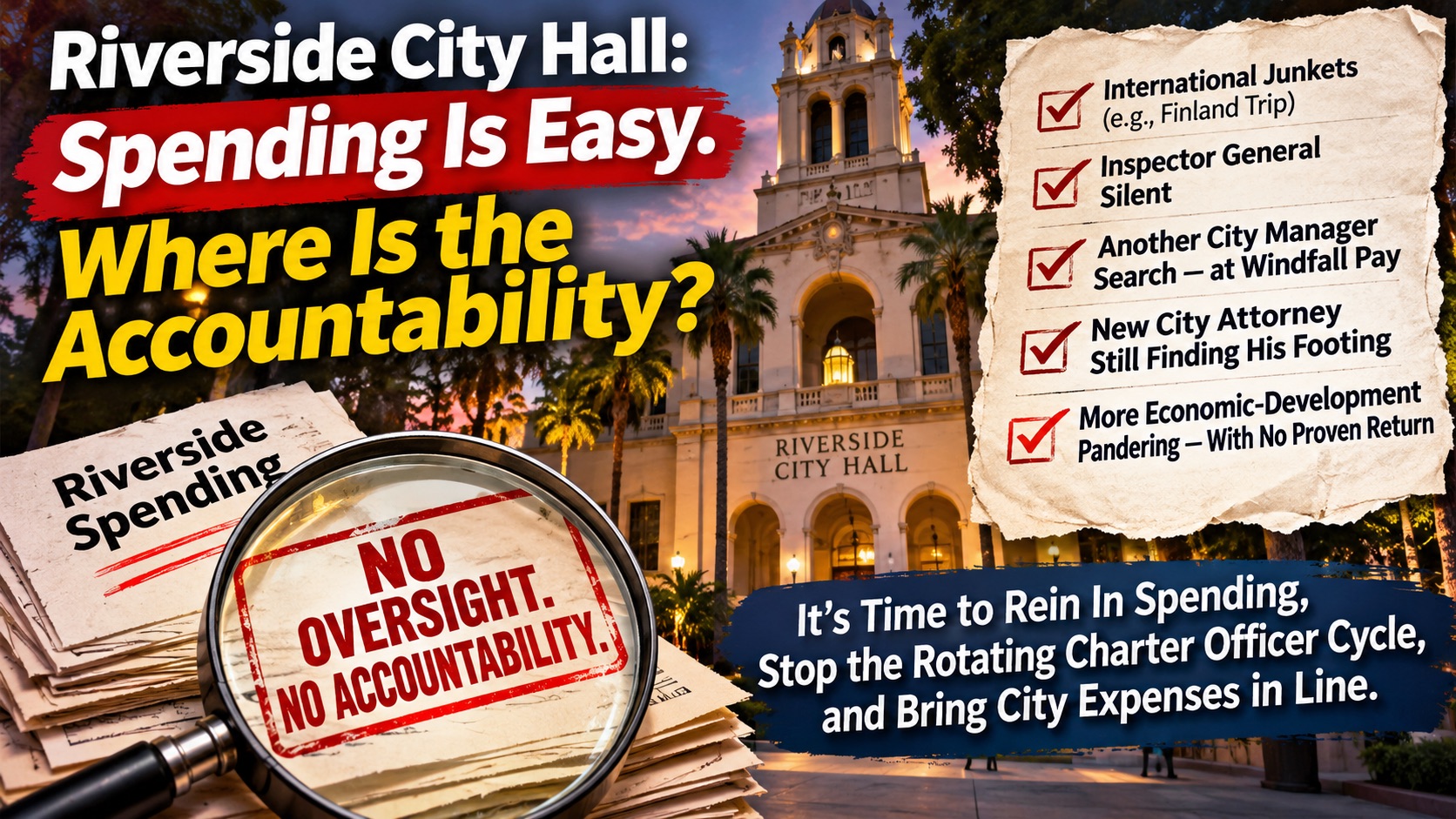
    By Keith J. Nelson, Ph.D. | October 23, 2026


    Riverside does not need another career City Manager. Riverside needs a proven business leader—and a Mayor and City Council capable of holding that leader accountable.

    As Riverside conducts public outreach to recruit its next City Manager, residents should be asking a far more important question than what qualities they want in another highly compensated bureaucrat:

    Why should taxpayers trust the same political leadership and executive hiring system that has repeatedly produced costly departures, lucrative employment contracts, and questionable results?

    For too long, California municipalities have participated in what increasingly resembles a taxpayer-funded executive revolving door. Career City Managers move between cities, negotiate generous compensation packages, and frequently secure severance protections that insulate them from the financial consequences of failed leadership.

    Executive recruiters collect their fees. Departing executives receive their contractual payments. City Councils announce another nationwide search.

    And taxpayers are left holding the bill.

    It is time for Riverside to challenge this system rather than perpetuate it.

    A $405,696 Salary—and a Job Description That Protects the Club

    Consider Riverside’s own 2026 City Manager recruitment announcement.

    The advertised annual salary was $405,696, before considering the full value of employment benefits.

    Even more revealing was the experience requirement: ten years of progressively responsible management or leadership experience in municipal government, including three years in senior management.

    Why?

    Why would Riverside automatically limit its applicant pool to experienced government administrators?

    A successful private-sector CEO, chief operating officer, chief financial officer, or executive managing a billion-dollar enterprise could possess precisely the financial discipline and organizational leadership Riverside desperately needs.

    Yet Riverside’s stated qualifications favor candidates who have spent their careers within the same municipal bureaucracy residents are increasingly questioning.

    Municipal experience has value. But it should not be an exclusive admission ticket to one of the City’s most important leadership positions.

    Are we hiring the most capable executive—or simply selecting the next member of California’s municipal management club?

    Riverside’s Expensive Revolving Door

    This is not a hypothetical concern.

    In 2022, Riverside authorized up to $44,750 for Ralph Andersen & Associates to conduct an executive search following City Manager Al Zelinka’s departure for Huntington Beach.

    The resulting appointment was Mike Futrell, who became Riverside’s City Manager in January 2023.

    In April 2026, Futrell announced he was leaving for Pasadena. He subsequently reversed that decision and remained in Riverside, only to separate from the City weeks later.

    The separation agreement included a lump-sum payment equivalent to nine months of regular salary and retirement contributions, plus one month of health benefits.

    By September, Futrell had been hired as City Manager of Hercules.

    Think about that sequence.

    Riverside pays for executive recruitment, negotiates a substantial employment agreement, experiences another leadership departure, provides a significant severance package, appoints an interim executive, and begins looking for another permanent City Manager.

    Meanwhile, the executive continues his municipal career elsewhere.

    The question is not whether any individual has the legal right to change employers.

    The question is why taxpayers must repeatedly finance the cost and risk of a system that appears better at protecting executive careers than ensuring long-term organizational stability.

    California Has Already Seen Where This Can Lead

    Anyone who believes California’s municipal executive compensation system is immune to abuse should remember Bell.

    Former Bell City Administrator Robert Rizzo became the symbol of one of the most notorious municipal corruption scandals in California history. His salary approached $800,000 annually, while public officials participated in a system of excessive compensation and failed oversight.

    The scandal produced criminal convictions and exposed extraordinary failures in local government accountability.

    Bell was not the only warning.

    In Vernon, the California State Auditor documented serious failures involving executive qualifications, compensation practices, contracting controls, and financial management.

    The audit identified problems in 21 of 25 contracts reviewed and a $28 million General Fund structural deficit in fiscal year 2010–11.

    These were not merely political disagreements over management style. They were documented institutional failures.

    I am not suggesting Riverside officials have committed the crimes uncovered in Bell. I am suggesting that California’s history demonstrates what can happen when executive compensation, political relationships, and weak oversight operate without meaningful accountability.

    The lesson from Bell and Vernon is not simply to avoid dishonest executives. It is to build a system that does not depend on politicians recognizing problems after the damage is done.

    Another Charter Officer, Another Golden Parachute

    Riverside’s City Manager recruitment is not an isolated example of questionable executive compensation policy.

    In June, the City Council approved a City Attorney employment agreement for James Johnson with an annual base salary of $372,624 and a 12-month severance provision for qualifying termination.

    The Council also waived its Sunshine Ordinance notice requirements to consider the appointment.

    I publicly opposed that contract before its approval.

    Why should an individual entering a highly compensated, nominally at-will executive position receive a contractual guarantee potentially worth a year of salary if the hiring decision does not work out?

    These provisions protect executives from the consequences of Council decisions while shifting financial exposure onto taxpayers.

    An at-will designation means relatively little to taxpayers when exercising that authority can trigger hundreds of thousands of dollars in contractual obligations.

    Such contracts deserve meaningful public scrutiny before approval—not hurried consideration accompanied by assurances that the Council knows best.

    Photo Opportunities Are Not Economic Development

    There is another dimension to Riverside’s executive leadership problem.

    Municipal executives work under elected officials who often have political priorities that do not necessarily align with sound financial management.

    A ribbon-cutting ceremony looks good on social media.

    A committee appointment creates political visibility.

    A subsidized economic development project generates press releases.

    But none of these necessarily produces sustainable tax revenue, good-paying jobs, stronger reserves, improved infrastructure, or a measurable return on public investment.

    Riverside needs executives willing to tell the Mayor and City Council no.

    No to speculative projects without defensible financial returns.

    No to expensive political priorities unsupported by sustainable revenue.

    No to organizational growth that taxpayers cannot afford.

    No to compensation increases without measurable performance.

    And no to treating the City’s economic development function as a publicity department for elected officials.

    The Mayor and Council should establish policy. Professional management should provide independent financial analysis, sound operational execution, and candid advice—even when that advice is politically inconvenient.

    The City Manager must serve the institution and its residents, not the political ambitions of those temporarily occupying elected office.

    The Bills Are Coming Due

    While Riverside searches for another highly compensated executive, residents face the realities of municipal financial pressure.

    During the development of its 2026–2028 budget, City staff proposed approximately $17.95 million in cost reductions for fiscal year 2026–27 and $22.27 million for the following year across the General Fund and Measure Z.

    Residents are also dealing with utility rate increases, infrastructure needs, and continuing questions about the financial sustainability of municipal services.

    Not every rate increase or budget reduction can fairly be blamed on a City Manager. Infrastructure costs, inflation, regulatory obligations, and economic conditions are real.

    But that is precisely why experienced financial leadership matters.

    When City Hall faces difficult spending choices, the public deserves a clear accounting of executive compensation, consulting fees, severance obligations, political initiatives, and administrative overhead before essential services become the next targets for reductions.

    Before City Hall asks residents to pay more or accept less, it should demonstrate that its own executive leadership and spending practices meet the same standard of financial discipline.

    We Need a Business Model, Not Another Bureaucratic Recruitment

    The City Manager position is an established part of Riverside’s municipal government. Eliminating the title is not necessary to reform how the City selects and compensates its leadership.

    What Riverside needs is a fundamentally different approach.

    I propose seven reforms:

    1. Open executive recruitment to qualified private-sector leaders. Evaluate proven financial, operational, organizational, and strategic accomplishments—not merely years spent in government.
    2. Require fully transparent compensation. Publish salary, benefits, retirement contributions, leave provisions, allowances, and potential separation costs before approving an employment agreement.
    3. Eliminate excessive golden parachutes. Make executive severance modest, clearly justified, and genuinely protective of taxpayer interests.
    4. Establish measurable performance requirements. Include reserve targets, expenditure management, infrastructure delivery, organizational effectiveness, and economic development returns.
    5. Build internal succession planning. Develop qualified executives within City Hall so every departure does not automatically produce another interim appointment and expensive nationwide search.
    6. Review executive recruiters and consultants. Disclose their fees, recruitment outcomes, guarantees, and any business relationships that could present conflicts of interest.
    7. Hold the Mayor and City Council accountable. Require elected officials to publicly explain the costs and measurable results of their executive hiring decisions.

    The private sector does not have a monopoly on effective management, and government has responsibilities that businesses do not. But financial discipline, succession planning, performance measurement, and executive accountability are universal leadership principles.

    Riverside should embrace them.

    Stop the Revolving Door Before Signing Another Contract

    Riverside residents are being invited to participate in the City Manager recruitment process.

    Good.

    But public participation should extend far beyond identifying desirable personality traits or leadership characteristics.

    Residents should demand answers about previous recruitment costs, severance agreements, executive turnover, compensation practices, performance evaluations, and the financial outcomes achieved under previous administrations.

    The City Council should explain why the municipal-experience requirement is necessary and whether it is willing to consider proven private-sector executives.

    Most importantly, the Mayor and City Council must recognize that they—not executive recruiters, consultants, or departing administrators—are ultimately responsible for these hiring decisions.

    Riverside does not need another executive whose greatest qualification is knowing how to navigate the politics of City Hall.

    We need someone capable of rebuilding financial discipline, protecting taxpayer resources, improving government operations, strengthening infrastructure, and establishing a culture where results matter more than appearances.

    And we need elected officials with the judgment and courage to support that kind of leadership.

    Riverside should lead California in reforming municipal executive recruitment and compensation—not continue financing a revolving door that rewards career mobility while shifting the costs of leadership turnover onto taxpayers.

    Before the next contract is signed, the public deserves more than another expensive promise.

    We deserve accountability. We deserve results. And we deserve leadership that puts Riverside first.

    This is the first installment in a Riverside Accountability Project investigation into charter officer recruitment, executive compensation, severance agreements, financial performance, and government accountability. Future installments will examine Riverside’s previous City Managers, their compensation and separation agreements, executive-search expenditures, and the measurable financial outcomes of their tenures.

    Sources and supporting records

    1. City of Riverside — 2026 City Manager job announcement
    2. Riverside City Council — 2022 executive recruitment agreement, Item 22-2091
    3. City Manager Futrell’s separation and severance — Los Angeles Times
    4. Riverside City Council — June 16, 2026, City Attorney appointment and compensation
    5. California Attorney General — Bell public compensation investigation
    6. California State Auditor — City of Vernon Audit 2011-131
    7. Riverside FY 2026–2028 budget documentation
  • Riverside’s Data Center Debate: When the Answer Is “Ban,” Why Bother With the Research?

    Riverside’s Data Center Debate: When the Answer Is “Ban,” Why Bother With the Research?

    Riverside calls itself the City of Arts & Innovation. Its elected leaders now face a test of whether that slogan reflects an economic strategy—or merely an effective marketing campaign.

    Opinion | Keith J. Nelson, Ph.D.

    Industrial warehouses, freight trains, and solar panels in a mountain valley

    Riverside has discovered a remarkably efficient approach to economic development: identify an industry that might present difficult challenges, discuss prohibiting it before receiving a formal development application, and then commission additional research to determine what the industry actually entails.

    Apparently, the conclusion can come before the investigation.

    That is the concern raised by Riverside’s September 14 Land Use Committee meeting, where Councilmembers Clarissa Cervantes, Philip Falcone and Sean Mill unanimously advanced a proposal for a 90-day urgency moratorium on data centers.

    The committee also directed staff to develop more detailed definitions addressing electricity and water consumption.

    The official minutes establish both actions. They do not establish that the committee has permanently decided the issue. But they raise an important question: Will the moratorium produce an objective evaluation of competing options, or simply provide the procedural foundation for a prohibition already favored by some councilmembers?

    Riverside residents deserve an answer.

    Political Theater Is Not Economic Development

    The timing of Riverside’s debate coincides with growing national political controversy surrounding artificial intelligence and the enormous infrastructure required to support it.

    Councilmember Cervantes also occupies an unusual position in this discussion. She chairs the Land Use Committee while campaigning for California’s 58th Assembly District.

    I have personally observed television campaign advertising in which she expresses opposition to data centers.

    There is nothing inherently improper about campaigning on a public-policy position. Nor does political advocacy automatically create a legal conflict requiring recusal.

    But residents are entitled to examine whether a committee’s deliberations meaningfully consider competing evidence when its chair has already advocated a position on the issue during an election campaign.

    The distinction matters.

    A political campaign is supposed to persuade voters. A land-use committee is supposed to evaluate evidence and develop sound public policy.

    Those responsibilities can coexist, but the public deserves transparency about how decisions are reached.

    At the September meeting, the committee considered an agenda item expressly framed around prohibiting data centers as an allowable land use.

    That framing is revealing.

    Why not begin by asking what standards Riverside should establish for electricity, water, environmental impacts, infrastructure financing, cybersecurity and economic benefits?

    Why begin with prohibition?

    A temporary moratorium can be a legitimate planning instrument. But its legitimacy depends on what government accomplishes during the pause.

    If the result is a serious, independent technical and financial analysis, Riverside may benefit.

    If the result is merely a longer explanation for an outcome already preferred, residents will have gained little.

    Riverside’s Economic-Development Record Deserves Scrutiny

    Before Council decides that private data-center investment presents unacceptable risks, it should examine the risks Riverside has already accepted in its own economic-development initiatives.

    Consider three recent examples.

    Ohmio: Riverside’s original agreement contemplated public expenditures of up to approximately $2.5 million to attract the autonomous-shuttle company and support a pilot program. Initial employment projections identified seven direct jobs.

    Voltu: Council approved approximately $2.39 million for 20 electric trucks, including more than $2.2 million from General Fund Infrastructure Reserves.

    Chaevi: Riverside approved approximately $1.96 million for 45 EV chargers, with reimbursement contemplated through Riverside Public Utilities’ Low Carbon Fuel Standard funds.

    But that does not eliminate the need for accountability.

    What were the original public commitments? What has actually been spent? How many jobs have materialized? What infrastructure costs were incurred? What tax revenue has been realized? How do the results compare with the projections used to justify the expenditures?

    Those are not unreasonable questions.

    Government should not evaluate its own investments by counting press releases, ribbon cuttings and projected jobs. It should evaluate measurable returns.

    And there is a fundamental difference between attracting private capital and using public money to help establish a market for selected private companies.

    The former can expand Riverside’s tax base while placing commercial risk primarily on investors.

    The latter can expose public funds to risks that taxpayers did not voluntarily choose.

    That distinction should be central to Riverside’s economic-development strategy.

    Data Centers Present Risks. That Is Why We Have Government.

    I am not advocating unrestricted data-center development.

    Large facilities can require extraordinary electrical capacity. Some cooling designs consume significant amounts of water. Backup generation can create emissions and noise. Certain projects employ relatively few permanent workers compared with their capital investment and land consumption.

    These are serious considerations.

    They require electrical engineering, utility-rate analysis, environmental review, water-resource planning, land-use expertise and financial modeling.

    They do not automatically require a citywide prohibition.

    The appropriate question is not whether data centers have impacts.

    Every significant industrial development has impacts.

    The appropriate question is whether a particular project can deliver benefits exceeding its costs while satisfying enforceable standards protecting Riverside residents.

    That is the distinction between regulating development and refusing to evaluate it.

    Other Communities Have Already Produced Measurable Results

    Loudoun County, Virginia, provides an instructive example.

    According to the county, data centers occupy approximately 4% of its commercial parcels while generating roughly 38% of General Fund revenue.

    That revenue supports public services and has helped reduce pressure on residential property-tax rates.

    Loudoun has also experienced legitimate problems associated with data-center concentration, including land-use conflicts and infrastructure demands. It has consequently strengthened development restrictions.

    Both sides of that experience matter.

    It demonstrates that data centers can produce substantial fiscal benefits while also creating problems requiring stronger regulation.

    Similarly, Grant County Public Utility District in Washington has expanded transmission infrastructure serving substantial data-center demand.

    Its policies require large power users to bear additional resource and infrastructure costs associated with their growth.

    That does not mean Riverside should copy every engineering or financial decision made in Washington.

    It means Riverside should investigate whether similar cost-allocation principles could protect RPU customers while supporting necessary infrastructure expansion.

    Learn from successful negotiations. Learn from mistakes. Then establish standards appropriate to Riverside.

    That is what research is supposed to accomplish.

    Riverside Owns Something Valuable: Its Electric Utility

    Unlike many cities, Riverside owns its municipal electric utility.

    That creates responsibilities, but it also creates potential negotiating opportunities.

    Riverside already needs additional transmission capacity and greater electrical redundancy.

    The Riverside Transmission Reliability Project is intended to provide a second connection to the regional grid.

    The project has also generated controversy because portions of the transmission system will remain overhead despite objections from neighboring communities seeking additional undergrounding.

    A prospective data-center developer requiring substantial electrical capacity could be asked to finance infrastructure attributable to its project.

    That might include substations, transmission upgrades, generation resources, storage and other facilities.

    Long-term service agreements, minimum-demand commitments and financial guarantees could help protect existing customers against stranded infrastructure costs.

    These arrangements would require detailed engineering, financial and legal review. They could not simply be imposed without regard to utility regulations or the existing RTRP approvals.

    But they are precisely the kinds of alternatives Council should investigate.

    Instead of asking only whether Riverside has enough electricity for a data center, ask whether a prospective developer could help finance additional capacity without shifting its costs to existing ratepayers.

    That is a substantially more productive starting point.

    What Happens Outside Riverside Does Not Stay Outside Riverside

    Riverside’s economic future is shaped by decisions made well beyond its municipal boundaries.

    The expansion of freight infrastructure at the Los Angeles and Long Beach ports illustrates that reality.

    Port and rail investments can generate regional economic activity while also increasing demands on Inland Empire transportation infrastructure.

    Riverside experiences truck traffic, congestion, pavement deterioration and air-quality impacts associated with regional logistics activity regardless of whether every associated investment occurs within city limits.

    Data-center development presents a different but related regional-policy challenge.

    Federal agencies have identified secure domestic computing infrastructure as important to national security.

    The federal government retains military property at March Air Reserve Base, while other former base properties have been transferred for civilian redevelopment.

    Tribal governments and neighboring municipalities may also evaluate data-center opportunities under their respective legal and regulatory frameworks.

    Nevertheless, the broader point remains: Riverside’s municipal land-use policies do not control every potential development location in the surrounding region.

    Regional electrical demand, transmission requirements and economic activity can cross jurisdictional boundaries.

    Tax revenue generally does not.

    A Riverside prohibition could therefore limit local opportunities without eliminating regional infrastructure pressures.

    That possibility deserves examination before Council adopts permanent restrictions.

    Is Riverside’s Alternative Another Generation of Warehouses?

    This is another question missing from much of the discussion.

    What alternative development does Riverside expect to attract to its industrial properties?

    The Inland Empire already bears significant infrastructure and environmental burdens associated with warehousing and logistics.

    Warehouses can generate employment, tax revenue and economic activity. They also create truck traffic, congestion, pavement wear, noise and air pollution.

    Data centers generally use substantially more electricity than conventional warehouses.

    Warehouses generally generate substantially more freight-vehicle activity.

    Neither land use is inherently appropriate for every location.

    A serious economic-development analysis would compare their respective impacts and benefits rather than assume one is acceptable and the other must be prohibited.

    It would also consider advanced manufacturing, research facilities, technology development and other potential uses.

    Riverside should not evaluate data centers against an imaginary alternative that consumes no resources, creates no pollution and requires no infrastructure.

    It should evaluate them against realistic competing uses for the same land.

    The Most Important Protection Is Competent Negotiation

    What would make me comfortable with data-center development in Riverside?

    A transparent process establishing enforceable requirements before any project receives approval.

    Developers should demonstrate adequate electrical capacity and finance the infrastructure costs attributable to their projects.

    RPU should establish appropriate large-load rates and financial guarantees protecting existing customers.

    Water consumption should be quantified, with strict limits appropriate to Riverside’s groundwater resources.

    Noise, emissions, cooling technology, fire protection and cybersecurity should be evaluated against measurable standards.

    Projects should disclose expected tax revenue, permanent employment, construction employment, wages, capital investment and community benefits.

    The City should also require periodic reporting comparing those promises with actual performance.

    And every proposal should undergo an independent analysis of its net public benefits and costs.

    If a developer cannot satisfy those requirements, Riverside should reject the project.

    That is not weakness.

    It is responsible governance.

    But a permanent prohibition adopted without examining whether projects could satisfy such standards would eliminate the opportunity to make that determination.

    A Moratorium Should Produce Answers, Not Just Delay

    The Braver Angels question asks whether Riverside should consider a moratorium.

    My answer depends on its purpose.

    A strictly temporary moratorium that produces credible technical research, transparent public discussion and enforceable development standards can serve a legitimate planning function.

    But a moratorium should not become a substitute for making difficult decisions.

    The Council should establish measurable deliverables and deadlines.

    What electrical capacity is available?

    What additional capacity could be developed?

    What rate structures would protect residential customers?

    What water-use limits are appropriate?

    What infrastructure costs must developers bear?

    What economic benefits would justify the land consumed?

    What development alternatives exist?

    And how would Riverside compare proposals objectively?

    Those questions deserve answers before Council decides whether a permanent prohibition is warranted.

    Riverside Deserves More Than a Slogan

    Riverside proudly calls itself the City of Arts & Innovation.

    That identity should represent more than branding.

    Innovation requires infrastructure. Economic development requires judgment.

    Public investment requires accountability. And responsible regulation requires expertise.

    The City Council does not need to approve a single data center to demonstrate competent governance.

    It needs to show that it can evaluate the technology, understand the economics, protect residents and negotiate effectively.

    If a proposed project cannot benefit Riverside without burdening taxpayers, ratepayers or surrounding neighborhoods, reject it.

    But if private investors can meet demanding standards, finance necessary infrastructure and produce measurable public benefits, residents deserve to know that possibility was seriously considered.

    The Council’s responsibility is not to guarantee that development happens. Nor is it to guarantee that development never happens.

    Its responsibility is to make informed decisions in Riverside’s best interests.

    And if Riverside’s economic strategy ultimately consists of subsidizing selected emerging businesses, refusing to consider privately financed technology infrastructure and continuing to absorb the consequences of regional warehouse and logistics growth, residents may reasonably question what the City’s innovation slogan actually means.

    Perhaps the welcome sign would be more candid:

    RIVERSIDE — CLOSED FOR BUSINESS


    The City of Logistics and Warehouses.

    But before changing the sign, let’s give Riverside’s elected officials an opportunity to demonstrate that they can do something more difficult than prohibit development.

    Research it. Understand it. Regulate it. Negotiate it. And reject it when the facts justify rejection.

    That is the standard Riverside residents should expect from their government.

  • When the Bargaining Table Meets the Ballot Box: Who Does an RUSD Trustee Represent?

    When the Bargaining Table Meets the Ballot Box: Who Does an RUSD Trustee Represent?

    The first in a series examining Riverside Unified, academic performance, taxpayer accountability, organized labor, and the role parents must play in public education.


    There is an important distinction in public government that too often gets ignored:

    Something can be legal and still raise serious questions about good governance.

    That distinction matters enormously when an employee union financially supports, organizes for, endorses, or otherwise helps elect the very public officials who will later sit on the opposite side of the bargaining table.

    That is the issue Riverside parents and taxpayers should be willing to discuss openly.

    The Riverside City Teachers Association exists to represent the employment interests of its members. There is nothing improper about that mission. Collective bargaining is part of California public education, and teachers have every right to organize and advocate for compensation, benefits, working conditions and employment protections.

    But a school-board trustee has an entirely different fiduciary responsibility.

    A trustee does not represent the teachers union.

    A trustee does not represent district administrators.

    A trustee does not represent contractors.

    A trustee does not represent political organizations.

    A trustee represents the public, with responsibility for the education of children and stewardship of public resources.

    And that creates an unavoidable governance question when one of the organizations with substantial financial interests in decisions made by the school board also participates aggressively in determining who sits on that board.

    Campaign Support Is Legal. That Does Not End the Conversation.

    California’s campaign-finance laws permit unions and political committees to participate in elections subject to disclosure and other requirements.

    In fact, California’s Fair Political Practices Commission has specifically explained that campaign contributions generally are not treated as personal income or gifts to an officeholder for conflict-of-interest purposes. California’s special pay-to-play statute also contains important limitations and exceptions, including treatment of labor agreements.

    So this argument should not be distorted into an accusation that a disclosed union endorsement or campaign contribution is inherently illegal.

    It is not.

    But legality is the floor of government ethics, not necessarily the ceiling.

    The larger question is one of institutional independence.

    When an organization helps finance or politically support a candidate and that candidate subsequently participates in decisions affecting the compensation, benefits, job protections and working conditions of that organization’s members, the public has every right to examine the relationship.

    That does not prove corruption.

    It does not prove a quid pro quo.

    It does not establish that any particular vote was purchased.

    But it creates precisely the type of relationship that deserves transparency and public scrutiny.

    The appropriate question is therefore not:

    “Was something illegal?”

    It is:

    “Can taxpayers be confident that every decision was made independently and solely on the merits?”

    Those are very different standards.

    The Board Is Supposed to Be the Public’s Side of the Bargaining Table

    Consider the institutional structure.

    During collective bargaining, the teachers association represents teachers.

    Its negotiators are supposed to pursue the best possible agreement for their members.

    That is their job.

    They may seek increased salaries.

    They may seek improved benefits.

    They may seek smaller class sizes.

    They may seek restrictions on transfers, evaluations, disciplinary procedures or working conditions.

    They may seek additional staffing.

    They may seek limits on management flexibility.

    Some of those proposals may also benefit students.

    Some may have little effect on students.

    Some may require difficult tradeoffs between employee compensation and other educational priorities.
    That is why there are two sides of a bargaining table.

    Someone has to represent the district, taxpayers and long-term interests of students.

    Ultimately, elected trustees approve the agreement.

    That makes independence extraordinarily important.

    A trustee should be able to tell the teachers association:

    “No. The district cannot afford that.”

    Or:

    “Yes. This expenditure will improve our ability to recruit and retain excellent teachers.”

    Or:

    “Show us the educational evidence supporting this proposal.”

    Or:

    “Before approving additional compensation, explain how this affects classroom resources, special education, facilities, reserves and future liabilities.”

    Those decisions should be made on evidence.

    Not political loyalty.

    Not campaign gratitude.

    Not fear of opposition in the next election.

    And not an expectation that an organization that helped elect someone deserves something in return.

    Riverside Has a Real Example Worth Examining

    Dr. Noemi Hernandez Alexander was elected to the Riverside Unified School District Board of Education in November 2022.

    She received 6,066 votes, or 37.23 percent, in a four-candidate Trustee Area 1 election. She is now president of the RUSD Board of Education and is seeking reelection in the November 3, 2026 election.

    Her current campaign materials publicly identify the Riverside teachers association among her endorsements.

    That endorsement is itself legitimate political activity.

    But voters are equally entitled to ask what that relationship means when the Board considers compensation, benefits, staffing rules and collective-bargaining agreements affecting the association’s members.

    The appropriate approach is not to assume wrongdoing.

    It is to demand transparency.

    Campaign contributions should be disclosed.

    Independent expenditures should be disclosed.

    Union-funded communications should be disclosed.

    Endorsements should be disclosed.

    And when the Board votes on matters affecting employee compensation and working conditions, taxpayers should examine the votes and determine whether the decisions can be justified by educational results, labor-market conditions and the district’s finances.

    The Ultimate Measure Must Be Student Performance

    Campaign endorsements are secondary.

    Political affiliations are secondary.

    Personal relationships are secondary.

    The primary question for a Board of Education should be extraordinarily simple:

    Are Riverside students receiving the educational results the community should reasonably expect from the resources being invested?

    Here the numbers deserve attention.

    California’s official 2024-25 CAASPP results show that across Riverside Unified:

    47.33% of students met or exceeded the state standard in English Language Arts.

    That means approximately 52.67% did not.

    In mathematics:

    33.20% met or exceeded the state standard.

    Approximately 66.80% did not.

    Those numbers should concern everyone involved in RUSD governance.

    There is also important context: the district improved from 2024, with the percentage meeting or exceeding standards increasing approximately 1.85 percentage points in English and 1.63 points in mathematics.

    Improvement should be acknowledged.

    But improvement and satisfactory performance are two different questions.

    When roughly two-thirds of tested students are not meeting or exceeding the mathematics standard, Riverside should be having an intense conversation about educational outcomes.

    And that conversation should dominate school-board politics.

    One Trustee Does Not Own Every District Outcome

    Accountability also requires intellectual honesty.

    Hernandez Alexander joined the Board after the November 2022 election. She therefore cannot reasonably be held personally responsible for every problem that predates her tenure, nor can any single trustee control a five-member board or a district serving tens of thousands of students.

    Educational performance is affected by numerous factors: curriculum, instructional quality, student attendance, family circumstances, poverty, English-language acquisition, special-education needs, pandemic learning disruption, district administration, state policy and classroom conditions.

    But incumbency carries responsibility.

    An incumbent asking voters for another term can fairly be asked:

    What improved?

    What did not?

    What policies did you support?

    What did they cost?

    What measurable outcomes resulted?

    What would you change?

    Those are accountability questions, not personal attacks.

    Follow the Money Alongside the Outcomes

    The financial numbers are equally important.

    Federal NCES data for Riverside Unified for fiscal year 2022-23 show approximately:

    • $906.4 million in total revenue
    • $743.2 million in total expenditures
    • $669.7 million in current expenditures
    • $16,986 in current expenditures per pupil
    • $18,852 in total expenditures per pupil

    Instructional expenditures accounted for approximately $10,261 per pupil in that dataset.

    Those figures do not prove that RUSD spends too much or too little.

    They establish something more fundamental:

    Public education is an enormous taxpayer investment.

    With that investment should come measurable accountability.

    The question should never simply be:

    “Did we increase the budget?”

    It should be:

    “What educational result did taxpayers purchase with the additional money?”

    Riverside Has Already Received a Serious Warning About Financial Transparency

    This concern is not theoretical.

    On June 9, 2026, the California State Auditor released its review of RUSD’s proposed Riverside STEM Education Center.

    The auditor did not conclude that RUSD illegally used Measure O money.

    That distinction is important.

    But the auditor found significant governance problems.

    The report concluded that delayed decision-making and inconsistent communication contributed to delays, higher costs and reduced transparency.

    The auditor found that RUSD had inconsistently reported how much Measure O funding had been allocated or committed to the STEM project.

    According to the audit, the district sometimes reported financial commitments without sufficiently clear documentation showing Board authorization.

    The auditor wrote that these inconsistencies limited the ability of both the Board and the community to understand the district’s actual funding plans and made accountability more difficult.

    That matters.

    It means Riverside’s debate about fiscal accountability is not based simply on political rhetoric.

    California’s independent state auditor identified legitimate transparency deficiencies and recommended that RUSD standardize its budgeting, accounting and reporting procedures.

    As of the auditor’s published follow-up page, those recommendations were scheduled for district action by December 2026.

    Again, that does not make one trustee personally responsible for the entire history of the STEM project.

    The project itself predates the current Board composition.

    But an incumbent Board has responsibility for correcting governance failures once they are identified.

    That is a fair standard for every trustee.

    The Larger National Question: More Money Has Not Automatically Produced Proportional Academic Improvement

    There is also a broader issue Riverside should be willing to discuss.

    American public education has become dramatically more expensive over generations.

    NCES historical data show that national current expenditures per enrolled student, adjusted into constant 2022-23 dollars, were about $6,354 in 1970-71.

    By recent decades, inflation-adjusted spending was far higher.

    That means the United States has unquestionably devoted substantially greater real resources per student to public education.

    Academic outcomes, however, have not risen proportionally.

    NAEP’s long-term trend data illustrate why this deserves discussion. Reading performance among younger students improved over portions of the historical period, but long-term progress has been uneven and recent declines have erased some gains. The data do not support a simple story in which steadily increasing expenditures automatically produce steadily increasing achievement.

    That should trouble policymakers.

    But it would also be inaccurate to make the opposite leap and say:

    “Teachers unions caused all of the decline.”

    The research does not establish that.

    What Does Research Actually Say About Teachers Unions?

    This is where public discussion deserves more sophistication than campaign slogans from either side.

    Teachers unions can affect education policy through collective bargaining, elections, lobbying and political organization.

    Economic research indicates that union strength can influence how education dollars are allocated.

    A 2023 study published in the American Economic Journal: Economic Policy, examining California school boards, found that electing an additional educator to a school board increased teacher salaries relative to boards with other types of members; the authors interpreted the results as consistent with bargaining shifting in favor of teachers unions.

    Other research has identified potential adverse effects.

    Michael Lovenheim and Alexander Willén studied state duty-to-bargain laws and reported negative long-term labor-market effects for men exposed to teacher collective bargaining during childhood.

    Research following Wisconsin’s restructuring of public-sector collective bargaining has also found improvements in certain student outcomes associated with reforms that reduced union power and gave districts greater compensation flexibility.

    But there is evidence pointing in another direction as well.

    Research examining school-finance reforms found that districts with stronger unions directed more new state aid into school spending and teacher compensation—and that the additional expenditures were associated with larger gains in student achievement.

    Another multi-state study found that additional operational school spending generated measurable gains in test scores and graduation rates, particularly in lower-spending districts.

    And recent research into teacher strikes found substantial increases in teacher compensation and modest reductions in pupil-teacher ratios following strikes, with little evidence of large achievement effects from the average strike, although longer strikes were associated with short-term mathematics losses.

    So the serious conclusion is not:

    “Unions are responsible for every educational problem.”


    Nor is it:

    “More spending always produces better schools.”

    The evidence supports something more useful:

    Incentives matter. Governance matters. How money is allocated matters. Teacher quality matters. Accountability matters.

    And political influence over the people deciding those questions deserves scrutiny.

    Teachers and Teachers Unions Are Not the Same Thing

    This distinction is crucial.

    Criticism of union political activity should never become criticism of teachers as individuals.

    Riverside has thousands of educators who spend their careers teaching children, helping struggling students, managing difficult classrooms, communicating with parents and performing work that is essential to the community.

    Many teachers undoubtedly share parents’ concerns about bureaucracy, academic standards and district priorities.

    The political organization representing employees is a different institution.

    A union has a duty to represent its membership.

    A school board has a duty to govern the district.

    Those interests frequently overlap.

    But they are not identical.

    An excellent teacher deserves competitive compensation.

    Students deserve excellent teachers.

    Taxpayers benefit when RUSD can recruit and retain them.

    But taxpayers also deserve a district capable of differentiating between expenditures that demonstrably improve student outcomes and expenditures that merely increase institutional costs.

    That distinction becomes harder—not easier—when the organization bargaining for those expenditures is also heavily involved in choosing the people who approve them.

    Imagine This Structure Anywhere Else in Government

    Consider the governance principle outside education.

    Suppose a corporation allowed a vendor negotiating a multimillion-dollar contract to finance the campaigns for members of the corporation’s procurement committee.

    Would the contract automatically be corrupt?

    No.

    Would the board want extensive disclosure and independent review?

    Absolutely.

    Suppose a city contractor spent heavily electing councilmembers who subsequently determined the contractor’s compensation.

    Would every subsequent contract be illegal?

    No.

    Would taxpayers appropriately scrutinize the relationship?

    Of course.

    School districts should not receive a lower standard merely because the interested organization represents public employees.

    The Question Is Independence

    Every RUSD trustee—regardless of endorsements, ideology or political affiliation—should be able to demonstrate independence.

    When the teachers association presents a reasonable proposal benefiting educators and students, trustees should be willing to approve it.

    When it presents a proposal that is financially unsustainable or unsupported by educational evidence, trustees should be equally willing to reject it.

    And the same principle should apply to administrators, contractors, consultants, developers and every other organized interest seeking something from the district.

    The Board should owe no political debt when it enters the boardroom.

    That is ultimately what independent governance means.

    Riverside Parents Need Better Metrics

    One way to move this conversation beyond ideology is to establish measurable expectations.

    Before approving major new expenditures or multiyear commitments, parents and taxpayers should be able to see:

    Academic performance

    • Grade-level reading proficiency
    • Mathematics proficiency
    • Learning growth
    • Achievement gaps
    • English-learner progress

    Student readiness

    • Graduation rates
    • College readiness
    • Career-technical completion
    • Dual-enrollment participation
    • Chronic absenteeism

    Financial performance

    • Spending per pupil
    • Classroom versus administrative expenditures
    • Employee compensation growth
    • Pension and benefit obligations
    • Reserve levels
    • Capital-project performance

    Governance

    • Campaign contributions
    • Independent expenditures
    • organizational endorsements
    • Board voting records
    • Collective-bargaining agreements
    • Contract costs
    • Audit findings and corrective actions

    Then residents can examine relationships rather than speculate about them.

    Results Should Matter More Than Political Alliances

    This is the fundamental issue.

    Riverside’s public-school system does not exist to preserve any political institution.

    It does not exist for a union.

    It does not exist for administrators.

    It does not exist for consultants.

    It does not exist for elected trustees.

    All of those institutions and individuals exist because Riverside has children who need to be educated.

    That priority has to remain unmistakable.

    When only 47.33 percent of RUSD students tested are meeting or exceeding the state English standard and only 33.20 percent are meeting or exceeding the mathematics standard, the community has every justification for demanding a serious discussion about performance.

    When a California State Auditor identifies weaknesses in transparency and financial reporting, the community has every justification for demanding corrective action.

    And when organizations with direct financial interests before a school board become involved in electing members of that board, voters have every justification for examining the relationship.

    None of that requires conspiracy theories.

    It requires records.

    This Series Will Follow the Records

    This article is the first in a series examining Riverside Unified School District through measurable evidence rather than campaign messaging.

    Future installments will examine:

    RUSD academic performance over time.

    District expenditures and spending per student.

    Administrative versus classroom spending.

    Compensation and collective-bargaining agreements.

    Campaign contributions and independent expenditures.

    Board voting records.

    RUSD’s Measure O expenditures and the State Auditor’s findings.

    Enrollment trends.

    Academic achievement gaps.

    School-by-school performance.

    Parent participation and public access to Board decision-making.

    And the measurable results produced by major district initiatives.

    The purpose should not be to vilify teachers or any other group.

    It should be to restore something basic to the center of public education:

    Students first. Evidence first. Accountability always.

    Parents do not need to become professional political activists.

    But they should know what their school district is doing.

    They should read the performance data.

    They should follow the money.

    They should attend Board meetings.

    They should examine campaign-finance disclosures.

    They should read collective-bargaining agreements.

    They should question major expenditures.

    They should demand understandable metrics.

    And they should require every elected trustee to explain how major decisions advance student education and protect public resources.

    Organized interests will always participate in politics.

    That is their right.

    The counterweight in a representative system is an informed public.

    For Riverside’s parents, the most consequential question is not which organization has the strongest political operation.

    It is whether Riverside’s children are receiving the education that nearly a billion-dollar public institution should be capable of delivering.

    That is the standard against which every policy, every expenditure, every labor agreement and every trustee’s record deserves to be examined.

  • Riverside’s Global Relationships Need a Balance Sheet — Not Another Photo Album

    Riverside’s Global Relationships Need a Balance Sheet — Not Another Photo Album

    Mayor Patricia Lock Dawson recently published an opinion piece in the Raincross Gazette titled “Riverside’s Global Ties Make Us Stronger at Home.”

    Let’s start with an important distinction.


    This is an opinion column written by the Mayor, not an independent analysis of Riverside’s international programs or their return to taxpayers. It is part of the Mayor’s ongoing “From the Mayor’s Desk” advocacy. (The Raincross Gazette)

    There is nothing inherently wrong with Riverside having international relationships. There is nothing wrong with Sister Cities. There is nothing wrong with traveling internationally when a legitimate public purpose can be demonstrated.

    But elected officials should not confuse relationships, ceremonies, photographs, memorandums of understanding and press releases with measurable economic results.

    And Riverside taxpayers should not be expected to do so either.

    The appropriate question is remarkably simple:

    What did Riverside taxpayers spend, and what measurable benefit did Riverside taxpayers receive?

    The Mayor’s opinion piece does not answer that question.

    Instead, it gives us stories of visiting firefighters, foreign dignitaries, Sister City anniversaries, international relationships, charitable giving and economic-development announcements.

    Some of those activities may absolutely have value.

    But anecdotes are not performance measures.

    Photographs are not return on investment.

    And press releases are not audited economic results.


    Riverside Was Warned About This Exact Problem Years Ago

    This issue isn’t new.

    In 2017, Riverside commissioned an independent Performance Assessment and Financial Review of the Mayor’s Office by Matrix Consulting Group.

    The consultant examined the Sister Cities program specifically.

    What did it find?

    The benefits of the program were broadly described but not comprehensively quantified. There was no formal annual report adequately describing and quantifying its accomplishments. The consultant recommended measurable objectives, annual reporting, public performance information and the ability to conduct an actual cost-benefit analysis.

    The report’s conclusion deserves particular attention:

    “It is critical that the Sister Cities Program demonstrate its value to the public.”

    That was Riverside’s independent consultant speaking — not a political critic.

    The study calculated the Sister Cities operation at approximately $144,500 annually in 2016-17, including personnel costs, and projected approximately $146,500 the following year. More importantly, it recommended developing measurements that could ultimately determine whether continued taxpayer subsidy was justified.

    That was nearly a decade ago.

    So where are the results?

    Where is the public dashboard showing:

    • Total City spending on international relations;
    • Mayor’s Office personnel dedicated to international relations;
    • staff hours devoted to the program;
    • elected-official travel;
    • staff travel;
    • delegation expenses;
    • private investment actually received;
    • companies actually operating in Riverside;
    • Riverside residents actually employed;
    • payroll generated;
    • sales tax actually received;
    • property tax actually generated;
    • taxpayer incentives provided;
    • City purchases from recruited companies; and
    • net economic return to Riverside taxpayers?

    Those are the numbers necessary to evaluate the program.

    A collection of stories is not.

    A Claimed $586 Return for Every $1 Deserves Serious Scrutiny

    The Mayor makes a particularly dramatic economic claim in her article.

    She says that following Riverside’s Korean business-development activities, every $1 spent on City travel resulted in $586 of investment in Riverside.

    That sounds extraordinary.

    If Riverside has genuinely produced a 58,500-percent return on international travel, the City should be shouting the supporting financial analysis from City Hall.

    Instead, residents should ask:

    Where is the calculation?

    What investment is being counted?

    Is it money actually invested or merely announced?

    Does it include proposed investments contained in non-binding MOUs?

    Were promised future expenditures counted as current investment?

    And what was included in the denominator?

    Only airfare?

    What about:

    • hotels;
    • meals;
    • ground transportation;
    • employee salaries;
    • employee benefits;
    • economic-development staff;
    • administrative preparation;
    • consultants;
    • follow-up activity;
    • subsequent trips;
    • City subsidies;
    • infrastructure commitments; and
    • taxpayer-funded purchases from the companies recruited?

    You cannot calculate municipal return on investment by dividing a company’s announced future investment by the Mayor’s airline ticket.

    If the $586-to-$1 claim is legitimate, publish the spreadsheet.

    Ohmio Is a Perfect Example of Why Residents Need the Whole Story

    Remember Ohmio?

    Riverside announced that the New Zealand autonomous-shuttle company would move its international headquarters to Riverside and manufacture vehicles here.

    It made for excellent headlines.

    But the City’s own announcement disclosed that Riverside initially agreed to spend up to $2.5 million as part of bringing Ohmio to Riverside, including approximately $1.5 million to lease or purchase three Ohmio autonomous shuttles.

    The initial employment commitment?

    Seven jobs, eventually projected to reach at least 25.

    Subsequent participation from the Riverside Transit Agency and South Coast Air Quality Management District reduced Riverside’s projected direct cost to approximately $1 million, but taxpayers remained deeply involved in creating the market for the company Riverside was simultaneously celebrating as an economic-development success.

    That does not automatically make Ohmio a bad project.

    But it should change the way the project is described.

    Residents deserve an update today:

    How many Riverside-produced Ohmio vehicles have actually been manufactured?

    How many employees work at the Riverside operation today?

    How much private capital has actually been invested?

    How much payroll has been generated?

    How much tax revenue has Riverside actually collected?

    And how much public money has actually been spent?

    Those are economic-development metrics.

    Riverside Became Voltu’s First Customer

    Then there is Voltu.

    In June, Riverside issued another enthusiastic press release announcing commercial production of Voltu electric trucks in Riverside.

    But the City’s own announcement contains a remarkably important fact:

    The City of Riverside became Voltu’s first customer.

    Again, there may be sound public-policy reasons for purchasing electric trucks.

    But we should stop pretending these relationships are the same as traditional private-sector business attraction.

    There is a meaningful economic distinction between:

    “A company located in Riverside because private customers created sufficient market demand.”

    and

    “Riverside recruited a company and Riverside government became its first customer.”

    Both might ultimately produce economic benefits.

    But taxpayers deserve to know which one occurred.

    Chaevi Illustrates the Difference Between an Announcement and an Investment

    The Mayor also highlights South Korean EV technology company Chaevi.

    Riverside’s November 2025 announcement discusses a potential $100 million U.S. entry and expansion strategy involving Riverside.

    Impressive headline.

    Read further.

    The agreement is a non-binding Memorandum of Understanding.

    It creates no current financial obligation.

    The parties are still developing funding and investment strategies.

    And the agreement anticipates developing a plan involving Riverside’s purchase and installation of at least 45 Chaevi EV chargers, subject to subsequent Council approval.

    Those distinctions matter.

    A potential $100 million investment is not $100 million deposited into Riverside’s economy.

    A memorandum of understanding is not a manufacturing plant.

    An anticipated headquarters is not a payroll.

    And an agreement under which Riverside may become a customer deserves to be disclosed alongside the economic-development announcement.

    So let’s ask Chaevi the same questions:

    How much private capital has actually been invested in Riverside?

    How many people are presently employed in Riverside?

    How much payroll exists?

    How much tax revenue has been generated?

    And how much does Riverside anticipate purchasing from Chaevi?

    When those numbers become meaningful, celebrate them.

    Until then, distinguish promises from performance.

    Charity Is Admirable — But Charity Is Not Taxpayer ROI

    The Mayor also highlights approximately $600,000 raised by Riverside residents to help Sendai following the devastating 2011 Japanese earthquake and tsunami.

    That says something wonderful about the generosity of Riverside residents.

    But think carefully about the argument.

    Money voluntarily donated by Riverside citizens to residents of Japan cannot simultaneously demonstrate that Riverside taxpayers receive an economic return from funding municipal international-relations activities.

    Those are completely different measurements.

    The same applies to cultural exchanges, firefighter exchanges and educational programs.

    They may be worthwhile.

    Then measure them appropriately.

    How many students participated?

    How many firefighters?

    What did the exchange cost?

    Who paid?

    What training resulted?

    What new operational capability resulted?

    How many Riverside residents directly benefited?

    How much outside funding supported the activity?

    Good government programs should survive measurement.

    And Then There Is the Cost of Travel

    International engagement costs money.

    Riverside’s FY 2024-25 travel and meeting report shows substantial expenditures associated with the Mayor’s official activities. Importantly, not all of those expenses involve international travel, so it would be inaccurate to characterize the entire amount as Sister City spending. But it demonstrates exactly why the complete cost of international activity needs to be separated and publicly reported.

    The appropriate accounting shouldn’t stop with an elected official’s airfare.

    International trips can involve:

    • Mayor;
    • Councilmembers;
    • Mayor’s Office staff;
    • Community & Economic Development staff;
    • administrative personnel;
    • consultants;
    • registration;
    • lodging;
    • meals;
    • ground transportation;
    • gifts and ceremonial expenses;
    • employee compensation while traveling;
    • planning and preparation;
    • follow-up activity; and
    • potentially accompanying guests or spouses.

    That last category deserves careful wording.

    I am not alleging that taxpayers paid spouses’ expenses without the records proving it.

    That is exactly why records matter.

    Rather than speculate, let’s obtain the documentation.

    The Riverside Accountability Project Will Ask for Those Records

    This is exactly the kind of investigation I have proposed for the Riverside Accountability Project.

    Government accountability should not depend upon whether you agree politically with a Mayor or City Council.

    It should depend upon evidence.

    When City Hall makes an extraordinary claim — such as a $586 return for every $1 spent traveling internationally — residents should be able to examine the underlying records and independently determine whether the claim is accurate.

    So I will be submitting a California Public Records Act request seeking the documentation necessary to reconstruct Riverside’s actual international-relations expenditures and measurable results.

    Among the records I intend to request are:

    International Travel

    Records of international travel by the Mayor, Councilmembers and City employees since 2021, including airfare, hotels, meals, registration, ground transportation, reimbursements, City credit-card charges, itineraries and expense reports.

    Delegations and Accompanying Travelers

    Records identifying City officials, employees, consultants, guests, spouses or other individuals participating in official delegations, together with documentation establishing who paid each individual’s expenses and whether any expenses were reimbursed by outside organizations.

    International Relations Staffing

    Compensation, benefits, job descriptions and departmental allocation for employees assigned substantially to international relations, Sister Cities or foreign-direct-investment activities.

    Sister Cities

    Mayor’s Office and City expenditures associated with each Sister City relationship, including staff time, travel, receptions, gifts, visiting delegations, memberships, contracts and direct or indirect support provided to the International Relations Council.

    Foreign Direct Investment

    Records supporting every publicly announced foreign-direct-investment figure since 2021, including the amount originally announced and the amount actually invested.

    Jobs

    Records documenting employment commitments associated with recruited companies and the City’s verification of the number of jobs actually created, retained and presently existing.

    Ohmio

    All City expenditures, contracts, purchases, subsidies, reimbursements and financial projections relating to Ohmio, together with documentation of vehicles manufactured, jobs created, sales generated and tax revenue received.

    Voltu

    All City expenditures, purchases, contracts, incentives or assistance involving Voltu, including Riverside’s purchases as the company’s first customer, along with current employment and private-investment information provided to the City.

    Chaevi

    Documentation supporting the announced $100 million strategy, current capital actually invested in Riverside, employment created, and all contemplated or completed purchases of Chaevi equipment by the City or affiliated public agencies.

    The $586-to-$1 Claim

    Perhaps most importantly, I will request every document, spreadsheet, email, analysis, calculation and supporting record used to substantiate the Mayor’s statement that every $1 of City travel produced $586 in Riverside investment.

    That number should either be extraordinarily easy to substantiate —

    or extraordinarily difficult.

    Let’s find out.

    This Is What the Riverside Accountability Project Is About

    I have proposed the Riverside Accountability Project because Riverside desperately needs something largely absent from today’s civic conversation:

    Institutional memory combined with documented accountability.

    City Hall announcements come quickly.

    Groundbreakings produce photographs.

    MOUs produce headlines.

    Politicians move on to the next event.

    Years later, almost nobody goes back and asks:

    Did it actually happen?

    That is precisely where the Riverside Accountability Project should operate.

    Take the original promise.

    Find the original staff report.

    Identify the taxpayer expenditure.

    Document the projected jobs.

    Document the projected revenue.

    Then return one year, three years and five years later and compare the promise with reality.

    Imagine applying that approach to:

    • economic-development agreements;
    • Sister City programs;
    • foreign-direct-investment announcements;
    • Measure Z;
    • homelessness spending;
    • charter officer hiring and severance agreements;
    • outside consultants;
    • infrastructure commitments;
    • housing-development traffic projections;
    • utility investments;
    • incentive agreements; and
    • major City contracts.

    Not conspiracy.

    Not personalities.

    Not partisan politics.

    Documents. Numbers. Outcomes.

    That is accountability.

    Interestingly, City Hall Apparently Agrees

    There is some encouraging news.

    In 2026, Riverside began considering a formal Foreign Direct Investment Strategy containing requirements for quarterly reporting to the Economic Development Committee and annual reporting to the City Council specifically to provide transparency and accountability.

    Good.

    Let’s build upon it.

    For every significant economic-development initiative, Riverside should publish a simple public scorecard:

    PROMISED

    Private Investment
    Jobs
    Payroll
    Tax Revenue
    Project Completion Date

    PUBLIC INVESTMENT

    City Incentives
    Purchases
    Infrastructure
    Staff Costs
    Travel
    Consultants
    Other Subsidies

    ACTUAL RESULTS

    Capital Invested
    Jobs Existing Today
    Actual Payroll
    Tax Revenue Received
    Public Money Spent

    NET TAXPAYER RETURN

    That single dashboard would do more to establish confidence in Riverside economic development than a hundred press releases.


    Global Relationships May Be Valuable. Prove It.

    I am not arguing that Riverside should retreat from the world.

    Quite the opposite.

    Riverside has extraordinary assets.

    We have universities.

    We have sophisticated businesses.

    We have a strategically important location.

    We have access to international trade through Southern California’s ports and logistics infrastructure.

    We should aggressively recruit legitimate private investment.

    We should build relationships around the world.

    And cultural relationships between ordinary citizens can be tremendously worthwhile.

    But public officials should never ask taxpayers to confuse access with accomplishment.

    An overseas photograph isn’t economic development.

    A signed MOU isn’t investment.

    A promised job isn’t employment.

    A City purchasing products from the company it recruited isn’t necessarily evidence of private-market success.

    And a Sister City relationship isn’t automatically valuable merely because it has existed for decades.

    The Mayor’s opinion column presents the case for these relationships.

    Fair enough.

    Now taxpayers deserve the other half of the story:

    the balance sheet.

    Riverside’s own independent consultant recommended that kind of accountability nearly a decade ago.

    I’m going to ask for it.

    When the CPRA records arrive, the Riverside Accountability Project can do what

    City Hall public relations rarely does:

    Return to the original promises.

    Follow the money.

    Count the jobs.

    Measure the results.

    And let Riverside residents decide whether their investment produced a meaningful public return.

    That’s not anti-Sister City.

    That’s not anti-economic development.

    That’s not anti-Riverside.

    That’s what accountable government looks like.