Academic Performance, Financial Oversight, Political Influence, and the Future of Riverside’s Schools
By Keith J. Nelson, Ph.D.
On November 3, Riverside Unified School District voters will decide who represents Trustee Area 1 on the Board of Education.
This election comes at a consequential time for our schools.
RUSD faces declining enrollment, a substantial operating deficit, continuing questions about school construction oversight, and academic performance results that deserve far more public attention than they receive.
Yet school board campaigns frequently become contests of political endorsements, campaign financing, professional relationships, and promises about putting students first.
The question voters should be asking is much simpler:
What have our elected trustees actually accomplished for students, and what evidence demonstrates that their decisions are improving educational outcomes?
A school board is not a ceremonial organization. It is the governing body responsible for overseeing educational policy, district finances, executive leadership, and the responsible expenditure of taxpayer resources.
Trustees should be expected to understand the consequences of their decisions, challenge administrative recommendations when necessary, and demand measurable results.
Those responsibilities cannot be delegated to administrators, employee unions, political supporters, or campaign consultants.
A Diploma Is Not the Same as an Education
Riverside Unified has reason to recognize students who successfully graduate from high school.
But graduation statistics alone do not establish whether students have acquired the knowledge and skills necessary to succeed afterward.
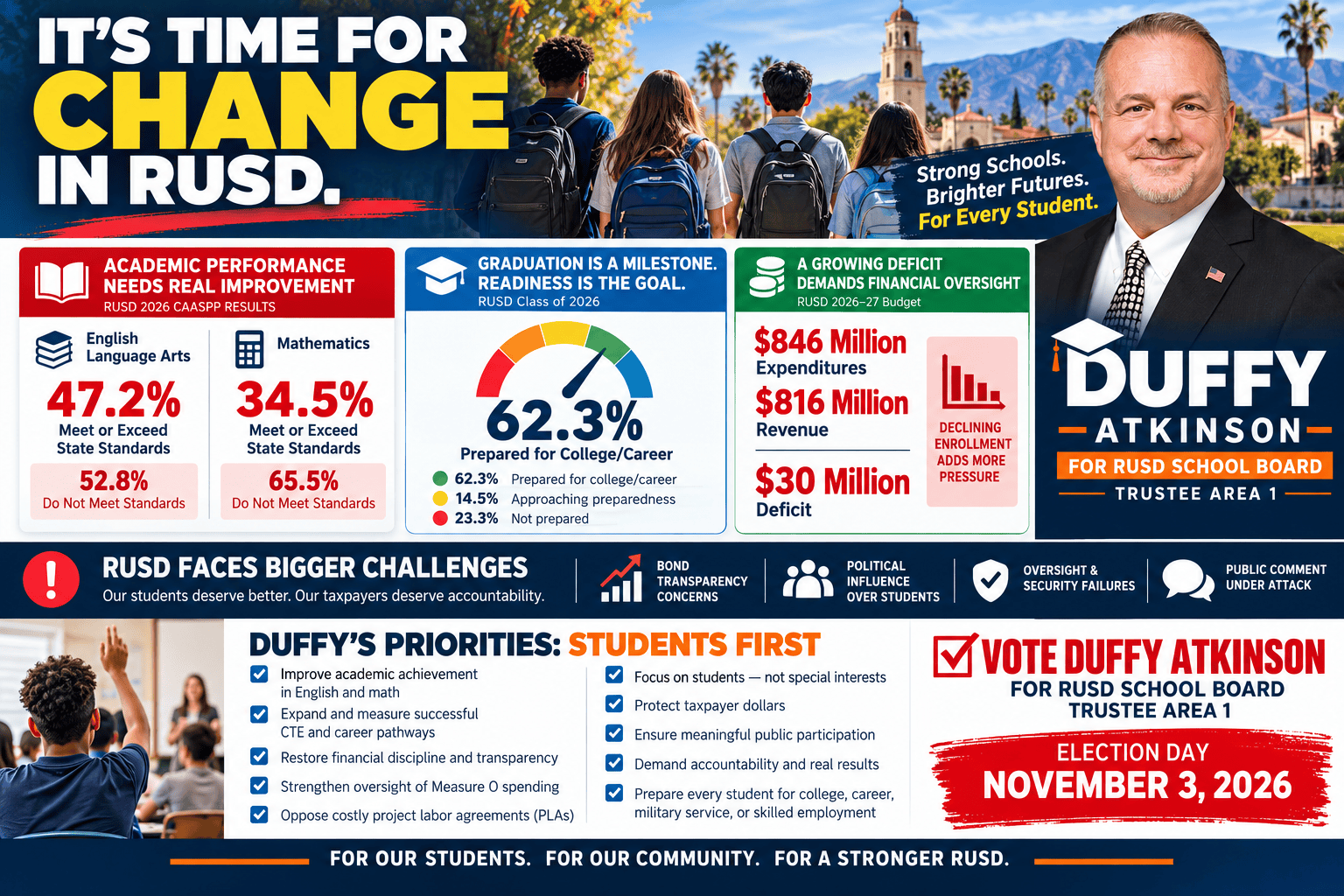
Consider RUSD’s 2026 California Assessment of Student Performance and Progress results.
Only 47.24% of tested students met or exceeded California’s English language arts standards.
In mathematics, that figure was just 34.47%.
Put another way, approximately two-thirds of students tested did not meet the state’s mathematics standard.
These are not abstract statistics. They represent real students whose future opportunities depend on the quality of their education.
Meanwhile, the district’s reported College/Career Indicator identifies 62.3% of the Class of 2026 as prepared for college or career.
These measures evaluate different populations and outcomes, but they raise a common governance question.
How does the Board of Education determine whether the district’s academic programs are working, and what changes does it require when they are not?
Students need more than reassuring presentations and graduation ceremonies.
They need proficiency in fundamental academic subjects, access to meaningful career pathways, and preparation for the opportunities and challenges that follow high school.
Career Technical Education can play an important role. But offering a pathway is not the same as demonstrating its effectiveness.
Families should have access to understandable information about enrollment, pathway completion, industry credentials, and postsecondary outcomes.
A board that approves educational programs should also establish how their success will be measured.
An $846 Million Budget Demands Serious Financial Oversight
RUSD’s adopted 2026–27 budget includes approximately $846 million in expenditures against $816 million in revenue.
That is a $30 million difference.
Declining enrollment adds further pressure because school funding is closely connected to student attendance and enrollment.
These conditions require difficult decisions about priorities, staffing, facilities, and the preservation of educational programs.
The public deserves to understand where district resources are going and what those expenditures accomplish.
Financial oversight requires more than approving a budget presented by district staff.
It requires trustees who can evaluate financial assumptions, identify long-term liabilities, question expenditures, and understand how today’s decisions affect tomorrow’s classrooms.
Before reducing programs that directly serve students, trustees should be prepared to demonstrate that administrative costs, discretionary spending, facilities commitments, and other expenditures have received meaningful scrutiny.
The district’s financial condition makes these questions increasingly urgent.
Measure O: What Were Taxpayers Promised?
I served multiple terms on Riverside Unified’s Citizens’ Bond Oversight Committee, including as chairman.
That experience gave me firsthand exposure to the challenges of overseeing major school construction programs.
During my service, I repeatedly raised concerns about project priorities, construction costs, financial controls, and the consequences that changes in spending could have for schools awaiting improvements.
I believe those warnings and the district’s responses deserve public examination.
The distinction between legally authorized expenditures and effective financial stewardship is fundamental.
A recent state audit, as reported by the Raincross Gazette, found that Measure O funds were used appropriately but identified deficiencies in transparency.
That is an important finding.
Taxpayers deserve to know not merely whether expenditures were permitted, but whether projects were completed within reasonable budgets, whether priorities changed, and whether the district adequately explained those decisions.
The questions are straightforward.
What projects were originally identified for funding?
How much was allocated to each?
How did those allocations change?
Which projects experienced substantial cost increases?
What improvements were postponed, reduced, or eliminated?
And how effectively did trustees communicate those changes to the public?
These questions become even more important when a district considers asking taxpayers to authorize additional borrowing.
Public confidence must be earned through transparent decisions and documented performance.
Labor Agreements and the Responsibility to Exercise Independent Judgment
Organized labor plays a significant role in public education.
Teachers, classified employees, and construction workers have legitimate interests in compensation, working conditions, and employment protections.
Those interests deserve consideration.
But the Board of Education has a broader responsibility.
Trustees must balance employee interests with student outcomes, fiscal sustainability, legal obligations, and the interests of taxpayers.
Campaign endorsements and contributions are lawful forms of political participation. They do not, by themselves, demonstrate improper influence.
Nevertheless, voters are entitled to examine the relationship between campaign support and subsequent policy decisions.
That includes decisions involving collective bargaining agreements, construction labor requirements, and the allocation of limited district resources.
Project labor agreements deserve particular scrutiny because they can affect contractor participation, workforce arrangements, and construction costs.
Supporters argue that these agreements can provide labor stability and workforce benefits. Critics question whether they restrict competition or increase costs.
The proper test is evidence.
What did the agreement cost?
What benefits did it deliver?
Were alternatives evaluated?
Did trustees independently examine the financial consequences?
And were those findings made available to taxpayers?
These are questions of public accountability, not hostility toward teachers or working families.
A trustee’s obligation is to exercise independent judgment on behalf of the entire school district.
Public Participation Must Be Meaningful
School board meetings are not private administrative conferences.
They are public proceedings where elected representatives conduct the people’s business.
Parents, employees, students, and taxpayers should have meaningful opportunities to address matters before the board.
Procedures governing public comment should be transparent, consistently applied, and compatible with California’s open-meeting requirements.
Disagreements between trustees and members of the public are inevitable.
But public criticism is not an inconvenience to be managed. It is an essential component of democratic oversight.
When members of the community raise questions about expenditures, educational performance, or administrative decisions, those questions deserve serious consideration.
The public should not have to depend on the preferences of a particular board president to understand when and how it may participate.
Clear, predictable procedures protect both the board and the community.
The Board Must Be Accountable for Oversight Failures
My concerns about RUSD governance extend beyond school construction.
During my oversight service, I raised questions about financial controls and cybersecurity risks.
Those concerns included vulnerabilities that I believed could expose district resources to financial loss.
The district’s handling of those warnings, its subsequent investigations, and its remediation efforts warrant examination through contemporaneous records and independent findings.
Public institutions manage substantial financial resources and sensitive information.
Effective oversight requires appropriate internal controls, independent audits, cybersecurity safeguards, and timely corrective action.
When weaknesses are identified, trustees should demand documented remediation and independently verify that corrective measures are effective.
The public deserves an understandable accounting of material control failures and the steps taken to prevent recurrence.
Political Relationships Cannot Replace Educational Results
School board service can provide valuable experience for people who subsequently pursue other public offices.
There is nothing inherently improper about an elected trustee seeking another position.
But public office must never become an excuse to subordinate institutional responsibilities to personal political objectives.
Voters should examine whether trustees demonstrate independence, maintain appropriate boundaries between public responsibilities and campaign activity, and disclose relationships that could create conflicts of interest.
The same scrutiny should apply to politically connected appointments, public expenditures, travel, and decisions that benefit particular organizations or constituencies.
Allegations of favoritism should be evaluated against documented policies, decisions, and records rather than assumed from political relationships alone.
The central principle remains unchanged.
Public education exists to serve students, not to provide political opportunities for the people entrusted with governing it.
Three Candidates, Three Records to Examine
The November 3 Trustee Area 1 election includes incumbent Noemi Hernandez Alexander, retired superintendent Jinane Annous, and local business owner Duffy Atkinson.
Each brings a different background and perspective.
Hernandez Alexander has emphasized collaboration among trustees and the continuation of district initiatives.
Annous brings extensive experience in public education and school administration.
Atkinson has emphasized financial scrutiny, performance measurement, transparent bond spending, and stronger governance oversight.
In his published candidate interviews, Atkinson has proposed clearer financial reporting, systematic examination of discretionary spending, and more specific safeguards governing future school construction bonds.
These proposals offer voters concrete commitments against which future performance could be evaluated.
The incumbent’s record also deserves examination.
What educational improvements can be documented during the current term?
How has the board responded to declining enrollment and financial pressure?
What changes followed concerns about bond transparency?
How effectively has the board evaluated the results of its educational investments?
These questions should be answered with evidence, not simply assurances.
The Standard Should Be Results
Riverside’s schools belong to the community.
Their purpose is to educate students and prepare them for productive, independent futures.
The Board of Education is responsible for ensuring that district leadership, educational programs, and financial decisions advance that mission.
That responsibility demands more than attendance at ceremonies, participation in committees, or the approval of administrative recommendations.
It demands independent oversight, financial discipline, transparency, and measurable educational improvement.
As voters evaluate the candidates for Trustee Area 1, they should insist on specific answers about academic achievement, student readiness, construction spending, operating deficits, and public accountability.
They should examine the candidates’ published commitments and the incumbent’s documented voting record.
They should question endorsements, scrutinize financial relationships, and evaluate whether proposed solutions address the district’s actual challenges.
And they should expect whoever is elected to report publicly on progress.
A diploma should represent meaningful achievement. A school budget should reflect responsible priorities. And a trustee’s record should demonstrate service to students and the community.
That is the standard Riverside Unified’s families and taxpayers deserve.
The November 3 election provides an opportunity to insist upon it.
