Blog

  • Upcoming RUSD School Board Elections: Making the Right Choice for Our Students

    Signs of indoctrination over education. Vote for Change.

    As the upcoming Riverside Unified School District (RUSD) Board of Education elections approach, it’s crucial for voters to carefully consider the qualifications and affiliations of each candidate. The decisions made by the school board profoundly impact the quality of education, the rights of families, and the moral values imparted to our students.

    Financial Oversight and Accountability

    Recent concerns have been raised about the board’s supervision of RUSD leaders and staff. Reports suggest that the district experienced a significant financial loss due to a spear phishing attack, allegedly amounting to over $800,000. This incident highlights a potential lack of internal protections, cybersecurity protocols, and standard accounting procedures. Effective oversight is essential to safeguard taxpayer money and ensure that resources are allocated appropriately for students’ education.

    Moreover, some community members feel that the board did not adequately address the incident, with claims that it was misrepresented to the public as a “proper invoice.” Transparency and accountability are vital in maintaining public trust, and it’s important that such incidents are handled openly and responsibly.

    Community Engagement and Public Input

    There are also concerns regarding the board’s receptiveness to public input. It’s been noted that the board may not actively welcome community feedback, adhering only to the minimal requirements under the Brown Act. For a school district to thrive, open dialogue between the board, parents, and taxpayers is essential. Community involvement ensures that diverse perspectives are considered, leading to more effective educational policies.

    Appointment Process and Ethical Considerations

    Questions have been raised about the board’s recent appointment to an interim seat. It was initially agreed that the appointee would not run for the seat in the upcoming election. However, allegations suggest that certain board members may have collaborated to appoint a candidate who is now running, potentially giving them an unfair advantage. Ethical transparency in such processes is crucial to uphold the integrity of the board and ensure fair representation for all constituents.

    Response to Union Influence and Educational Outcomes

    Some community members believe that the board has been overly influenced by union demands, particularly regarding school closures during the pandemic. Citing studies from institutions like Harvard University, they argue that extended closures have caused irreversible damage to students without sufficient scientific justification. It’s imperative that decisions impacting students’ education are based on sound evidence and prioritize their well-being.

    Evaluating Candidates for Positive Change

    The district has faced challenges, including declining test scores, concerns about student safety, and disruptions to the educational process. As voters, parents, and concerned citizens, we must critically evaluate each candidate. Consider whether they are endorsed by groups that align with your values and whether they represent a continuation of current policies or a shift toward improvement.

    • If a candidate is heavily endorsed by the teacher’s union or shares endorsements with those who have overseen educational decline, consider what that means for future policies.
    • Incumbent candidates may represent the status quo. Reflect on whether this aligns with your vision for the district’s future.

    A Call to Action

    Let us choose change. Let us vote for education, not excuses. Let us vote for safe schools. Let us vote for fiscal management.

    By supporting independent, student-focused candidates who prioritize transparency, fiscal responsibility, and effective leadership, we can work towards a better educational future for all. The stakes are high, and the future of thousands of students depends on the choices made at the ballot box.

  • California’s Water Crisis: A Policy Failure That Hurts Farmers, Communities, and the Environment

    Due to the continuous droughts and massive fires, water and its management in California are grossly inadequate. Despite its natural beauty and large-scale agriculture, California has been consumed by a bad water policy that caused the state to lose its farmland, broke the normal supply of drinking water, and led to catastrophic wildfires.

    Although wildlife conservation forms the substantial part of the proposition of these policies, the fact is otherwise. It is indeed a crisis that is manmade, arising from the mismanagement and non-maintenance of the core infrastructure of the California Aqueduct and the failure to address the needs of humans and wildlife in a sustainable manner. This blog post discusses how erroneous priorities and dismissive policies have made California’s water troubles all the worse.


    Prioritizing Smelt Over Human Lives and Farms
    For instance, one of the most erroneous examples of the water policy in California is the policy to protect the delta smelt—this is a small species of fish found in the delta of the Sacramento-San Joaquin. Of course, it is important to preserve biodiversity, but some of the actions are too aggressive and result in great unintended consequences.

    Masses of fresh water have been diverted away from human use, most notably from large agricultural areas that depend on it, to maintain certain balances for the smelt. This has resulted in significant cutbacks in supplies to California’s Central Valley farmers, a situation causing them to leave vast tracts of fertile lands lying fallow.

    In other words, this means a reduced agricultural output from California and seriously affected economies at the local level of the farming communities. Thousands of people have lost their jobs, the food prices skyrocketed, and the billions of chips in the state’s economy made through the agricultural business find itself in extremely hot water. Dependency on imported produce has increased, undercutting food security. It is indeed one of the best examples of policy favoring wildlife over human necessity yielding further destructive ripple effects.


    The State of California Aqueduct System Decays
    The California Aqueduct is a critical piece of state water conveyance infrastructure designed to transfer water from California’s wetter north to its drier south. However, years of deferred maintenance and lack of investment in repair have left this key piece of infrastructure far from reliable. It has serious leaks, structural issues, and millions of gallons of water have been lost that could have been used for agriculture, fire prevention, and community drinking needs.

    Despite repeated warnings and studies to the effect that the Aqueduct restoration is an absolute necessity, repair and modernization of the system have been woefully slow. To the detriment of Californians, resources have been misappropriated to the quick fixes or pet projects of politicians. Long-term water needs have been neglected at best. Resultant from the negligence in maintaining the Aqueduct, California has faced a serious incapacity to manage its water.


    Failure to capture water runoff
    A further substantial flaw in the Californian water management plan is that rainwater and runoff are not properly harvested. In California, although it gets periods of rainfall and flash floods when there is the occurrence of storms during the rainy winter, it lets billions of gallons of water run off to the Pacific Ocean. The lost water can be properly harvested, stored, and utilized when there is a drought, but the infrastructure for this is either lacking or is not enough in different parts of the state.

    That is a problem: rather than investing in enlarging reservoirs or developing state-of-the-art water capture systems, California has allowed much of this to escape, all while struggling with chronic shortages during dry years. Had the state invested in full runoff capture decades ago, much of what is happening now would have been avoided. Its failure to do so is emblematic of a deeper pattern of mismanagement that has left the state vulnerable to drought and fire.


    Bad Water Policy with Mexico and the California Dam
    The water policy failure in California is not only an internal crisis but also has leaked internationally. Water policy failure in this respect is along the US-Mexico border, regarding water-sharing agreements over the Colorado River and water flow through California Dam. It is noted that the agreement on water-sharing among Arizona, Nevada, California, Mexico, and others has not been doing its best since it did not take into account population growth and the need of both countries for more water for agriculture.

    In California, it is believed that the state, in the name of international diplomacy, has had a give away of too much water to Mexico, and as a result, it has left the Californian farmers and the communities in misery out of water shortage. It is also arguable the operations of the dam have been properly managed especially with increased drought conditions across southwestern U.S.

    Without renegotiating these agreements and ensuring that California’s needs are fairly implemented, the state will remain beleaguered by these chronic shortages.


    Consequences: Fires, Loss of Arable Land, and Water Shortages
    But in human terms, these bad policies with regard to water result in a state of crisis. From California’s lack of an ability to capture water runoff, its prioritization of endangered species, such as the delta smelt, above people and farms, to its dereliction of critical infrastructure—such as that of the California Aqueduct—California has set itself up for a perfect storm of drought, wildfire, and water scarcity. These policies have removed farmlands, adding to the pressure that hinders the state’s food production system. Many farmers have quit their fields, causing even lower crop production levels, leading to unemployment and recession in the countryside. The wildfires have devoured vast stretches of the state, creating cities of ash and spreading toxic emissions into the atmosphere.

    The cost to humans from these misdirected policies is beyond measure. California citizens, particularly in the countryside, no longer have reliable access to any source of clean drinking water. Fire seasons have longer and more intense effects, burning houses, displacing families, and increasingly undermining public safety. Yet, with all these desperate consequences, policymakers at the state and federal levels have never taken the appropriate and serious action to correct such policy failures.


    A Way Forward
    The solution to California’s water ills will be striking a new balance between the demands of nature and people. It is these investments that will now include fixing and modernizing the California Aqueduct system, expanded infrastructure for water capture, and a rethinking of water-sharing with Mexico that will place California on a path to a secure and sustainable water future. Furthermore, policymakers should understand that although the preservation of the species is important, it should not be at the expense of people’s livelihoods and agricultural productivity.

    California can solve its water problems, but not without abandoning failed policies of the past and moving toward a more balanced, proactive approach to water management. These are problems that can be addressed by getting at the root causes of California’s water crisis: mismanagement, neglect of infrastructure, and flawed policies. It is within reach that with the proper kind of leadership and investment, the state can take the weight of many of these environmental and economic concerns now pressing on it. Yet without a change in priorities, California’s droughts, fires, and water shortages will likely persist, continuing to impact millions of lives.

  • Helping Candidates on Social Media

    Increasingly, given the importance of social media in today’s world, the activities of liking, commenting and sharing posts can have real effects on policy issues, political campaigns, raising awareness and leveraging support. In this blog, I will explain how to become an activist by supporting your chosen political candidate on popular social media platforms such as socialmedia X, Twitter X and Instagram, and provide you with the best tags so that your posts can go viral!

    Liking, commenting and sharing may seem inconsequential when it comes to politics, but they are essential to making sure a political campaign message gets heard. Liking a post makes it visible to others, increases reach, and sends a signal to share. Commenting allows for two-way interaction and conversation, which can make the next round of posts more meaningful, and the candidate more human. Sharing ensures a message is spread to an even larger audience and, importantly, multiplied. Taken together, these actions create a community that can provide critical momentum for a political contender.

    Here are the social media specific guidelines for political advocacy.

    Based on a platform, here are simple guidelines for supporting a political candidate on Facebook, Twitter X and Instagram:

    Twitter X:

    Like: Tap the heart icon to like a tweet.
    Comment (Reply): Click the comment icon to write a reply tweet.
    Retweet: Tap the retweet icon to send the tweet to your followers, then decide among various options: ‘Retweet’, ‘Retweet with comment’ to add your thought.
    Tags to Use: #VoteFor[CandidateName], #Election202, #Support[CandidateName], #Retweet, #PoliticalAdvocacy, #MakeADifference

    Facebook:

    Like: Click the thumb icon below a post to show your support.
    Comment: Write good comments or questions to answer the post and involve yourself with other users.
    Share: After clicking on ‘Share’, a pop-up window will appear to decide if you want to share it on your timeline or add it to a specific group.
    Tags to Use: #VoteFor[CandidateName], #Support[CandidateName], #PoliticalCampaign, #Election2024, #Vote

    Instagram:

    Like: Double tap on post or click the heart icon to like it.
    Comment: Tap the comment icon to write your comment and join in conversations with other users.
    Share: Tap on the paper plane icon to share it on your Stories or send it via Direct Message to your friends.
    Tags to Use: #VoteFor[CandidateName], #Election2024, #Support[CandidateName], #MakeADifference, #YourVoteMatters

    You can also leverage the power of social media to change politics. By liking, commenting on, and sharing a candidate’s messages, you can expand the audience for the candidate’s message and mobilise others to support him or her. Use the information in the tags (and in the text above) to maximise the contribution you make on social media, and shape politics. The future of politics really is shaped by your social media activity.

  • The Importance of Open Debate and Free Speech in Our Conservative Movement

    With the ballots starting to drop and elections coming around, let’s come together as conservatives and do some meaningful work electing leaders who will fight for our values. Pride of place in any functioning democracy and at the heart of conservatism is open debate and the protection of free speech.

    But we tend to often retreat to censoring those opinions and ideas that make us uncomfortable or make us question our thinking. Now more than ever, we need to have those tough conversations and hold weak conservative leadership accountable in our endeavor to actually reflect values we profess to uphold.

    Free Speech is a Conservative Core Value

    At its core, conservatism is about individual freedom, free speech, and that includes even the freedom of disagreeable opinions. Unfortunately, in our own conservative circles, there is an increasing trend to shut down speakers that might cause discomfort or controversy. That is a dangerous road, very similar to those very tactics we criticize from the left.

    More harmful than that is the fact that by stifling debate and censoring viewpoints, we weaken our own position and drive off those who might otherwise be on our side.

    The conservative movement is about ideas-challenging the status quo, debating what is best for our nation, and making sure principles of leaders are put into practice. Shutting down debate erodes not only our moral authority but creates an environment where poor leadership can exist unchecked. If we are going to be successful at saving the nation and California, we must foster open debate and hold our so-called “conservative” leadership accountable when they stray from the path.

    Poor Leadership-The Accountability that Must be There

    But perhaps our biggest problem is that of weak leadership within our own ranks. Too many of our party “leaders” and organizations, which purport to represent conservative values, have shown fear in confronting the issues that are tearing apart not only our nation but our state. Failing to address voter integrity, appeasing liberal policies on infrastructure, or caving on critical school-board issues, too many of these leaders are quite literally just not doing the work required to stand up for conservative principles.

    This is why conservatives must be the loudest and most critical when it comes to accountability of those who say they represent us without actually doing so through their voting or legislative actions. We can’t afford to have so-called conservative leadership continuing to pander to liberal interests while the opposition gets mobilized, active, and dominates the conversation on social media and on the ground.

    By avoiding the debate or failing to critique our leadership, we become accomplices to that which we say we are against. The opposition is mobilizing, attending events, and making their voices heard, while too many of our conservative leaders aren’t showing up, leaving voters and communities unrepresented.

    RUSD and the Silencing of Conservative Voices

    A glaring example of this lack of engagement can be seen in how we as conservatives allowed the Riverside Unified School District (RUSD) to choose a new trustee without any significant response from parents or the community. This is a failure that directly impacts students, parent rights, the integrity of science-based education, and the very future of our schools.

    How did it happen? Because we weren’t there. We didn’t show up. We didn’t speak up. Our silence ceded the room to others, and the decision was made without a real conservative voice in the conversation. We let the defining moment slip away, and now we are standing by watching as decisions are made detrimental to the values we hold dear.

    Using Social Media for Change

    If we’re going to turn the tide of direction of our local and state governments, it’s going to take more than just showing up at the polls. We must engage on every front, including social media. The opposition knows how to use these platforms to mobilize their base and promote their candidates, and it’s time we do the same.

    We all can play a role in this effort. Liking, sharing, commenting, and tagging posts of conservative candidates widen their circle and build momentum. Little it may seem, but in these times, it is an important way to show support, create awareness, and dent the efforts of the opposition.

    Social media is no longer just an outlet, it’s a battlefield of ideas, and it’s time we get into the game. Because each comment, share, and like has the potential to reach hundreds, if not thousands, of people. If we are actually going to see these conservative candidates be successful, it is going to take all of us putting forth the effort to spread the word and stop allowing the left to dominate the narrative.

    The Road Ahead

    We are truly at a crossroads, and the decisions we make today will set in course the trajectory of not only our state but also our nation for decades to come. Let us not be afraid to have the tough conversations, challenge weak leadership, and hold ourselves and our leaders accountable to those conservative principles that make America strong.

    It is time to act-not just at the ballot box, but in every arena where ideas are shared and debated. And as I continue to write on the decisions of the RUSD school board, the Riverside City Council, the Board of Supervisors, along with State and Federal Office Holders, and Legislation-let us do the work. For change can happen, but it takes our commitment to being the voice for the conservative movement and the future that will shape our communities.

    We need to devise a strategy that is not limited to meetings and discussions, but one that would emerge in terms of action and results. We are fighting against an opponent that is well organized and established, using the offices for political leverage.

  • Instead of Politics and Chanting – We need to address mass shootings.

    If you are simply chanting a single “solution” you are not for solving the problem but simply taking unscrupulous advantage of catastrophe for your own agenda.

    1. Parental Responsibility: Parents play a crucial role in monitoring their children’s behavior, but it is a complex issue when it comes to prosecution for the actions of their children. However, cases where parents knowingly ignore serious red flags, especially when those signs are tied to violent intentions, could be grounds for stronger legal scrutiny. The challenge is distinguishing between normal behavior and genuine danger while acknowledging the difficulties of modern parenting. This does not end at 18 years of age. Hold parents responsible.

    2. Law Enforcement and School Systems: There have been cases where law enforcement and school officials were aware of warning signs yet failed to act decisively. Improving protocols to ensure that potential threats are taken seriously and that proper intervention measures are followed could make a substantial difference in preventing tragedies. Enhancing the training for school personnel and law enforcement to identify and respond to mental health issues or violent tendencies is another avenue for change. Hold those being paid to protect accountable for the failure to act.

    3. Focus on Solutions, Not Division: The political hijacking of mass shooting incidents often overshadows practical solutions. Much of the debate is polarized around the Second Amendment instead of focusing on accountability and preventative measures. Encouraging discourse that seeks collaborative solutions rather than political division could help create more effective policies. This is a simple component of “community organizing” and never letting a crisis go to waste. It is NOT about saving lives.

    4. Educational Systems: The role of schools in maintaining student safety and supporting student development through engagement is critical. If the focus shifts too far away from ensuring a safe environment for all students, it could result in a failure to intervene in situations where students exhibit dangerous or concerning behaviors. The schools over the past decade have moved from education to indoctoctination. They are causing much of the divide by trying to force an agenda vs education and emplowerment.

    My viewpoint advocates for a multi-layered approach to preventing mass shootings by emphasizing accountability, mental health intervention, and community responsibility, rather than exclusively focusing on gun control or political narratives. Starting with accountablility. These mass shooting rarely happen without warning.

  • The Consequences of Power: A Critical Examination of the Democratic Party’s Actions

    Over the decades, the mantra “Elections have consequences” has echoed through the halls of American politics, a phrase popularized by former President Barack Obama. This statement is not just a reminder of the impact of voting but has been a call to action for fundamental changes. However, beneath this rallying cry lies a series of actions by the Democratic Party that have sparked significant controversy and debate.

    Weaponization of the IRS

    One of the most contentious issues during Obama’s tenure was the alleged weaponization of the IRS against political opponents. Critics argue that the IRS was used to target conservative groups, stifling their ability to operate and influence elections. This move was seen by many as an attempt to undermine the democratic process and silence dissenting voices.

    Fundamental Changes: A Double-Edged Sword

    The call for “fundamental change” has often been interpreted as a dog whistle for more radical shifts that could potentially undermine the very fabric of our Democratic Republic. The Democratic Party has faced accusations of opposing citizens’ rights to vote in primaries, effectively setting up an oligarchy that selects the party nomination. This centralization of power within the party is seen as antithetical to the democratic principles that allow for open and fair competition.

    Election Security and Open Borders

    The issue of election security has been another point of contention. The Democratic Party has been criticized for opposing measures that would secure our elections, such as voter ID laws and stricter voting regulations. Additionally, their open border policy and changes to the census count, allowing non-citizens to be counted, have been seen as attempts to skew representation in Congress and the Electoral College. This, critics argue, gives undue power to non-citizens, many of whom are in the country illegally, thereby diluting the representation of legal American voters.

    Campaigning from the Basement and Lack of Work Ethic

    President Joe Biden’s approach to his campaign and his subsequent behavior in office have further fueled these concerns. During his campaign, Biden was frequently criticized for conducting much of his campaigning from his basement, avoiding public scrutiny and minimizing direct engagement with voters. This pattern continued into his presidency, with excessive vacations and a perceived lack of work ethic becoming points of contention. Biden’s failure to provide regular press conferences and limited access to the press have raised questions about accountability and transparency. Additionally, the involvement of his wife, Jill Biden, and his son, Hunter Biden, in official meetings has been criticized as inappropriate and indicative of a lack of professional boundaries.

    Weaponization of the Justice Department and Courts

    Under Biden’s administration, there have been accusations of the Justice Department and courts being weaponized against political opponents. This alleged misuse of power to target and undermine opposition has been seen as a significant threat to the integrity of the democratic process. The partisan use of legal mechanisms to settle political scores undermines public trust in these critical institutions and erodes the foundations of justice and fairness.

    Stifling Debate and Ignoring Constitutional Responsibilities

    In the pursuit of power, the Democratic Party has been accused of stifling debate and ignoring their constitutional responsibilities. Their handling of President Joe Biden’s administration is a prime example. Despite clear signs of incompetence and an inability to effectively carry out the duties of the office, the party has been accused of turning a blind eye, prioritizing their political agenda over the nation’s well-being. This, coupled with their alleged collusion with the media to create false narratives and mislead the public, paints a troubling picture.

    The Liberal Elite and the Erosion of Democracy

    The influence of the liberal wealthy elite within the Democratic Party has raised concerns about the erosion of democratic principles. These elites are seen as attempting to steal power from legal American voters, celebrating the forced withdrawal of Joe Biden from the election while ignoring their complicity in his rise to power. The false narratives propagated by the media have furthered this agenda, creating an environment where truth and accountability are sacrificed for political gain.

    A Call for Accountability

    The actions of those who have committed what many see as the actual coup and insurrection – the theft of power from legal American voters – demand accountability. Those who lied about Joe Biden, covered for his inadequacies, and attempted to impose him upon the nation despite the risks, should resign in shame and be tried for treason.

    Conclusion

    The Democratic Party’s journey over the past few decades has been marked by significant controversy and actions that many believe threaten the very core of our Democratic Republic. From the weaponization of government agencies to the manipulation of election processes and the stifling of debate, these actions have led to a growing call for accountability and a return to the principles that truly uphold our democracy. As the nation moves forward, it is imperative that all political actors are held to the highest standards of integrity and responsibility, ensuring that the power truly remains with the people.

  • The Hypocrisy of Mark Takano’s Call for Joe Biden to Drop Out

    In a stunning twist of political theater, Mark Takano and several other prominent Democrats are now calling for President Joe Biden to drop out of the race for the White House. This sudden shift is not only bewildering but reeks of hypocrisy, especially considering the lengths to which these very individuals have gone to secure and defend Biden’s presidency over the past four years. The audacity of such demands underscores a deeper issue within the Democratic Party and raises serious questions about their commitment to the principles they profess to uphold.

    The Democratic Charade

    For over four years, the Democratic establishment, along with their media allies, have leveraged every tool at their disposal to support and protect Joe Biden. From controlling narratives in the media to deploying political machinations behind the scenes, they have worked tirelessly to paint a picture of Biden as the best and only choice for America. Now, these same voices are turning against him, suggesting that he should step aside. This about-face is not just hypocritical; it is an insult to the intelligence of the American people who were sold a very different story during the last election cycle.

    A Call for Resignations: The Height of Hypocrisy

    If Takano and his fellow Democrats genuinely believe that Biden is unfit to continue his candidacy, then their calls should not stop at him alone. Vice President Kamala Harris, the Cabinet, and all Democrats in Congress and the Senate who have supported this administration should also step down. After all, they have been complicit in the very actions and policies they now seemingly disavow. To single out Biden while ignoring the broader complicity of the Democratic establishment is to engage in a cynical power play designed to maintain their own positions of influence.

    The Power Play

    It is clear that the calls for Biden to step down are not born out of a genuine concern for the nation’s well-being but rather out of a desire to reposition power within the Democratic Party. By scapegoating Biden, these politicians are attempting to distance themselves from any potential fallout and realign themselves with what they perceive as the prevailing winds of public opinion. This maneuvering is a transparent attempt to retain their own power while sacrificing Biden as a political pawn.

    Media’s Role in the Manipulation

    The media’s role in this spectacle cannot be understated. For years, they have acted as the Democratic Party’s mouthpiece, shaping and disseminating the narratives that have kept Biden in a positive light. Now, as some factions within the party turn against him, the media is all too willing to amplify these calls for his resignation. This shift further demonstrates the media’s complicity in the political gamesmanship at play, prioritizing sensationalism and partisanship over truth and accountability.

    Conclusion

    The calls for President Joe Biden to drop out of the race are not just misguided but emblematic of a deeper hypocrisy within the Democratic Party. If those calling for his resignation truly believe in accountability and integrity, they must also call for the resignation of Vice President Harris, the Cabinet, and all Democratic members of Congress and the Senate who have supported this administration. Anything less is simply pandering to preserve their own power, further eroding the public’s trust in our political system. The American people deserve better than to be manipulated by those who claim to serve them.

  • The Fraud of “Independent Committees in Riverside

    We are seeing the faux formation of so-called “independent committees” by local Riverside Office Holders (Politicians) and this has become a topic of significant debate. While these committees are ostensibly designed to provide unbiased oversight and guidance, the reality often falls far short of this ideal. One of the core reasons is the inherent conflict of interest that arises when politicians appoint campaign committee members, surrogates, and insiders to these supposedly independent bodies.

    True independence in a committee is crucial for ensuring that all voices are heard and that decisions are made in the best interest of the community as a whole. However, when the selection process is controlled by the very individuals whose actions and policies are under scrutiny, the outcome is predictably skewed. Politicians naturally tend to select individuals who share their perspectives, support their agendas, and can be relied upon to maintain the status quo. This practice undermines the fundamental purpose of an independent committee and perpetuates a cycle of partiality and exclusion.

    A truly independent committee would be selected without the prejudices of the office holder or their staff. Instead, it would be constituted by a diverse range of community groups, opposition members, and representatives from all political views—not just the major parties. Such a committee would also reflect a broad spectrum of demographics, income groups, and lived experiences.

    Unfortunately, current practices often exclude the most underrepresented groups in our society, such as the disabled, neurodiverse individuals, the homeless, aged-out foster youth, and the poor. These groups are frequently overlooked in favor of more politically advantageous demographics. This deliberate and self-serving methodology fails to provide true inclusion and perpetuates systemic inequities.

    For an independent committee to be genuinely effective and representative, it must include:

    1. Community Group Representation: Voices from grassroots organizations and local advocacy groups should be integral to the committee. These groups have a direct understanding of community needs and challenges.
    2. Opposition Members: Including members from opposing political parties ensures a balance of perspectives and prevents one-sided decision-making.
    3. Diverse Demographics: Representation should extend beyond the typical demographic categories to include a wide range of ages, ethnicities, and socio-economic backgrounds.
    4. Underrepresented Groups: Deliberate efforts must be made to include individuals from marginalized communities, including those with disabilities, neurodiverse individuals, the homeless, aged-out foster youth, and the economically disadvantaged. Their unique perspectives are essential for holistic and inclusive policymaking.

    Creating such a committee is not merely a matter of fairness; it is a necessity for building trust and ensuring that all community members have a voice in the decisions that affect their lives. Without this level of inclusivity and impartiality, the committees fail to serve their intended purpose, and the most vulnerable continue to be marginalized.

    In conclusion, the establishment of truly independent committees is hindered by the inherent biases and self-interest of those in power. For these committees to achieve their full potential, the selection process must be reformed to prioritize genuine independence and broad-based representation. Only then can we hope to create a political landscape that truly serves all members of our society. To create these committees for social media photo ops and future campaigning in my opinion is a material misrepresentation that borders on fraud. Office holders with a true commitment to those they purport to serve (their employers) will welcome and encourage decent and focus on the community over self.

  • City of Riverside Budget Shortfall Resolution.

    It is imperative that we address the critical need to cut wasteful spending and optimize our budget for the betterment of our community. To achieve this, I propose the following actions:

    1. Evaluate Salaries and Travel Expenditures: Conduct a comprehensive review of all salaries and travel expenses. Reducing unnecessary travel and aligning salaries with our region’s cost of living will provide immediate savings.
    2. Eliminate Non-Essential Expenditures: Assess each expenditure for its direct value to the quality of life in Riverside. This includes cutting city-funded social media campaigns that do not contribute to tangible community benefits.
    3. Reassess Homeless and Vagrant Initiatives: We need a thorough evaluation of the costs associated with initiatives like the “build it and they will come” approach to homelessness. Ensure these programs are effective and fiscally responsible.
    4. Reform Pensions and Employment Costs: The current pension and employment costs are unsustainable. We must consider outsourcing certain services, such as technology, to reduce fully burdened employment costs while improving service quality and cybersecurity.
    5. Outsource Services: To better serve taxpayers and citizens, we should outsource as many services as possible, including technology and sanitation services. This approach will help us deliver higher quality services while reducing costs. The current costs of city-staffed services are far too high and need to be reduced. Our goal should be to serve the public efficiently, rather than operating as an employment agency for unions.
    6. Consider Impacts of Federal Changes: Anticipate the impact of pending federal classification changes under the Biden administration, which could affect the profitability of local dispensaries and reduce tax revenue.
    7. Focus on Waste Reduction: The city’s current approach lacks a focus on eliminating waste, which is estimated at about 40% in government agencies. Instead of increasing taxes, we need to identify and eliminate inefficiencies.
    8. Address Overhead Transmission Lines: The presence of overhead transmission lines negatively impacts our local economy and reinforces Riverside as a warehouse district rather than a serious technology hub. According to the California Public Utilities Commission (CPUC), undergrounding electric lines can beautify our city, increase property values, reduce urban blight, and enhance electric reliability and safety. Many cities, such as Irvine and Santa Ana, have successfully buried overhead lines without succumbing to high-density, low-income housing developments.

    We should demand that the governor and the state fund the mandate for Governor Newsom’s housing plan or rescind the commitment. Our focus should be on developing Riverside into a modern business and technology hub, not a low-income warehouse district.

  • What Is Microsoft Security Copilot? Should You Use It?

    What Is Microsoft Security Copilot? Should You Use It?

    It can be challenging to keep up with the ever-evolving cyber threat landscape. Companies need to process large amounts of data. As well as respond to incidents quickly and effectively. Managing an organization’s security posture is complex.

    That’s where Microsoft Security Copilot comes in. Microsoft Security Copilot is a generative AI-powered security solution. It provides tailored insights that empower your team to defend your network. It works with other Microsoft security products. It also integrates with natural language to generate tailored guidance and insights.

    In this article, we will explain what Microsoft Security Copilot is. We’ll explore its benefits and whether it’s the right choice to enhance your digital defenses.

    What Is Microsoft Security Copilot?

    Microsoft Security Copilot is a cutting-edge cybersecurity tool. It leverages the power of AI and machine learning for threat detection and response. Copilot aims to enhance the efficiency and effectiveness of cybersecurity operations.

    Microsoft Security Copilot helps security teams:

    • Respond to cyber threats
    • Process signals
    • Assess risk exposure at machine speed

    It works with other Microsoft security products as well. A big benefit is that it integrates with natural language. This means you can ask questions plainly to generate tailored guidance and insights.

    Security Copilot can help with end-to-end scenarios such as:

    • Incident response
    • Threat hunting
    • Intelligence gathering
    • Posture management
    • Executive summaries on security investigations

    How Does Microsoft Security Copilot Work?

    You can access Microsoft Security Copilot capabilities through a standalone experience. As well as embedded experiences available in other Microsoft security products.

    Copilot integrates with several tools, including:

    • Microsoft Sentinel
    • Microsoft Defender XDR
    • Microsoft Intune
    • Microsoft Defender Threat Intelligence
    • Microsoft Entra
    • Microsoft Purview
    • Microsoft Defender External Attack Surface Management
    • Microsoft Defender for Cloud

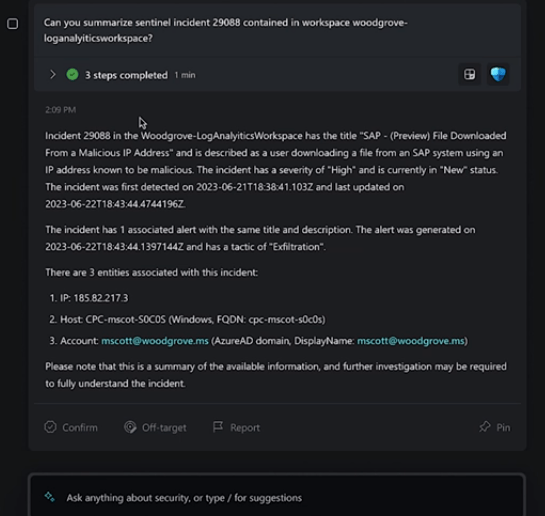
    You can use natural language prompts with Security Copilot. This makes it easy to ask for information or guidance on various security topics.

    For example, you can ask:

    • What are the best practices for securing Azure workloads?
    • What is the impact of CVE-2024-23905 on my organization?
    • Generate a report on the latest attack campaign.
    • How do I remediate an incident involving TrickBot malware?
    Security Copilot
    Image source: Microsoft

    Should You Use Microsoft Security Copilot?

    The Pros:

    1. Advanced Threat Detection
      Microsoft Security Copilot employs advanced algorithms. These detect and analyze threats that may go unnoticed by traditional security measures. It has the ability to adapt to new threats in real time. This enhances the security posture for organizations.
    1. Operational Efficiency
      Copilot automates threat analysis. This allows security teams to focus on strategic decision-making. It also reduces the time and effort spent on manual data analysis. The tool streamlines workflows, enabling quicker responses to potential threats.
    1. Integration with Microsoft Products
      Microsoft Security Copilot seamlessly integrates with several Microsoft products. This creates a comprehensive cybersecurity ecosystem. The synergy between these tools enhances threat visibility as well as response capabilities.
    1. Continuous Learning
      The AI and machine learning components of Copilot continuously learn from new data. This improves their ability to identify and mitigate emerging threats over time. This adaptive learning approach ensures that the tool evolves. Which is important to do alongside the ever-changing threat landscape.
    1. Reduced False Positives
      Copilot’s advanced algorithms contribute to a more accurate threat detection process. This minimizes false positives that can overwhelm security teams. The result is a more focused and efficient response to genuine threats.

    The Considerations:

    1. Integration Challenges
      Microsoft Security Copilot seamlessly integrates with Microsoft and other security products. But organizations using a diverse range of cybersecurity tools may face integration challenges. Consider the compatibility of Copilot with your existing cybersecurity infrastructure.
    1. Resource Requirements
      The deployment of advanced AI and machine learning technologies may demand extra resources. Companies should check if their existing infrastructure supports the requirements of the tool.
    1. Training and Familiarization
      Successfully leveraging the benefits of Copilot requires training. As well as familiarization with the tool’s functionalities. Ensure that your security team is adequately trained. This will maximize the potential of this cybersecurity solution.

    The Bottom Line

    Microsoft Security Copilot represents a leap forward in the realm of AI-driven cybersecurity. It has an advanced capacity for real-time threat detection and operational efficiency. As well as extensive integration capabilities. These factors make it a compelling choice. Especially for businesses seeking to fortify their
    digital defenses.

    Your unique business needs should guide the decision to adopt Microsoft Security Copilot. Consider factors such as existing cybersecurity infrastructure and resource availability. As well as the commitment to ongoing training.

    Get Expert Microsoft Product Support Here!

    Microsoft is a vast ecosystem of interconnected business tools. Security Copilot is one of the newest to help you secure your online landscape. If you need some help leveraging these tools for your company, let us know. We are experienced Microsoft service providers. Our team can help you make the most of these tools.

    Contact us today to schedule a consultation.

    —
    Featured Image Credit

    This Article has been Republished with Permission from The Technology Press.