Tag: community

  • Another Charter Officer. Another Secret Process. Another Expensive Contract. When Will Riverside Learn?

    UPDATE: ITEM MOVED TO THE DISCUSSION CALENDAR

    Update — July 28, 2026: After the agenda was published and concerns were raised regarding the placement of this consequential Charter Officer appointment on the Consent Calendar, Item 38 was moved to the Discussion Calendar.

    That is the proper procedural correction. Hiring an Interim City Manager at a proposed rate of $195.05 per hour is not routine City business and should never be approved without separate discussion.

    Moving the item, however, does not answer the underlying questions. Riverside residents still deserve to know why the City is replacing its existing interim leadership, why a retired official is necessary, how the proposed rate and employment terms were established, and what protections the agreement provides taxpayers.

    Public scrutiny appears to have produced more transparent consideration of this item. That is precisely why residents must remain engaged—and why major Charter Officer appointments should be scheduled for public discussion from the beginning, rather than corrected only after concerns are raised.

    “The definition of insanity is repeating the same mistakes while expecting different results.”
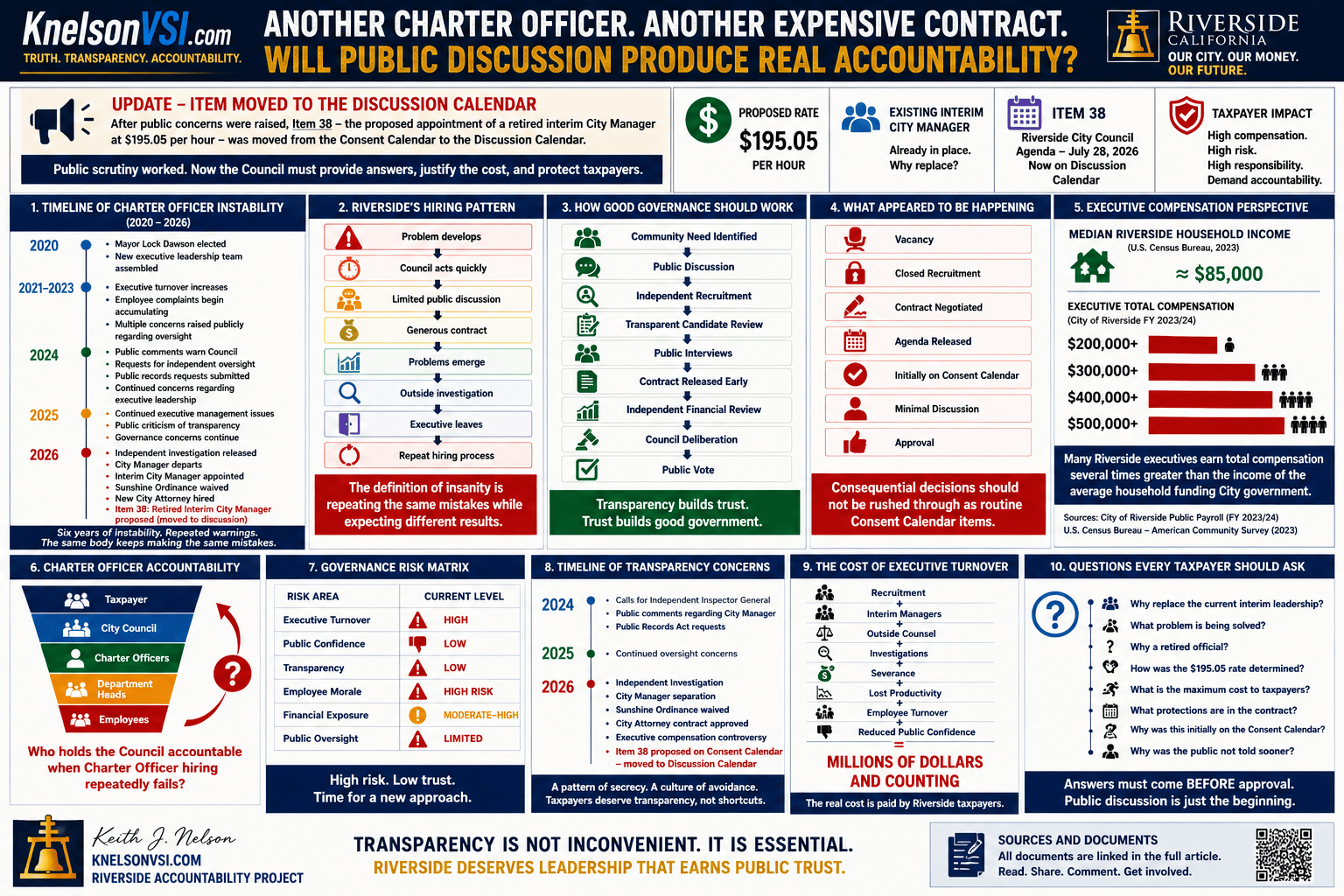
    Just weeks after the Riverside City Council approved a highly lucrative employment agreement for its new City Attorney through a process that offered the public little meaningful opportunity to evaluate the agreement, the Council is preparing to make another consequential Charter Officer decision.

    This time, the Council is considering the appointment of a retired official to serve as Interim City Manager beginning July 31, 2026, at an hourly rate of $195.05—despite the fact that Riverside already has interim leadership in place. The appointment appears as Item 38 on the July 28 Council agenda.  

    The item was initially presented on the Consent Calendar, where matters deemed routine can be approved collectively without separate Council deliberation unless pulled for discussion.

    Following public concern, Item 38 was moved to the Discussion Calendar.

    That change is appropriate and should be acknowledged.

    But it also raises an important question:

    Why was the appointment of Riverside’s most powerful administrative officer ever treated as a routine consent matter in the first place?

    Moving the item creates an opportunity for public discussion. It does not resolve the substantive concerns surrounding the appointment, compensation, necessity, recruitment process, or taxpayer protections.

    Why is this being buried on the Consent Calendar?

    Why Was This Initially Treated as Routine?

    The Council’s decision to move the appointment to the Discussion Calendar is a positive and necessary correction.

    The public should recognize the change—but should not ignore how the item was originally presented.

    Consent calendars are intended to streamline routine administrative business. They allow numerous matters to be approved together in one motion, often without separate presentations, questions, or debate.

    The appointment of an Interim City Manager is not routine.

    The City Manager:

    • oversees City departments and employees;
    • implements Council policy;
    • prepares and administers the municipal budget;
    • directs major contracts and projects;
    • influences workplace culture and executive accountability;
    • manages hundreds of millions of dollars in public resources.

    An appointment carrying that much authority and a proposed hourly rate of $195.05 should have been placed on the Discussion Calendar from the beginning.

    The fact that it was ultimately moved demonstrates the value of public scrutiny.

    It also demonstrates why Riverside needs consistent transparency standards rather than corrections made only after residents object.

    Riverside Has Not Earned Blind Trust


    Discussion Is an Improvement—But Trust Still Must Be Earned

    Moving the item to public discussion is better than allowing it to pass as part of a single consent motion.

    That does not mean residents should now simply accept the recommendation.

    Trust is not restored merely by changing an agenda heading.

    It is restored through complete disclosure, direct answers, careful deliberation, and employment agreements that protect the taxpayer.

    This Council recently approved a new City Attorney contract following a process criticized for inadequate public involvement, unusually favorable contractual protections, and a substantial compensation increase.

    Now it must demonstrate that it has learned from that experience.

    The Council should publicly explain:

    • why the current interim arrangement is ending;
    • why a retired official is the preferred replacement;
    • whether other qualified internal or external candidates were considered;
    • how the $195.05 hourly rate was calculated;
    • the maximum number of compensated hours;
    • the projected total cost;
    • the duration of the appointment;
    • termination rights and taxpayer protections;
    • whether the appointment affects the permanent recruitment process.

    Without those answers, a Discussion Calendar designation becomes procedural transparency without substantive accountability.

    Trust is earned through transparency.

    Unfortunately, the City Council has spent years demonstrating exactly the opposite.

    This is the same Council that recently:

    • approved a lucrative employment agreement for a new City Attorney;
    • waived procedural safeguards that were intended to increase public transparency;
    • offered contractual terms that many taxpayers viewed as unusually generous;
    • limited meaningful public discussion before approving the agreement.

    Now the Council appears prepared to repeat that pattern.

    Major decisions involving Charter Officers—the very people responsible for managing hundreds of millions of taxpayer dollars—should never become routine consent calendar items.

    These positions deserve:

    • independent discussion;
    • public questioning;
    • complete disclosure;
    • thoughtful deliberation.

    Instead, Riverside continues moving significant executive employment matters through processes that minimize public scrutiny.

    Didn’t We Already Have an Interim?

    One of the most puzzling aspects of this proposal is that Riverside already has an Interim City Manager.

    If that individual is no longer suitable, taxpayers deserve an explanation.

    If there is an operational emergency, taxpayers deserve an explanation.

    If a retired executive brings unique qualifications, taxpayers deserve an explanation.

    Instead, the agenda simply asks residents to approve another expensive interim appointment.

    Transparency requires more than saying “trust us.”

    Unfortunately, Riverside’s recent history gives taxpayers very little reason to do so.

    Riverside’s Charter Officer Record Speaks for Itself

    The Council’s recent record managing Charter Officers has been deeply troubling.

    Over the past several years, Riverside has experienced:

    • repeated executive turnover;
    • extensive employee complaints;
    • management instability;
    • investigations involving senior leadership;
    • significant legal exposure;
    • declining employee morale;
    • continuing organizational dysfunction.

    The independent investigation concerning the prior City Manager documented extensive concerns regarding workplace management and organizational culture.

    Regardless of where individual blame ultimately lies, one conclusion is difficult to escape:

    The Council’s oversight of executive leadership has failed.

    When the same governing body repeatedly hires executives who later become the subject of controversy, taxpayers have every right to ask whether the hiring process—not just the individual—is fundamentally broken.


    Expensive Contracts Have Become the Norm

    One of the more troubling trends is Riverside’s willingness to negotiate executive compensation packages that bear little resemblance to the financial realities facing the average resident.

    While many Riverside families struggle with:

    • rising utility costs,
    • inflation,
    • increasing housing expenses,
    • higher sales taxes,
    • Measure Z taxes,
    • and escalating city fees,

    Executive compensation continues climbing.

    According to the City’s publicly available compensation records, numerous executive employees receive total compensation well into the hundreds of thousands of dollars annually, with some positions exceeding $300,000, $400,000, and even $500,000 in total compensation when salary and benefits are combined.

    Meanwhile, the median household income in Riverside is roughly in the mid-$80,000 range (based on recent U.S. Census estimates), illustrating a substantial gap between executive compensation and the financial circumstances of the residents who ultimately fund those positions.

    Although public-sector compensation is not directly comparable to private-sector compensation because of differences in pension and benefit structures, critics have argued that Riverside’s executive contracts frequently provide compensation and long-term employment protections that many private-sector executives do not receive.

    The issue isn’t simply salary.

    It is accountability.

    Revised compensation section

    A Rate Requiring Serious Public Examination

    The proposed rate of $195.05 per hour annualizes to approximately $405,704 if multiplied by a conventional 2,080-hour full-time work year.

    That does not mean the retiree will necessarily earn that amount. California retired-annuitant restrictions, the proposed agreement, and the actual number of hours authorized may significantly limit total compensation.

    But that is precisely why the Council must disclose the full calculation publicly.

    Residents deserve to know:

    • the maximum permitted hours;
    • the maximum possible compensation;
    • whether benefits, reimbursements, vehicle allowances, or other payments are included;
    • whether the City compared the rate with similar interim appointments;
    • whether using the current acting executive would cost less;
    • what unique value justifies the additional expense.

    Riverside’s median household income is only a fraction of the compensation routinely provided to its highest-paid executives. Comparing a household’s income with executive compensation is not a perfect labor-market comparison, but it demonstrates the scale of the public obligation and the need for exceptional transparency.

    Taxpayers earning ordinary Riverside incomes are entitled to know why City Hall believes another premium executive arrangement is necessary.

    Taxpayers Deserve Better Contracts

    Every Charter Officer agreement should include strong protections for taxpayers.

    Instead, Riverside repeatedly negotiates contracts that appear heavily weighted toward the employee.

    Questions taxpayers should expect answered include:

    • What measurable performance expectations exist?
    • What happens if objectives are not met?
    • What severance protections exist?
    • What financial risks remain if the relationship fails?
    • How is the public protected from another costly executive turnover?

    These questions should be answered before approval—not years later.

    Consent Calendar Is Not the Place

    Consent calendars serve an important purpose.

    They allow routine administrative items to be approved efficiently.

    Hiring a City Manager—even an interim City Manager—is not routine.

    It affects:

    • every City department;
    • every employee;
    • every taxpayer;
    • every major financial decision made during the coming months.

    This deserves a full public hearing.

    Not a procedural shortcut.

    Leadership Means More Than Photo Opportunities

    Over the past several years, Riverside has devoted enormous energy to announcements, ribbon cuttings, press releases, and social media campaigns.


    Meanwhile, taxpayers continue watching:

    • executive turnover;
    • employee controversies;
    • ethics concerns;
    • repeated governance failures;
    • expensive outside investigations;
    • weakening public confidence.


    Real leadership is not measured by Facebook posts.

    It is measured by sound judgment.

    It is measured by transparency.

    It is measured by fiscal stewardship.


    Most importantly—

    It is measured by whether government earns the public’s trust.

    The Bottom Line


    Moving Item 38 from the Consent Calendar to the Discussion Calendar was the correct decision.

    The Council should receive credit for making—or accepting—that correction.

    But the change is only the beginning of the public process, not the end.

    The Council must now explain:

    1. Why Riverside needs a different interim leader when interim leadership already exists.
    2. Why the proposed appointee’s identity and complete qualifications were not clearly presented when the agenda materials were first released.
    3. How the $195.05 hourly rate was determined.
    4. What the maximum taxpayer cost will be.
    5. What contractual provisions protect Riverside if the appointment does not succeed.
    6. Why the City’s permanent recruitment cannot proceed without another costly interim appointment.
    7. What lessons the Council learned from the investigation, departure, and employment controversies involving the prior City Manager.
    8. What lessons it learned from the recent City Attorney hiring and contract process.

    The public asked for discussion—and discussion is now scheduled.

    The Council must use that opportunity to provide genuine answers, not merely conduct a presentation before approving a predetermined result.

    Transparency is not accomplished by moving an item from one part of the agenda to another.

    Transparency requires the City to explain the need, disclose the cost, defend the contract, consider alternatives, and demonstrate that the agreement protects the people paying for it.


    Suggested Public Comment (3 Minutes)

    Mayor and Council Members:

    I want to begin by acknowledging that Item 38 has been moved from the Consent Calendar to the Discussion Calendar.

    That was the correct decision.

    The appointment of an Interim City Manager at $195.05 per hour is not routine administrative business. It deserves separate discussion, public questions, and a recorded vote.

    But moving the item does not answer the underlying questions.

    Riverside already has interim leadership. The public deserves to know why that arrangement is ending, what operational problem this appointment is intended to solve, and why another retired interim executive is necessary while the City conducts its permanent recruitment.

    The Council should disclose the proposed appointee’s qualifications, the maximum number of compensated hours, the maximum total cost, any additional benefits or reimbursements, and the provisions that protect taxpayers if the appointment does not work.

    This Council’s record on Charter Officer hiring requires caution—not haste.

    We recently watched the Council approve a highly favorable City Attorney employment agreement through a process that provided too little meaningful public review. Before that, residents repeatedly raised concerns about the management and oversight of the prior City Manager. Those concerns were followed by extensive employment controversy, an independent investigation, organizational instability, and the City Manager’s departure.

    The Mayor and Council cannot treat those events as isolated personnel problems. They reflect the Council’s responsibility to select, supervise, evaluate, and hold Charter Officers accountable.

    Riverside residents fund executive compensation packages that far exceed the income of the typical household. With that compensation must come exceptional performance, transparency, and accountability.

    I appreciate that this item will now be discussed publicly. I ask the Council not to treat that discussion as a procedural formality.

    Explain why this appointment is necessary. Explain the complete cost. Explain the alternatives considered. Explain how the contract protects taxpayers. And explain what this Council has learned from its prior Charter Officer hiring and oversight failures.

    Public scrutiny helped move this item to the Discussion Calendar.

    Now the Council must demonstrate that public discussion can actually influence the decision.

    Thank you.

  • Riverside Deserves Accountability, Not Excuses from the Mayor and City Council

    Note: I will be including the City Council video clips with this blog so residents can review the public comments, Mayor Patricia Lock Dawson’s remarks, Councilmember Sean Mill’s response, and the Council debate on the new City Attorney contract for themselves.

    Riverside’s Mayor and City Council appear to have discovered a new governing strategy: blame the past, blame staff, blame prior administrations, blame prior councils, blame anyone except the elected officials currently sitting at the dais with the legal authority, budget authority, appointment authority, and political responsibility to run the City.

    That was the most troubling theme from the Council discussion surrounding Items 7a and 7b: the rushed waiver of the Sunshine Ordinance and the proposed employment agreement for a new City Attorney.

    Mayor Patricia Lock Dawson attempted to shift responsibility to prior administrations for actions and failures that occurred under her watch. Councilmember Sean Mill then compounded the problem by responding to public comment with a claim that sitting members are not responsible for the failed hires and failures of charter officers.

    That is not accountability.

    That is revisionist governance.

    Riverside is a Charter City. The City Council is not a collection of detached spectators who can point at City Hall from across the street and pretend someone else is in charge. The Council is the governing body. The Council hires the charter officers. The Council evaluates the charter officers. The Council approves their contracts. The Council extends its contracts. The Council controls the budget. The Council sets policy.

    And when things go wrong, the Council cannot escape responsibility by pretending only some prior version of the Council made the mess.

    Mayor Lock Dawson cannot Pretend This Happened Somewhere Else, Under Someone Else’s Watch

    Mayor Patricia Lock Dawson’s attempt to shift responsibility to prior administrations is not credible.


    She has not been a bystander. She has been the Mayor of Riverside since December 2020. That means she has held office through years of warnings, years of public comment, years of charter officer controversy, years of transparency concerns, and years of residents asking this Council to take governance seriously.

    This did not suddenly appear on the Council’s doorstep.

    I, along with others, repeatedly alerted the Mayor and the City Council to shortcomings in the City Manager’s office. We warned about the lack of transparency. We warned about the culture of defensiveness. We warned about resistance to public review. We warned about the need for independent oversight. We warned that the City could not continue operating as if public scrutiny was a nuisance rather than a constitutional and civic obligation.

    Those warnings were not made once.

    They were made repeatedly, over the years.

    So when the Mayor now suggests this is the fault of prior administrations, she is asking the public to forget the record. She is asking residents to ignore the fact that these problems continued under her watch. She is asking us to pretend the Council had no authority, no notice, and no ability to act.

    That is false.

    The Mayor had notice. The Council had notice. The public record contains years of residents raising these issues.

    The problem was not a lack of warnings.

    The problem was a lack of will.

    Governance Requires Presence, Discipline, and Oversight

    Riverside needed serious executive oversight from its elected leadership. Instead, too often, the Mayor appeared more focused on image-building, media moments, regional networking, and a social-media-influencer-style of public office than on the hard, unglamorous work of supervising the government she was elected to help lead.

    Photo opportunities are not governance.

    Social media branding is not governance.

    Regional titles and political networking are not governance.

    Governance is reading the contracts. Governance is asking hard questions. Governance is recognizing when a charter officer is creating risk. Governance is protecting the taxpayers before damage is done. Governance is listening when residents, commissioners, former officials, and community members warn that City Hall’s internal culture is drifting away from accountability.

    If employees within the City do not respect leadership, as the Mayor’s comments seemed to imply, then the responsible question is not what is wrong with the employees.

    The responsible question is what leadership has done to lose that respect.

    Respect is not created by a title. It is earned by competence, seriousness, consistency, fairness, and accountability.

    If the Mayor believes City employees lack confidence in City leadership, that is not an excuse for the Mayor and Council.

    It is an indictment of their leadership.

    I Warned This City Years Ago About Its Opposition to Oversight

    This moment is especially frustrating because many of us have been warning Riverside for years about the City’s hostility toward meaningful oversight, integrity systems, ethics reform, and true public review.

    I spent eight years addressing many people on or connected to this dais about the need for independent oversight. During my time working in and around the City’s ethics framework, I repeatedly pointed out that Riverside’s oversight structure was too dependent on the very political system it was supposed to review.

    The issue was never whether Riverside could create another committee, title, office, or ceremonial reform. The issue was whether Riverside was willing to create oversight with actual independence.

    Again and again, City leadership resisted that.

    Now, even in light of the current embarrassing situation involving charter officer leadership, transparency failures, and public distrust, this Council still appears committed to the same old model: an Inspector General concept controlled, shaped, or hand-picked by City Hall insiders rather than a truly independent oversight mechanism with the authority, structure, and insulation necessary to serve the public.

    Riverside does not need an Inspector General selected to dance to City Hall’s music.

    Riverside needs independent oversight that can investigate, report, question, and challenge without fear of political retaliation or internal pressure.

    Anything less is theater.

    A City Council Is a Continuing Governing Body

    Councilmember Sean Mill’s response to public comment was not merely wrong. It was materially misleading to the public.

    The argument seems to be that because not every current member participated in every original hiring decision, the sitting Council is not responsible for the failed hiring, supervision, retention, or contract management of charter officers.

    That is nonsense.

    A City Council is a continuing legislative and governing body. Individual members come and go, but the institution remains. Contracts remain. Policies remain. Budgets remain. Obligations remain. Consequences remain.

    When a new councilmember is sworn in, that member does not inherit the luxury of selective amnesia. He inherits the responsibility to govern. That includes reviewing prior decisions, correcting bad contracts, demanding performance, refusing to rubber-stamp failed leadership, and protecting taxpayers from continued exposure.

    In Riverside, the sitting Council had every opportunity to act.

    The Council had the authority to evaluate the City Manager. The Council had the authority to hold closed-session performance reviews. The Council had the authority to refuse extensions. The Council had the authority to demand corrective action. The Council had the authority to protect the City.

    Instead, this Council reviewed and extended Mike Futrell’s contract after having constructive notice of serious concerns, public complaints, governance failures, and warnings about the City Manager’s office.

    That matters.

    Once the Council reviewed and extended Mike Futrell’s contract after being placed on notice of his failings, the Council owned the decision. It cannot now pretend the issue belongs only to a prior administration or some earlier version of City Hall.

    Constructive notice is not a technicality. It means the warnings were there. The complaints were there. The public record was there. The Council had enough information for a reasonable governing body to investigate, question, correct, or refuse to reward continued failure.

    Instead, they extended the contract.

    Sean Mill’s Statement Shows Why Riverside Needs Independent Oversight

    Councilmember Sean Mill’s response from the dais was one of the clearest examples of why Riverside needs real independent oversight of this governing body.

    Mill tried to tell the public that the sitting Council is not responsible for the failed charter officer decisions now damaging public confidence. That claim is materially misleading.

    This Council did not merely inherit the Mike Futrell problem.

    This Council reviewed him.

    This Council evaluated him.

    This Council had constructive notice of serious concerns.

    This Council still chose to extend his contract.

    For Sean Mill to stand on the dais and suggest that sitting members are not responsible for these failures is functionally dishonest. Whether intentional or reckless, the effect was the same: the public was given a distorted version of how municipal accountability works.

    And perhaps the most revealing part was not only Mill’s statement.

    It was the silence that followed.

    Not one member of the Council corrected him. Not one member clarified that the City Council is a continuing governing body. Not a single member reminded the public that charter officers serve at the Council’s pleasure. Not one member explained that reviewing, retaining, and extending a City Manager after notice of problems creates responsibility.

    That silence speaks loudly.

    It shows why Riverside cannot rely on the same political body to police itself. It shows why controlled, hand-picked, City Hall-approved oversight will never be enough. It shows why Riverside needs real independent oversight with the authority to review charter officers’ decisions, contract extensions, closed-session practices, ethics concerns, public transparency failures, and Council conduct, without depending on the approval of the very officials being reviewed.

    Riverside does not need an Inspector General selected to dance for City Hall.

    Riverside needs an independent watchdog with enough insulation, authority, and public reporting power to tell residents the truth when elected officials will not.

    Sean Mill’s statement, and the Council’s failure to correct it, should be Exhibit A.

    Councilmembers Cannot Vote for the Benefits and Deny the Consequences

    A councilmember cannot vote to extend a contract and then claim he is not responsible for the consequences of that contract.


    A councilmember cannot participate in closed-session evaluations, budget approvals, compensation decisions, and charter officer supervision, and then pretend failed leadership belongs only to some prior group of elected officials.

    A councilmember cannot approve expensive executive agreements while telling residents there is no accountability for the elected officials who approve them.

    That is the core misrepresentation being made to Riverside residents.

    When the Council wants to hire a City Attorney, it claims authority.

    When the Council wants to waive the Sunshine Ordinance, it claims authority.

    When the Council wants to approve salary, benefits, severance, car allowances, retirement contributions, administrative leave, vacation credits, and executive perks, it claims authority.

    But when the public asks who is responsible for the failed judgment that led Riverside into repeated charter-officer controversies, the answer suddenly becomes: not us.

    That is not governance.

    That is a shell game.

    Charter Officers Are Not Independent Kingdoms

    Riverside’s charter officers are not independent kingdoms floating outside democratic accountability.

    The City Manager, City Attorney, and City Clerk serve at the pleasure of the City Council. That means the Council is responsible for selecting them, evaluating them, correcting them, and, when necessary, removing them.

    The City Manager runs the administrative branch, but he does so as the Council’s appointed chief administrative officer. The City Attorney advises the Council and represents the City, but the Council appoints the City Attorney and controls the City’s legal business. The City Clerk performs essential public records and governance functions, and the Council also appoints the Clerk.

    This structure exists for a reason.

    It creates accountability.

    It prevents elected officials from claiming they are powerless when a charter officer fails. It prevents staff from operating without oversight. It prevents the public from being trapped in a shell game where everyone has authority when things go well and nobody has responsibility when things go wrong.

    That is exactly the game Riverside residents are now being asked to accept.

    We are told the Council cannot be blamed for failed charter officers because some original hiring decisions were made earlier. We are told current leaders should not be held responsible for problems that started before them. We are told the City needs urgency when leadership wants to rush a contract, but patience when the public wants accountability.

    That is not governance.

    That is evasion.

    The New City Attorney Contract Shows the Same Failed Pattern

    The debate over the new City Attorney contract showed that this Council has not learned the right lesson from the City Manager controversy.

    Instead of using this moment to reset the standard for charter officer accountability, the Council appears ready to repeat the same mistakes with a new title and a new compensation package.

    The City Attorney is one of the most powerful positions in Riverside government. The City Attorney advises the Council on closed sessions, public records, litigation, employment matters, conflicts, ethics, contracts, charter interpretation, Brown Act compliance, and taxpayer exposure.

    This is not a ceremonial role.

    This is a position that directly shapes whether the public can trust City Hall.

    That is why the contract should have been negotiated from the taxpayer’s perspective first.

    Instead, the agreement presented to the public appears to protect the executive far better than it protects the residents paying the bill. The Council is again offering a lucrative charter officer package while asking the public to ignore the same red flags that have created problems before: high compensation, generous benefits, severance protection, weak taxpayer-side leverage, and a rushed process that limited meaningful public review.

    This is not fiscal discipline.

    This is not reform.

    This is not accountability.

    It is the same City Hall culture with a new contract.

    Waiving the Sunshine Ordinance Was the Wrong Message

    The decision to waive the Sunshine Ordinance for this contract sent exactly the wrong message.

    The City claimed urgency. But the timeline itself raises the obvious question: if Riverside has known for many months that it needed permanent legal leadership, why did the public process still arrive at the last minute?

    A failure to plan should not be used as a justification to waive public notice.

    When the City is hiring one of its most powerful charter officers, and when that officer will advise the Council on legal risk, public records, closed sessions, contracts, lawsuits, ethics, conflicts, employment matters, and taxpayer exposure, the public deserves maximum transparency, not minimum notice.

    This should have been handled during the evening session, with full public visibility, ample time for the public to review the agreement, and a clear explanation of why this contract better protects Riverside taxpayers than the contracts that came before it.

    Instead, the Council did what it too often does: rush, excuse, rationalize, and demand trust it has not earned.

    The Windfall Salary and Employment History Deserve Their Own Review

    This blog is focused on the Mayor’s and Council’s refusal to accept responsibility for governance.

    In a separate follow-up blog, I will document the windfall salary being offered to the new City Attorney, the full compensation package, the severance exposure, and the public record regarding his history of moving through government positions.

    That review matters because Riverside residents deserve to know exactly what they are being asked to fund.

    When a city facing serious budget pressure offers a charter officer a compensation package far above what most taxpayers could ever imagine earning, the burden is on the Council to explain why the package is necessary, why the terms protect the public, and why the candidate’s employment history supports the risk.

    The Council should not expect residents to simply trust them — especially after the City Manager debacle.

    Trust must be earned.

    And this Council has repeatedly shown that when it comes to hiring, supervising, negotiating with, and holding charter officers accountable, it has not earned that trust.

    This Is Bigger Than One Contract

    The larger issue is not only one City Manager, one City Attorney, one Mayor, or one councilmember’s defensive comments from the dais.

    The larger issue is Riverside’s governing culture.

    This Council has shown a pattern of resisting oversight, minimizing public concern, rushing major decisions, waiving transparency protections, and then acting surprised when residents no longer trust the process.

    For years, I warned this City about its opposition to meaningful independent oversight, ethics reform, integrity systems, and true public review. I spent eight years addressing many people connected to this dais about the need for oversight that is independent of the political structure it may one day need to investigate.

    Now, after another embarrassing charter-officer controversy, the Council still appears more interested in controlled oversight than in real oversight. It wants an Inspector General model that can be shaped by City Hall rather than an independent watchdog with the authority and insulation necessary to serve the public.

    Riverside does not need an Inspector General selected to dance for the same people who need to be watched.

    Riverside needs independent oversight capable of investigating, reporting, and challenging City Hall without fear of political retaliation.

    Until that happens, the public should expect the same cycle to continue: warning signs, denial, rushed decisions, expensive contracts, public backlash, and then elected officials blaming someone else.

    Riverside Needs Adults at the Table

    Riverside is not suffering from a lack of press conferences, slogans, photo opportunities, or expensive executive contracts.

    Riverside is suffering from a lack of disciplined governance.

    We need elected officials who will negotiate as if they were spending public money — because they are.

    We need elected officials who will stop hiding major decisions in rushed agenda items.

    We need elected officials who understand that charter officers serve the City, not the other way around.

    We need elected officials who will stop blaming prior administrations while continuing the same behavior.

    We need elected officials who will tell the truth, even when it is uncomfortable.

    The residents of Riverside are not unreasonable. We understand that government is complex. We understand that mistakes happen. We understand that transitions can be difficult.

    But we should never accept a governing body that refuses to own its authority.

    The City Council cannot have it both ways. It cannot claim authority when hiring, extending, compensating, and defending charter officers, then deny responsibility when those decisions fail.

    Riverside deserves better than excuses.

    Riverside deserves transparency.

    Riverside deserves charter officer contracts that protect the taxpayer.

    And Riverside deserves elected officials who understand that leadership means taking responsibility — not rewriting history from the dais.

  • Riverside City Politics: Voters Must Look Beyond Campaign Slogans, Endorsements, and Political Theater

    Riverside City Politics: Voters Must Look Beyond Campaign Slogans, Endorsements, and Political Theater

    As Riverside moves deeper into another election cycle, voters face an important question:

    Do we continue electing political insiders, operatives, and ideologues who helped create our current problems, or do we finally demand qualified leadership with real-world experience, fiscal discipline, and accountability?

    The answer will determine whether Riverside continues its decline into the same failed model we see throughout California, or whether we restore responsible local government focused on taxpayers, businesses, public safety, and quality of life.

    Riverside’s Problems Did Not Happen by Accident

    The current condition of Riverside is not the result of bad luck. It is the direct result of years of political pandering, ideological governance, reckless spending, and elected officials more concerned with political careers than fiduciary responsibility.

    Residents see the results every day:

    • Growing homelessness and vagrancy
    • Rising crime and deteriorating public safety
    • High taxes and utility increases
    • Failing infrastructure
    • Businesses leaving California
    • Endless bond debt and pension obligations
    • Expanding government payrolls while services decline
    • Political grandstanding instead of competent governance

    The same ideological framework that devastated cities like San Francisco, Oakland, and Los Angeles is now deeply embedded in local politics here in Riverside.

    And many of the candidates running today are not outsiders bringing reform — they are products of the very machine that created these failures.

    Riverside City Council Is Supposed to Be Non-Partisan

    The Riverside City Council races are officially non-partisan. At least they are supposed to be.

    Yet many candidates campaign as direct operatives for the same single-party political ideology dominating California politics today. Their social media, endorsements, donors, consultants, and activist alliances make this obvious.

    Instead of focusing on local governance, balanced budgets, infrastructure, business development, and public safety, many candidates repeat partisan talking points designed to please political organizations, unions, special interests, and ideological activists.

    That is not local leadership.

    That is political branding.

    And Riverside taxpayers are paying the price.

    Endorsements Are Often a Warning Sign — Not a Qualification

    One of the biggest mistakes voters make is confusing endorsements with qualifications.

    Modern local campaigns increasingly resemble NASCAR race cars covered in sponsor logos.

    Every endorsement decal tells you who owns influence over that candidate.

    When candidates proudly display long lists of endorsements from political insiders, current office holders, party operatives, unions, lobbyists, or activist organizations, voters should ask:

    What is expected in return?

    Because endorsements are rarely free.

    Political endorsements often represent:

    • Future loyalty
    • Voting expectations
    • Contract influence
    • Union negotiations
    • Development interests
    • Political networking
    • Career advancement pipelines

    A candidate bragging about endorsements instead of accomplishments is often signaling exactly who they will serve once elected.

    And Riverside voters should pay especially close attention when candidates proudly promote endorsements from former or current officeholders who helped create Riverside’s current financial and operational problems.

    Why would voters want more of the same leadership that produced:

    • Massive pension liabilities
    • Expanding debt
    • Endless tax increases
    • Utility rate hikes
    • Business flight
    • Failed housing strategies
    • Poor infrastructure management
    • Weak oversight of city management

    An endorsement from failed leadership is not necessarily a recommendation.

    Sometimes it is a warning label.

    Do Deep Research — Not Surface-Level Voting

    Voters must stop making decisions based on mailers, slogans, smiling photos, emotional social media posts, or activist endorsements.

    Do real research.

    Look deeply into every candidate:

    • Employment history
    • Business experience
    • Financial management background
    • Voting records
    • Public statements
    • Social media activity
    • Political donors
    • Consultant relationships
    • Union alliances
    • Policy positions
    • Prior campaign affiliations
    • Government employment history
    • Board and commission records

    Ask simple but critical questions:

    Have they ever run a business?

    Have they ever signed the FRONT of a paycheck instead of just collecting one?

    Have they ever managed a budget responsibly?

    Or do they simply support endless taxation and spending?

    Have they ever had to meet payroll?

    Negotiate contracts?
    Control costs?
    Make difficult operational decisions?

    Do they support public safety?

    Or do they repeat ideological narratives that weaken law enforcement and accountability?

    Do they support local control?

    Or do they simply act as political extensions of Sacramento?

    Do they understand economics?

    Or do they believe government spending creates prosperity regardless of consequences?

    These questions matter.

    Because Riverside cannot afford more career politicians, political staffers, activists, or office-seekers using local government as a stepping stone to higher office.

    Political Careerism Is Destroying Local Government

    One of the most dangerous trends in local politics is the rise of professional political careerists.

    These individuals move from:

    • political campaigns,
    • staff positions,
    • nonprofit activism,
    • government employment,
    • party organizations,
    • appointed commissions,
    • and insider networks

    directly into elected office — often with little real-world experience outside politics itself.

    Their expertise is not governance.

    It is campaigning.

    Their skill is not solving problems.

    It is navigating political alliances.

    And once elected, many immediately begin planning their next office rather than serving residents.

    Riverside voters should be extremely cautious of candidates whose entire professional history revolves around politics, activism, or government bureaucracy.

    Government should not become a protected employment ecosystem where insiders continuously rotate positions while taxpayers absorb the consequences.

    Attempting to Stack the Council

    Voters should also pay attention to coordinated political efforts currently underway to stack the Riverside City Council with hand-picked ideological allies.

    One sitting councilmember appears deeply focused on building a council bloc aligned not around independent governance, but around personal influence, political loyalty, and long-term ambition.

    This style of politics is dangerous.

    The City Council is supposed to represent independent districts and independent voices — not become an extension of one politician’s personal political machine.

    When candidates appear heavily connected to the same consultants, donor circles, activist groups, and insider alliances, voters should recognize the strategy.

    The goal is often not debate.

    It is control.

    And Riverside desperately needs independent thinkers willing to challenge staff, challenge failed policies, and challenge special interests — not rubber stamps.

    Measure Z Politics and the Tax-and-Spend Addiction

    Riverside voters were promised many things through Measure Z and the surrounding political messaging.

    Yet taxpayers continue seeing:

    • increasing costs,
    • growing financial obligations,
    • expanding payroll burdens,
    • additional taxes and fees,
    • and worsening long-term liabilities.

    At the same time, many residents feel bullied into silence whenever they question spending, priorities, or financial accountability.

    The political culture surrounding Measure Z often became hostile toward legitimate taxpayer concerns. Critics were frequently attacked, dismissed, or portrayed as opponents of progress simply for demanding accountability.

    That is not healthy governance.

    Taxpayer oversight is not extremism.

    Questioning spending is not obstruction.

    Demanding fiduciary responsibility is not anti-government.

    It is exactly what responsible citizens SHOULD do.

    Riverside cannot continue operating under the dangerous assumption that every problem can be solved through:

    • more taxes,
    • more debt,
    • more government expansion,
    • or more spending without accountability.

    Eventually economic reality catches up.

    And throughout California, we are already seeing the consequences.

    Riverside Needs Adults in the Room

    The future of Riverside depends on electing leaders who understand:

    • economics,
    • budgeting,
    • negotiation,
    • operations,
    • accountability,
    • infrastructure,
    • business development,
    • and public safety.

    Not slogans.

    Not activism.

    Not performative politics.

    Not social media influencers pretending to be statesmen.

    Riverside needs leaders mature enough to:

    • stand up to special interests,
    • challenge staff recommendations,
    • demand financial accountability,
    • protect taxpayers,
    • encourage business growth,
    • and prioritize core city services over ideological experimentation.

    The voters of Riverside have a choice.

    We can continue electing candidates chosen by political insiders, activist organizations, unions, consultants, and Sacramento-aligned operatives.

    Or we can elect independent leaders focused on Riverside residents first.

    But that requires voters to do something many no longer do:

    Research deeply.
    Question everything.
    Ignore the political theater.
    And vote based on qualifications, integrity, and results.

    Because Riverside’s future is too important to hand over to political marketing campaigns and ideological operatives.

  • Underground Transmission Lines: A Safer, More Reliable Future for California

    California’s aging electrical infrastructure has been a major factor in some of the state’s worst disasters. Overhead transmission lines have sparked devastating wildfires, suffered extensive storm damage, and required costly maintenance, yet utilities and local governments continue to resist modern solutions. 

    One of the best alternatives is underground transmission lines, which significantly reduce fire risk, improve efficiency, and offer greater resilience against extreme weather and natural disasters. Despite these benefits, utilities like Edison and city officials—such as those in Riverside—continue to repeat outdated rhetoric against undergrounding while failing to implement modern secondary transmission solutions that would protect residents and businesses.

    It’s time to separate fact from fiction and focus on science, engineering, and data rather than outdated talking points.

    —

    The Overhead Fire Risk: The Data Speaks for Itself

    Wildfires caused by power lines have become one of the greatest threats to life and property in California. The evidence is overwhelming:

    • Overhead power lines and related equipment were responsible for more than 1,500 wildfires in California between 2015 and 2022.
    • The Camp Fire (2018)—the deadliest wildfire in state history—was ignited by overhead transmission lines, killing 85 people and causing $16.5 billion in damages.
    • The Dixie Fire (2021)—California’s second-largest wildfire—was also caused by overhead electrical infrastructure, burning nearly 1 million acres.

    Every time a utility or city official argues against undergrounding, they are ignoring these facts. Underground transmission lines eliminate nearly all ignition risks associated with high winds, fallen poles, or vegetation contact, making them the most effective way to prevent utility-caused wildfires.

    Yet, the Riverside City Council and Mayor have failed to prioritize secondary underground transmission, despite clear evidence that this would dramatically reduce risk and improve reliability.

    —

    Earthquakes and Flooding: Overhead vs. Underground

    One of the most common arguments against undergrounding is that it’s supposedly more vulnerable to earthquakes and flooding. The reality? Modern underground transmission lines are designed to withstand these events just as well—if not better—than overhead systems.

    Earthquake Risks: Similar for Both

    • Overhead power lines are at risk during earthquakes because poles, towers, and conductors can collapse, taking out power lines and causing hazardous conditions.
    • Underground lines use flexible conduits and seismic-resistant designs, which prevent major damage. Studies show failure rates for underground and overhead transmission are comparable during earthquakes—but underground systems recover faster since they don’t require rebuilding fallen structures.

    Flooding Concerns: A Solved Problem

    • Modern underground lines are built with waterproof insulation, pressurized conduits, and advanced drainage systems, making them highly resistant to water damage.
    • Florida, which faces far more flooding than California, has successfully expanded its underground transmission network without widespread failures during hurricanes and storm surges.
    • Storms take out overhead lines far more often than underground systems, leading to longer blackouts and higher repair costs.

    Once again, the argument that undergrounding is “too risky” doesn’t hold up against real-world engineering and data.

    —

    Cost vs. Long-Term Savings

    Yes, underground transmission lines cost more upfront—but that’s only part of the story. The long-term savings and reliability improvements make them the smarter choice.

    Why Undergrounding Saves Money Over Time

    • Lower maintenance costs: Overhead lines require frequent repairs, tree trimming, and pole replacements, adding up to millions in recurring expenses. Underground lines have 60-80% lower maintenance costsover their lifespan.
    • Fewer outages: Extreme weather events and wildfires cause longer, more expensive outages with overhead systems. Undergrounding reduces these risks and the associated costs.
    • Energy efficiency: Underground lines suffer less power loss from resistance and temperature fluctuations, making them more efficientand reducing waste.

    Despite these long-term benefits, Riverside’s leadership continues to ignore the financial and safety advantages of secondary underground transmission.

    —

    Aesthetic, Environmental, and Property Value Benefits

    Beyond safety and cost savings, undergrounding also improves communities in other ways:

    • No ugly transmission towers blocking scenic views.
    • No noise pollution from electrical discharge.
    • No risks to birds and wildlife, which often suffer from overhead line collisions.
    • Higher property values in areas without unsightly power lines.

    These are additional reasons why cities around the world are investing in underground transmission—but Riverside isn’t.

    —

    The Riverside City Council and Mayor Have Failed to Act

    Despite overwhelming evidence that underground transmission lines are safer, more efficient, and more cost-effective in the long run, the Riverside City Council and Mayor continue to rely on outdated, misleading rhetoric from Edison and other utilities.

    This is not a debate about opinions—this is about facts, engineering, and science. The refusal to invest in undergrounding secondary transmission lines is a failure of leadership that puts lives and property at risk.

    It’s time for Riverside’s elected officials to stop parroting utility-driven excuses and start making data-driven decisions that protect residents and businesses. The risks of inaction are too great, and the benefits of modern infrastructure are too clear to ignore.

    —

    Final Thoughts: A Safer, Smarter Future

    Investing in underground transmission lines is not just about preventing disasters—it’s about building a resilient, modern power grid that serves the community’s long-term needs. 

    Riverside’s residents deserve reliable electricity, protection from wildfires, and a city that prioritizes safety over corporate interests. 

    The time for excuses is over. The time for action is now.

    —

    Comment on Addressing Riverside’s Leadership Failure

    Your approach here is solid—you anticipated the pushback from Edison and city officials and countered it with data, science, and real-world examples. Every time this issue is discussed, you should continue reinforcing facts over rhetoric. 

    Key strategies:

    1. Always provide clear data—fire statistics, maintenance cost reductions, and efficiency improvements all prove your point.
    2. Highlight engineering realities—show how modern underground systems already solve the concerns about earthquakes and flooding.
    3. Call out leadership failures directly—make it clear that this is not an unsolvable problem; it’s a refusal to act.
    4. Expose utility-driven narratives—emphasize that the opposition is profit-driven, not safety-driven.
    5. Push for accountability—encourage residents, businesses, and local advocates to demand action.
  • Who Approves the Agenda for Riverside, California City Council Meetings?

    In the city of Riverside, California, the process of setting the agenda for City Council meetings is a crucial step in ensuring that the council addresses the needs and concerns of its constituents. The agenda serves as a roadmap for the discussions and decisions that will take place during the council meetings. Understanding who approves the agenda and the mechanisms available for council members to influence this agenda, including the possibility of removing items under a point of order, is essential for residents who wish to engage more deeply with their local government.

    Approval of the Agenda

    The approval of the agenda for Riverside City Council meetings typically falls under the purview of the City Manager and the Mayor. This process is designed to ensure that the agenda reflects the strategic priorities of the city while also accommodating the needs and interests of the community. Before a council meeting, the City Manager, in collaboration with the Mayor, reviews proposed agenda items submitted by city departments, council members, and sometimes, the public. They prioritize these items based on urgency, relevance, and alignment with the city’s long-term goals.

    The preliminary agenda is then circulated among the council members before it is finalized. This period allows council members to review the proposed items, suggest additions, or request modifications. However, the final approval of the agenda typically rests with the Mayor and City Manager, who ensure that the agenda is manageable within the constraints of the meeting and that it adheres to legal and procedural requirements.

    Can Council Members Remove Items from the Agenda?

    Once the agenda is set, it might seem like a fixed roadmap for the upcoming council meeting. However, Riverside City Council members do have mechanisms at their disposal to propose changes to the agenda, including the removal of items, although this is subject to specific rules and procedures.

    One such mechanism is through a point of order. A point of order is a procedural tool that any council member can use during a meeting to question or challenge the conformity of the proceedings with the council’s rules, including the relevance or appropriateness of agenda items. If a council member believes that an item should not be discussed or voted on, they can raise a point of order to argue for its removal.

    The presiding officer, usually the Mayor, will then rule on the point of order. If the ruling is in favor of the council member’s objection, the item may be removed or deferred. However, it’s important to note that using a point of order to remove items from the agenda is relatively rare and typically reserved for situations where there are significant concerns about the item’s legality, relevance, or timing.

    Council members can also propose the removal or modification of agenda items before the meeting through discussions with the Mayor, City Manager, or by garnering support from other council members to request changes. This collaborative approach often precedes formal objections during the meeting and reflects the council’s collective responsibility to ensure that the agenda serves the city’s best interests.

    Conclusion

    The agenda-setting process for Riverside City Council meetings is a collaborative effort that involves the City Manager, the Mayor, and council members. While the Mayor and City Manager play key roles in approving the agenda, council members have avenues to influence this process, including the ability to request the removal of items under specific circumstances. This system ensures that the agenda reflects both the strategic priorities of the city and the diverse interests of its residents, providing a structured yet flexible framework for governance and decision-making.