
The recent Los Angeles Times article about Riverside City Manager Mike Futrell and his wife, Susan Freeman, reads less like a hard look at City Hall dysfunction and more like an attempt to reframe a documented governance crisis into a sympathetic story about anonymous letters, free speech, and political disagreement.
That framing is incomplete.
The issue is not whether Susan Freeman has a First Amendment right to post political opinions on Facebook. She does. The issue is not whether she likes or dislikes Donald Trump. That is her personal choice. The issue is not whether a City Manager’s spouse may attend public events, support nonprofits, host dinners, or have opinions. Of course she may.
The real issue is whether the City Manager’s spouse became an unofficial extension of the City Manager’s Office — communicating with City employees, requesting internal staff information, using the City Manager’s title in civic promotion, helping draft employee-facing City Manager messages, routing private parties to City staff, and creating a workplace environment where employees reportedly felt pressure because of her relationship with the City Manager.
That is not a free-speech issue.
That is a City Manager performance issue.
And it is a City Council accountability issue.
This Article Sounds Like Resume Repair, Not Accountability
The Times article heavily emphasizes Mike Futrell’s résumé, Susan Freeman’s professional background, anonymous letters, Facebook posts, and their claim that this controversy damaged his opportunity in Pasadena.
That framing conveniently shifts attention away from the public records.
It presents Futrell and Freeman as a prominent couple unfairly targeted by critics, while minimizing the central fact: the Riverside City Council itself sent Susan Freeman a certified letter stating that her communications had become disruptive to the workplace, caused significant distress to City staff, and created pressure because of her relationship with the City Manager.
That is not a rumor. That is not anonymous gossip. That is an official City Council letter.
The LA Times article quotes the letter, but then pivots quickly into Freeman’s denial, her Trump-post explanation, and Futrell’s argument that his family deserves fairness. Fairness is appropriate. But fairness does not mean ignoring the documented pattern leading up to that letter.
To many Riverside residents, this article reads like a thinly veiled attempt to rewrite the record and create a résumé defense for a “City Manager Team” looking for the next place to land — a place that, like Riverside, may fail to conduct full due diligence unless the public record is clearly laid out.
The City Manager’s Wife Was Never Hired to Co-Manage Riverside
The basic principle is simple:
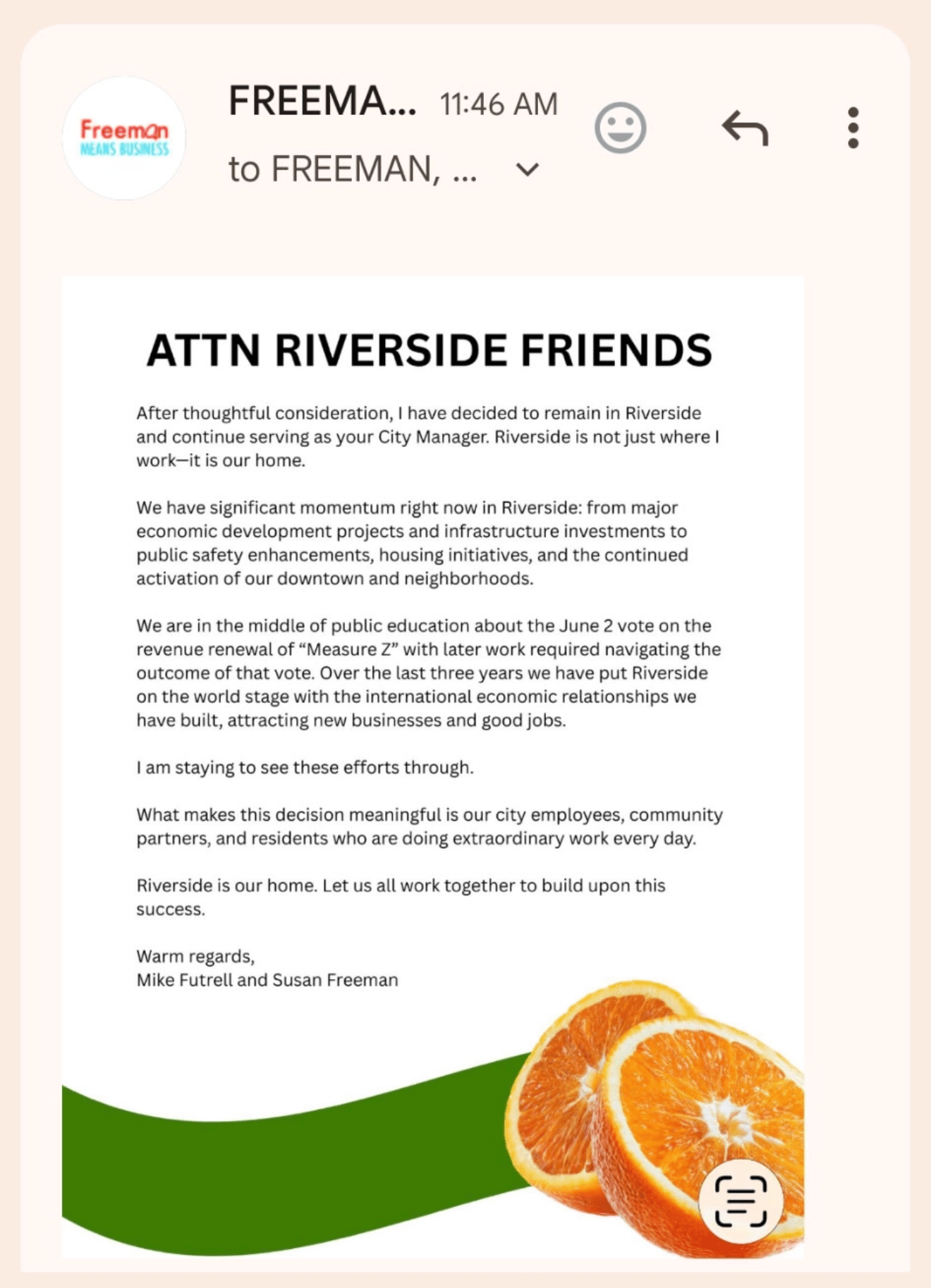
Susan Freeman was never hired, appointed, contracted, or elected to co-manage the City of Riverside.
She was not a Charter officer.
She was not a City employee.
She was not a City consultant.
She was not appointed by the Council.
She had no public authority to speak for the City Manager’s Office.
The City’s own December 11, 2025 letter made that exact point. It stated that comments suggesting Freeman was part of the City’s decision-making team were inappropriate because she was not a City employee and not a consultant hired by the City.
That sentence should have been the center of the LA Times article.
Because once the City itself says the City Manager’s spouse appeared to be insinuating involvement in City decision-making, the question is no longer whether she had a right to post political opinions.
The question becomes:
Why did the City Manager allow the boundary between his office, his spouse, City staff, and City operations to become so blurred that the City Council had to formally intervene?
The Official Warning Letter Is the Central Evidence
The December 11, 2025, letter from the City Council to Susan Freeman is the strongest public record released so far.
It stated that the City had become aware that Freeman had directly and indirectly contacted City employees through:
“unwanted and harassing calls, text messages, emails, comments, social media posts, and other communications.”
It further stated that her communications about confidential personnel or disciplinary issues were intrusive and violated employee privacy.
Most importantly, the letter stated that Freeman’s relationship with the City Manager created pressure for staff when she solicited employees to participate in paid services or asked staff for donations, and that staff could fear negative career consequences if they opted out.
Then the City wrote:
“Your pattern of communication has been disruptive at the workplace, caused significant distress to City staff, and serves no legitimate purpose.”
That is the story.
Not Trump.
Not partisan Facebook posts.
Not anonymous letters alone.
Not whether Freeman feels misunderstood.
The story is that the City Council formally warned the City Manager’s spouse that her conduct was disrupting City employees and creating pressure inside City Hall.
Futrell’s Free-Speech Defense Misses the Point
Futrell and Freeman’s comments about free speech and anti-Trump posts reveal part of the deeper problem.
City government is supposed to be nonpartisan in administration. The City Manager is not elected to run a partisan operation. He is hired to manage the City professionally, protect employees, execute Council direction, safeguard public trust, and keep City operations above political factionalism.
A City Manager’s spouse can have political opinions. But when a City Manager and spouse attempt to recast workplace-boundary complaints as retaliation for anti-Trump speech, they are avoiding the central issue: City employees are not required to absorb pressure, disruption, or unwanted communications because the City Manager’s household claims political victimhood.
The City’s letter did not simply criticize political opinions. It expressly said Riverside respects political party affiliations and political speech, but that speech that harasses City employees and disrupts their work is not protected in the workplace context.
That distinction matters.
This is not about silencing political speech. It is about whether the City Manager allowed his spouse to operate in City-adjacent spaces in a way that created pressure, confusion, or disruption for employees.
The Records Show a Pattern — Not One Misunderstanding
The Times article references hundreds of emails and public records, but it does not fully explain the pattern those records reveal.
The public records show much more than Facebook disputes.
# Freeman asked for “Mike’s 14 department heads” and assistants
On November 22, 2024, Freeman emailed the City Manager’s Office asking:
“Can you send me an email with the full names of: Mike’s 14 department heads; Mike’s assistants?”
Why was the City Manager’s spouse requesting lists of department heads and assistants?
Was it for invitations? Donations? Gifts? Events? Messaging? Staff outreach? No resident should have to guess.
Freeman appears to have drafted or revised City Manager messages to employees
On November 26, 2024, Freeman sent Futrell a revised Thanksgiving message to “Team Riverside,” signed “Mike.” Her version added language such as:
“You are the foundation of what we are building together. We are not going back, we are ‘going better.’”
On December 14, 2024, Freeman sent Futrell a rewritten employee-facing message about Riverside-branded gloves and beanies, ending:
“WARM regards, Mike.”
That is not merely attending events. That appears to be participation in employee-facing communications from the City Manager.
City employees deserve to know whether official messages attributed to the City Manager were written by the City Manager, City staff, or the City Manager’s spouse.
Freeman used Futrell’s City Manager title in a ticket-promotion invitation
A December 2024 Ballet Brunch invitation promoted BRAVA’s Nutcracker, told recipients:
“BUY YOUR TICKETS TODAY!”
and signed off as:
“Susan Freeman, CEO, Freeman Means Business, LLC”
“Mike Futrell, CEO/City Manager, City of Riverside, CA.”
That is a serious boundary issue. When the City Manager’s official title appears in an invitation asking people to buy tickets, City employees and civic partners may reasonably question whether saying no carries consequences.
Freeman asked the Mayor to help promote the event
When Mayor Lock Dawson said she could not attend the brunch, Freeman replied and copied Mike Futrell, asking:
“Is there any way you can help her promote the event?”
Again, this is not simply private speech. This is the City Manager’s spouse using civic access and City leadership relationships to promote a selected outside event.
Freeman connected BRAVA to the City communications staff
BRAVA’s representative wrote to Freeman asking for help getting Nutcracker listed on the City Arts Calendar and said:
“I have another urgent ask of you and Mike. Perhaps he could help get Nutcracker on the Riverside City Arts calendar.”
Freeman then copied Kaitlin Reierson, the City’s Director of Communications, saying Reierson could help explain how to promote BRAVA and The Nutcracker.
Freeman later sent promotional materials and wrote:
“That’s super helpful, Kaitlin. See attached. Love ya! Maybe y’all can chat too, so Glenda can learn how to self-post/promote?”
This raises obvious questions: was this a normal public process, or special access? Was City staff time used? Did staff feel free to decline?
Freeman offered City Hall access through Mike
In November 2023, Freeman wrote to a private party about a creative learning center:
“Mike can schedule a time to have you come into City Hall and pitch your idea, and then he can introduce you to the right people.”
She copied the City Manager’s assistant and added:
“I have cc’d his amazing assistant, Jennifer Anderson, here so she can make it happen.”
That is one of the clearest examples of the problem. Freeman was not pointing someone to a public application process. She was representing that Mike could arrange a City Hall pitch and that his assistant could make it happen.
Freeman circulated fundraising information
Records show Freeman circulated GoFundMe information, including a link that “can still be shared,” a fundraising total of $1,975, and donor names and amounts.
This matters because the City later warned that Freeman’s relationship with the City Manager created pressure when she asked City staff for donations or participation in paid services.
Freeman participated in a City Library / Council-connected fundraising activity
Records show the Tool Library project involved City Library processes and City Council acceptance of funds. Meeting notes list Freeman as present and assign “Elva and Susan” to visit Home Depot, Lowe’s, and Ace Hardware to ask for donations, discounts, demo tools, open-box items, or returns.
The City Library Director later clarified that the Library would present the funds to Council for approval, and then purchase the items.
Again, the issue is not whether the Tool Library is a good idea. The issue is the pressure dynamic when the City Manager’s spouse is involved in fundraising and donor outreach connected to City projects.
“All We Have Done for the City” Is Not a Defense
According to the Times article, Freeman wrote:
“After everything Jennifer, Mike, and I do for this city, this kills.”
That sentence captures the problem.
City service is not a private entitlement. Riverside is not a personal project. City Hall does not belong to a small network of insiders, spouses, department heads, civic friends, and private dinner guests.
Public service requires boundaries.
The City Manager is paid to manage the City. His wife was not hired to co-manage it. If the City Manager and his spouse viewed themselves as a “team” working for the City, that alone explains why the boundary problem became so severe.
No matter how many dinners, nonprofits, civic events, or personal connections they claim as service, the public record shows a failed management environment:
- employee pressure concerns;
- workplace disruption;
- private spouse involvement in City communications;
- City Manager title used in outside promotions;
- City staff routed to help outside organizations.
- fundraising activity tied to City-connected projects;
- and the City Council was forced to warn the City Manager’s spouse directly.
That is not a résumé. That is a failure of governance.
The Pasadena Reversal Was Not the Cause — It Was the Exposure
The article suggests that the public release of the letter damaged Futrell’s Pasadena opportunity and contributed to his reversal.
That may be true as a matter of timeline.
But the real question is why the letter existed in the first place.
If another city was considering hiring Riverside’s City Manager, it had every right to know whether his current city had formally warned his spouse about workplace disruption involving City employees. That is not sabotage. That is due diligence.
Riverside taxpayers and Pasadena residents both deserve to know whether a City Manager candidate brings with him a documented workplace-boundary problem.
The article’s sympathetic framing risks missing the obvious: the public record did not create the problem. The public record revealed the problem.
The Article Understates Futrell’s Own Responsibility
A City Manager cannot hide behind the claim that “some allegations involve my wife, my family.”
The issue is not guilt by marriage. It is a leadership responsibility.
A competent City Manager should maintain clear boundaries between:
- his office and his household;
- City employees and his spouse;
- City communications and private business identities;
- official City titles and nonprofit/civic promotions;
- public processes and private introductions;
- employee communications and spouse-drafted language.
The records raise serious questions about all of those boundaries.
If Freeman was requesting department-head names, drafting City Manager messages, routing outside parties to City staff, promoting events with Futrell’s title, and acting as a connector among City, UCR, nonprofits, and civic networks, then Futrell had a duty to stop the ambiguity.
He did not.
And if employees felt pressure because of her relationship with him, then that is directly relevant to his performance.
The “Anonymous Letters” Framing Is a Distraction
The LA Times article leans heavily into anonymous letters. Anonymous letters can be unfair. They can be incomplete. They can be malicious. They should not be accepted blindly.
But the public record here does not rest only on anonymous letters.
It includes direct emails.
It includes City staff threads.
It includes Freeman’s own messages.
It includes Futrell’s forwarded communications.
It includes the City Council’s certified warning letter.
It includes Freeman’s own response acknowledging disputes involving her professional work, leadership courses, City employees, and Facebook.
That is far more than anonymous accusations.
The anonymous letters may have triggered attention. But the documented conduct is visible in the records themselves.
The Nonpartisan Standard Matters
Futrell’s comments about anti-Trump posts and Freeman’s repeated claims that “MAGA” critics wanted her silenced expose a serious mismatch with professional city administration.
City government must serve everyone.
Republicans.
Democrats.
Independents.
Conservatives.
Liberals.
People who voted for Trump.
People who despise Trump.
People who do not care about partisan politics at all.
The City Manager’s Office must be able to operate above personal partisan grievance. When the City Manager and spouse publicly frame workplace boundary issues as a fight over Trump posts, they are showing why they are not a good fit for a nonpartisan city administration.
The City Manager is not a campaign operative. The City Manager’s spouse is not a political surrogate for City Hall. Riverside deserves professional administration, not partisan melodrama.
Riverside’s Broader Problem: Image Management Over Core Governance
This controversy also fits a larger pattern already documented in prior Riverside City Politics posts.
In my blog“Public Records Request – The Riverside Clown Show,” the CPRA request focused on Futrell, Freeman, hiring, employment, resignation, contract matters, complaints, communications, vendors, and related records — exactly the categories now being validated by the released documents.
In prior Measure Z commentary, the critique has been that Riverside keeps asking residents for more money while failing to deliver basic services, manage spending, fix roads, address homelessness effectively, and maintain public trust. The Measure Z critique specifically argues that City Hall has become dependent on higher sales taxes rather than disciplined governance.
The City’s own Measure Z proposal would increase the local transaction and use tax from 1% to 1.25%, raising Riverside’s total retail sales tax rate from 8.75% to 9%, according to the City Attorney’s impartial analysis. It would also remove the current expiration date and continue until ended by voters. That revenue would go to the general fund for general governmental purposes, not a legally locked box for one specific service.
This matters because a City asking for more tax revenue should first prove it can govern itself. A City Hall distracted by executive drama, employee pressure, spouse involvement, and failures of public trust is in no position to demand another blank check.
What the LA Times Should Have Asked
A serious investigation should ask:
- Did Mike Futrell know Freeman was asking City Manager staff for department-head and assistant names?
- Did he authorize or encourage it?
- Did Freeman draft or revise employee-facing City Manager messages?
- Were those messages sent to staff?
- Did City employees know Freeman had a role in drafting them?
- Did Freeman use the City Manager’s official title in invitations or promotions?
- Did City staff feel pressure to attend events, donate, purchase tickets, provide services, respond to messages, or participate in Freeman-related activities?
- Did the City Manager intervene to protect employees?
- Did the City Attorney or Human Resources review the matter?
- Did Council evaluate Futrell’s responsibility before Pasadena?
- Did Pasadena receive complete due diligence?
- Did Futrell submit a resignation to Riverside?
- Was it accepted?
- Was it rescinded?
- What closed-session actions occurred, and what should have been reported?
Those are the real questions.
Riverside Needs a Clean Break
The public record now shows a sustained boundary failure.
It is no longer credible to present this as simply a dispute over Facebook posts, Trump, anonymous letters, or one spouse’s personality. The City’s own records show direct involvement in employee communications, City staff access, nonprofit promotion, City Manager title usage, fundraising, department-head names, City Library/Council-connected projects, and private-home strategy networks.
That is not compatible with stable city management.
The City Manager’s job is to protect the institution. Instead, the institution has been pulled into a scandal involving his own household.
Riverside deserves better.
The City Council should stop waiting for the next article, the next document dump, the next public records request, or the next city willing to consider Futrell. It should act in the best interest of Riverside residents, taxpayers, businesses, and City employees.
The City Manager should be relieved of duty and access, all records should be preserved, employees should be protected from retaliation, and the City should begin a transparent recruitment process for new leadership.
Riverside does not need a “City Manager Team.”
Riverside needs a City Manager.
One City Manager.
Properly hired.
Properly supervised.
Professionally accountable.
And fully committed to the City — not to rewriting history, defending blurred boundaries, or building a résumé for the next landing spot.
This Record Is Still Developing
This blog reflects the public records released and reviewed so far. It is not the final word.
I have submitted public records requests and will continue reviewing the documents as they are produced. As more emails, texts, letters, calendar records, meeting records, and related communications become available, I will update this blog on knelsonvsi.com with additional evidence, timelines, citations, and analysis.
Riverside residents deserve the full record — not a selective narrative, not political spin, and not a résumé-repair version of events. The public deserves to know what happened, who knew, when they knew it, and whether City employees, taxpayers, and residents were protected.
This is not about personal attacks. It is about public trust, City Hall accountability, and whether Riverside’s elected officials have the courage to manage their Charter officers, protect City employees, and put residents’ interests above insiders, image management, and political convenience.

You really are not credible when all you do is share what the bad actors inside city hall ask you to. Have you even asked me?
I allow all comments, unlike many others who attack and then hide and block. Instead of making such a weak comment with an emotional attempt at a personal attack, focus on the facts. Refute any of the facts.